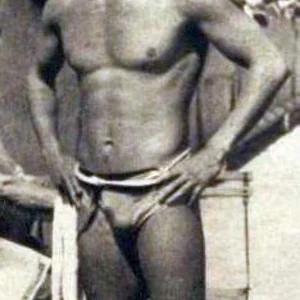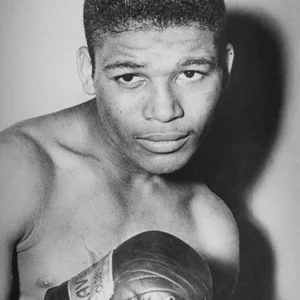

Sugar Ray Robinson (1921-1989) was an American boxer regarded as one of the greatest boxers of all time, pound for pound. World welterweight then middleweight champion, he dominated boxing in the 1940s and 1950s.
Sugar Ray Robinson(1921 — 1989)
Sugar Ray Robinson
États-Unis
6 min read
Frequently asked questions
Key Facts
- Born in 1921 in Ailey, Georgia, he grew up in Detroit and then in Harlem, New York.
- World welterweight champion from 1946 to 1951.
- World middleweight champion five times between 1951 and 1960.
- A record of roughly 174 wins and 19 losses across more than 200 professional fights.
- Died in 1989 in Culver City, California; he inspired the expression “pound for pound.”
Works & Achievements
Robinson wins his first world belt, which he holds undefeated until moving up to the higher weight class.
Victory over Jake LaMotta in the bout nicknamed the “St. Valentine’s Day Massacre,” a classic of the rivalry between the two men.
After losing his title in London, Robinson reclaims it 64 days later in New York, a feat of resilience.
Out of retirement, Robinson becomes world middleweight champion again at age 34 against Carl “Bobo” Olson.
Robinson recaptures the title one last time, setting the all-time record of five times world champion in the division.
Robinson finishes with a record of roughly 173 wins for only 19 losses, the benchmark for “pound for pound.”
Memoir co-written with journalist Dave Anderson, recounting his life on and off the ring.
Charitable foundation created to help underprivileged youth in Los Angeles.
Anecdotes
Sugar Ray Robinson was nicknamed “Sugar” by journalists: a reporter had described him as “sweet as sugar” in the ring. The nickname stuck with him throughout his career, and he became one of the most elegant figures in the history of boxing.
In 1951, during a fight against the Englishman Randy Turpin in London, Robinson lost his world middleweight title. But just 64 days later, he took his revenge in New York and reclaimed the belt in a fight that became famous, proving his resilience.
Robinson often traveled with a genuine entourage, including a hairdresser, a masseur, and even a dwarf serving as a jester, riding in a flamboyant pink Cadillac. This spectacular lifestyle made him a true star, far beyond the world of boxing.
In 1952, during a title fight against Joey Maxim in overwhelming heat (nearly 40 °C), Robinson was leading comfortably on points but collapsed from exhaustion before the end: it was the only fight of his career that he lost by stoppage, defeated by the heat rather than by his opponent.
After a first retirement, Robinson briefly attempted a career as a tap dancer and music-hall performer before returning to boxing in 1955 and once again becoming world middleweight champion at the age of 34, demonstrating exceptional longevity.
Primary Sources
They called me Sugar because, as the saying went, I was as sweet as sugar in the ring. I always believed that boxing was as much an art as it was a fight.
Robinson reclaims the world middleweight title by stopping Turpin in the tenth round before more than 60,000 spectators at the Polo Grounds.
Ahead on all three judges' scorecards, Robinson could not answer the bell for the fourteenth round, overcome by stifling heat.
Key Places
Small rural town in the southern United States where Walker Smith Jr., the future Sugar Ray Robinson, was born in 1921.
Iconic African-American neighborhood where Robinson grew up and made his debut in the boxing gyms.
Legendary venue of world boxing where Robinson fought several of his most famous title bouts.
Stadium where Robinson reclaimed his world middleweight title against Randy Turpin in 1951 before an immense crowd.
London arena where Robinson lost his title to England's Randy Turpin in July 1951.
Town in the Los Angeles area where Robinson spent his final years and died in 1989.
Typical Objects

Padded leather gloves used to protect the fists and the opponent during fights. The emblematic tool of the professional boxer.

A trophy worn at the waist rewarding the holder of a world title. Robinson won several in the welterweight and middleweight divisions.

A square platform surrounded by ropes where fights take place. It is the arena where Robinson built his legend.

Long strips of cloth wound around the wrists and hands under the gloves to support the joints.

A suspended bag or ball used for training, to work on the power and precision of one's punches.

A flamboyant car that became the symbol of Robinson's spectacular lifestyle, as much a star as an athlete.
School Curriculum
Vocabulary & Tags
Key Vocabulary
Tags
Daily Life
Morning
Robinson's mornings began early with a long run (the *roadwork*) of several kilometers to maintain his endurance. He maintained a disciplined lifestyle while preparing for a fight.
Afternoon
Afternoons were devoted to gym training: sparring in the ring, work on the punching bag and jump rope, and stretching exercises. His light, precise footwork was the admiration of his trainers.
Evening
In the evenings, away from the training camps, Robinson led a celebrity's life in Harlem, frequenting jazz clubs and running his own cabaret. He loved music, dancing, and the company of artists.
Food
While in training, his diet was strict: lean meats, eggs, vegetables, and plenty of water to stay within his weight class. He avoided alcohol and excess during the weeks leading up to a fight.
Clothing
Renowned for his elegance, Robinson wore impeccable suits, hats, and polished shoes around town. In the ring, he sported boxing trunks and boots, an image of athletic simplicity contrasting with his dandy's appearance.
Housing
At the height of his fame, Robinson lived in Harlem, where he owned several businesses, including a café-bar bearing his name. Later, he settled in California, in the Los Angeles area.
Historical Timeline
Period Vocabulary
Liens externes & ressources
Références
Œuvres
Titre mondial des poids welters
1946
Premier titre mondial des poids moyens
1951
Revanche contre Randy Turpin
1951
Retour et reconquête du titre
1955
Cinquième règne de champion des poids moyens
1958
Bilan de carrière
1940-1965
Sugar Ray (autobiographie)
1970