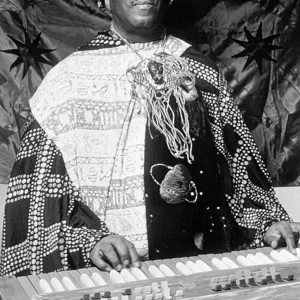

Sun Ra (1914-1993) was an American jazz pianist, composer, and bandleader. A pioneer of the avant-garde, he founded the Sun Ra Arkestra and developed a “cosmic” aesthetic blending free jazz, Egyptian mysticism, and the imagery of outer space.
Sun Ra(1914 — 1993)
Sun Ra
États-Unis
6 min read
Frequently asked questions
Famous Quotes
« Space is the place.»
Key Facts
- Born in 1914 in Birmingham (Alabama) under the name Herman Poole Blount
- Founded his big band, the Sun Ra Arkestra, in Chicago in the 1950s
- Pioneer of the use of electronic keyboards in jazz (1950s–1960s)
- A major figure of Afrofuturism and free jazz, with a discography spanning several hundred records
- Died in 1993 in Birmingham; the Arkestra carries on his work after him
Works & Achievements
Creation of his large orchestra, a one-of-a-kind ensemble blending big band, free jazz, and theatrical staging, which would outlive him.
A manifesto album heralding music turned toward the future and the “space age,” often cited as a high point of his work.
A radically avant-garde record with no fixed pulse, which became a touchstone of free jazz and experimental music.
A long collective suite inspired by Birmingham's nickname, a striking example of free orchestral improvisation.
An album in which Sun Ra explores electronic keyboards, showcasing his pioneering role in bringing electric sounds to jazz.
An emblematic work of his cosmic philosophy, whose title became the slogan of his Afrofuturism.
A science-fiction feature film in which Sun Ra plays his own character, arriving to save African Americans by taking them into space.
Anecdotes
Born Herman Poole Blount in Birmingham in 1914, the musician claimed all his life that, as a young man in the 1930s, he had been transported to Saturn by luminous beings who entrusted him with a mission: to guide humanity through music. Whether a genuine inner vision or a mythological tale he invented for himself, this story became the heart of his cosmic persona.
In 1942, during the Second World War, he refused to be drafted by declaring himself a conscientious objector. Summoned by the American authorities, he chose prison over the uniform and was briefly jailed before being assigned to civilian service, which he also rejected.
In 1952, he officially abandoned his birth name to become “Le Sony'r Ra,” after Ra, the sun god of ancient Egypt. For him, changing his name meant being reborn and breaking away from an identity imposed on him.
With his orchestra, the Sun Ra Arkestra, he enforced an almost monastic way of life: the musicians often lived together in the same house, rehearsed day and night, and both alcohol and drugs were forbidden. This iron discipline explains the band's exceptional longevity.
He was one of the very first jazz musicians to play electronic keyboards: as early as the late 1960s, he experimented with the Minimoog synthesizer—its inventor Robert Moog reportedly gave him a model—bringing “spacey” sounds into jazz.
Primary Sources
I'm not real. I'm just like you. You don't exist in this society. If you did, your people wouldn't be seeking equal rights.
Sun Ra teaches an entire semester devoted to the place of the Black man in the universe, blending music, poetry, the Bible, and Egyptian mythology.
The music of this album is a portrait of the future, the world of tomorrow, the world of the space age.
Key Places
Birthplace and place of death of Sun Ra, nicknamed “The Magic City,” a title he would reuse for one of his albums.
City where he trained as a pianist, played with Fletcher Henderson, founded the Arkestra, and launched the El Saturn label during the 1940s and 1950s.
Neighborhood where, starting in 1968, Sun Ra set up the Arkestra's communal house, the band's home and rehearsal space.
A major stage of the 1960s jazz avant-garde, where the Arkestra performed notably during long residencies in clubs.
A stop on the 1971 tour that fueled Sun Ra's fascination with the mythology and monuments of ancient Egypt.
Typical Objects

Sun Ra's instrument of training and choice, on which he composes and conducts the Arkestra from the keyboard.

One of the first portable synthesizers, which Sun Ra adopted very early to create his airy, “cosmic” soundscapes.

An electrified keyboard used by Sun Ra to broaden the sonic palette of jazz beyond acoustic instruments.

Stage costumes inspired by ancient Egypt, adorned with sequins and solar motifs, worn by Sun Ra and the Arkestra.

Headgear evoking a cosmonaut, a symbol of the interstellar imagination claimed by the musician.

On his label, some sleeves were decorated by hand by the band members, becoming genuine works of art.
School Curriculum
Vocabulary & Tags
Key Vocabulary
Tags
Daily Life
Morning
In the Arkestra's communal house, days often begin with music and discussion. Sun Ra, an avid reader, dives each morning into the Bible or books on Egyptology and numerology, which he comments on to his musicians.
Afternoon
The afternoon is devoted to composition and, above all, to endless rehearsals. Sun Ra constantly writes new arrangements and drills his orchestra for hours on end, demanding rigor and total commitment.
Evening
In the evening came the concerts: the Arkestra, in glittering costumes, transformed the stage into a cosmic ceremony blending dance, song, processions, and improvisation. Performances could stretch very late into the night.
Food
The Arkestra's collective life came with shared meals that were rather frugal. Sun Ra advocated discipline of both body and mind, in stark contrast to the excesses often associated with the jazz world.
Clothing
In public, Sun Ra and his musicians sported spectacular outfits: embroidered robes, sequined capes, pharaonic headdresses, and space-evoking helmets, turning every appearance into a visual spectacle.
Housing
From 1968 onward, the orchestra lived together in a house in the Germantown neighborhood of Philadelphia. This communal dwelling served at once as a residence, a rehearsal studio, and the center of the Arkestra “family”.