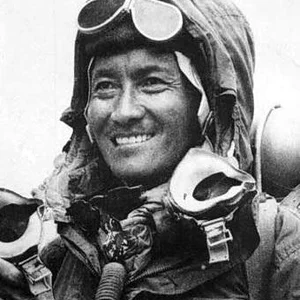

A Nepali Sherpa of Tibetan origin, Tenzing Norgay reached the summit of Everest on May 29, 1953, alongside Edmund Hillary. This historic ascent made him one of the most celebrated mountaineers in the world.
Tenzing Norgay(1914 — 1986)
Tensing Norgay
Inde, Népal
9 min read
Frequently asked questions
Famous Quotes
« We've done it!»
Key Facts
- Born around 1914 in the Khumbu region (Nepal), of Tibetan origin
- Took part in several Himalayan expeditions before 1953, including an attempt on Everest in 1952
- On May 29, 1953, reached the summit of Everest (8,849 m) with Edmund Hillary, as part of the British expedition led by John Hunt
- Received the British George Medal and became a national figure in Nepal and India
- Founded the Himalayan Mountaineering Institute in Darjeeling in 1954
Works & Achievements
A historic achievement accomplished as part of the British expedition led by John Hunt. This world first brought Tenzing instant fame and made him a symbol of Nepali and Sherpa pride around the globe.
Roped together with Raymond Lambert of Geneva, Tenzing reached 8,600 metres, setting a world record. This feat proved the summit was within reach and directly motivated the preparations for the victorious 1953 British expedition.
Tenzing's first autobiographical account, translated into many languages. This personal narrative offered, for the first time, the Sherpa perspective on the history of Himalayan mountaineering — a story long told exclusively from the Western point of view.
For more than twenty years, Tenzing trained hundreds of Indian mountaineers at this institute founded by Nehru. In doing so, he helped democratise mountaineering in India and bring recognition to the traditional technical knowledge of the Sherpas.
Tenzing's second autobiography, in which he reflects on his life after the glory of 1953: the honours, the political tensions between India and Nepal over his legacy, and his Buddhist spiritual meditation on the meaning of the ascent.
Anecdotes
At the summit of Everest, on 29 May 1953, Tenzing Norgay took offerings from his backpack — biscuits and chocolate — and buried them in the snow as a tribute to the Buddhist gods. This gesture, in keeping with Tibetan tradition, reflects his deep faith and the sacred respect he held for the mountain he called 'Chomolungma', the 'goddess mother of the world'.
After the ascent, the whole world wanted to know which of the two — Tenzing or Hillary — had set foot on the summit first. Tenzing always refused to say publicly, insisting that both had arrived 'together as one team'. This diplomatic discretion, guided by his sense of honour, earned him immense respect in both Nepal and India.
In 1952, during the Swiss expedition, Tenzing and Genevan mountaineer Raymond Lambert reached 8,600 metres without supplemental oxygen — a world altitude record at the time. Despite the ultimate failure, the two men forged a deep friendship, and Tenzing wore until his death a watch given to him by Lambert as a memento of their shared adventure.
Tenzing was illiterate and spoke no European language at the time of his first ascent. His autobiography 'Tiger of the Snows' (1955) was entirely dictated to American writer James Ramsey Ullman. The book reveals a humble and curious man who learned English late in life and chose 29 May — the day of the summit — as his birthday, since his exact date of birth was unknown.
Tenzing attempted Everest at least six times before succeeding in 1953, including a first expedition as early as 1935 as a simple porter, in his early twenties. This extraordinary perseverance, under often deadly conditions, illustrates the resilience of the Sherpas, long overlooked in official mountaineering accounts even as they carried virtually all of the equipment.
Primary Sources
We looked around us. There was nothing above us. Everywhere, the land fell away. We were on top of the world.
At 11:30 a.m. on 29 May 1953, Tenzing Norgay and Edmund Hillary stood on the highest point on the surface of the Earth. The summit of Everest had been reached at last.
Tenzing was more than a mere porter or guide: he was a rope companion in the noblest sense of the word, a man whose worth and courage equalled those of the finest European mountaineers.
I was born in the mountains, I grew up with them. Everest was not for me a conquest but an encounter with the goddess mother of the earth.
Key Places
The highest point on Earth at 8,849 metres, reached by Tenzing on 29 May 1953. For the Sherpas, this mountain is a living deity to be revered, not a sporting conquest; Tenzing left offerings there as an act of devotion.
A city in north-east India where Tenzing settled with his family and spent most of his adult life. It was here that he became a celebrated sirdar, founded the Himalayan Mountaineering Institute, and died in 1986.
The Himalayan homeland of the Sherpas, where Tenzing grew up at the foot of Everest. The monastery of Thyangboche, a place of prayer before ascents, and the village of Namche Bazaar, the gateway to Everest, are both found here.
The starting point for all expeditions via the Nepalese route, at roughly 5,380 metres altitude on the Khumbu Glacier. Tenzing stayed here during many expeditions, and it was from this camp that each rotation toward the high-altitude camps began.
An institution founded in 1954 by Jawaharlal Nehru to honour the ascent of Everest. Tenzing served as Director of Field Training there for more than twenty years, shaping generations of Indian mountaineers and helping to pass on Sherpa knowledge.
Typical Objects

A fundamental tool for mountaineers, used to anchor oneself in snow and ice. The iconic photograph taken at the summit in 1953, in which Tenzing holds aloft his ice axe adorned with four flags, is one of the most celebrated images in the history of mountaineering.

Compressed-oxygen breathing apparatus used during the 1953 expedition to cover the final 500 metres. Without this equipment, the last push to the summit would have been near impossible; their use was nonetheless controversial among mountaineers of the day.

Spiked metal frames strapped to the soles of mountaineering boots, essential for moving across ice and hard-packed snow at high altitude. Tenzing had mastered their use since his earliest expeditions in the 1930s.

At the summit, Tenzing attached four small flags to the tip of his ice axe: those of Nepal, the United Kingdom, India, and the United Nations. This symbolic gesture captured the various allegiances and alliances that had made the expedition possible.

The Hillary–Tenzing rope team moved roped together with a hemp-and-nylon line — the ultimate guarantee of solidarity between climbers. If one slipped, the other would hold him; the rope embodied the total trust that is indispensable at high altitude.

Roasted barley flour, a staple food of Sherpas and Tibetans, routinely carried on expeditions to provide energy in extreme cold. Tenzing ate it mixed with yak-butter tea, a culinary tradition inherited from his Tibetan upbringing.
School Curriculum
Vocabulary & Tags
Key Vocabulary
Daily Life
Morning
Tenzing began his day, like most Buddhist Sherpas, with a moment of prayer and offerings before a household altar. Before each expedition, a puja ceremony was held at Thyangboche Monastery or directly at base camp to seek the protection of the mountain gods. These rituals shaped the sacred relationship that Sherpas held with Everest.
Afternoon
During expeditions, the afternoon was devoted to carrying heavy loads (sometimes 30 kg) up icy slopes and setting up high-altitude camps. As sirdar — head of the Sherpa porters — Tenzing coordinated the work of the entire local team, served as liaison with the Western climbers, and looked after the safety of his men in extreme conditions.
Evening
In the evenings at the bivouac or base camp, Tenzing would gather with his Sherpa companions around a fire to eat and sleep in tents. In Darjeeling, where he lived with his family, evenings were more peaceful: family life, conversations with mountaineers who came to consult him, and reading after having learned to read later in life.
Food
The traditional Sherpa diet was based on tsampa (roasted barley flour), potatoes, legumes (dal), rice, and yak butter tea. On expeditions, these local rations were supplemented by Western foods brought by European teams: chocolate, biscuits, and canned goods. At very high altitude, appetite dropped sharply and Sherpas had to force themselves to eat in order to maintain their energy.
Clothing
In everyday life, Tenzing wore traditional Sherpa clothing: a long wool tunic (chuba) and a woven belt. On expeditions, Western gear was essential: a down jacket, thick wool trousers, cramponed mountain boots, and thick gloves. In 1953, this equipment was far less effective than it is today and provided insufficient protection against the polar cold of high altitudes.
Housing
In their native Khumbu region, Sherpas lived in two-story stone houses: animals and fodder on the ground floor, the family upstairs around a central hearth. In Darjeeling, Tenzing lived in a more modest house in this city shaped by British colonial influences. Sherpa dwellings were always located near a Buddhist monastery, the spiritual and social heart of the entire community.
Historical Timeline
Period Vocabulary
Liens externes & ressources
Références
Œuvres
Première ascension de l'Everest (8 849 m) avec Edmund Hillary
29 mai 1953
Record d'altitude sur l'Everest (8 600 m) — expédition suisse
1952
Tiger of the Snows (autobiographie dictée à James Ramsey Ullman)
1955
Direction de l'entraînement à l'Institut himalayen de Darjeeling (HMI)
1954–1976
After Everest: An Autobiography (avec Malcolm Barnes)
1977