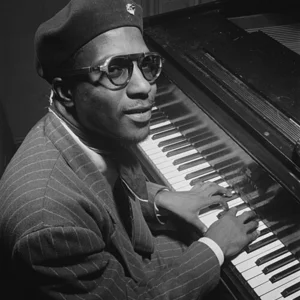

Thelonious Monk (1917-1982) was an American jazz pianist and composer, a major figure of bebop. His distinctive harmonic and rhythmic style, built on dissonance and silence, profoundly renewed the language of modern jazz.
Thelonious Monk(1917 — 1982)
Thelonious Monk
États-Unis
7 min read
Frequently asked questions
Famous Quotes
« The piano ain't got no wrong notes.»
Key Facts
- Born in 1917 in Rocky Mount (North Carolina), he grew up in New York, where he became the house pianist at Minton's Playhouse in the early 1940s, the birthplace of bebop.
- He composed 'Round Midnight' (around 1944), one of the most played jazz standards in the world.
- He recorded for the labels Blue Note (from 1947), Prestige, then Riverside, laying the foundations of his repertoire as a composer.
- In 1957, his residency at the Five Spot Café with John Coltrane marked a major milestone in modern jazz.
- He appeared on the cover of Time magazine in 1964, a rare recognition for a jazz musician; he died in 1982 in New Jersey.
Works & Achievements
His nocturnal ballad, written when he was very young, became one of the most recorded jazz pieces in history. On its own it embodies Monk's melancholy art.
His first recordings as a leader, revealing an entirely new harmonic language. The collection's title already says everything about how posterity would come to regard him.
A simple, luminous blues that became one of his most played themes. It shows that Monk's modernity is rooted in tradition.
A landmark album whose title track was so difficult that the musicians had to record it in fragments. A demanding work hailed as a pinnacle of modern jazz.
A composition dedicated to his wife Nellie, written while she was ill. It is one of the few Monk pieces conceived with no room for improvisation, like a frozen tribute.
A recorded trace of his residency at the Five Spot with saxophonist John Coltrane. This encounter left a lasting mark on both musicians.
An angular, playful blues theme that became an essential standard. Its title would later be given to a documentary film about the pianist.
Anecdotes
In the middle of a concert, Thelonious Monk would sometimes rise from his piano to spin slowly in place, as if dancing in the center of the stage. Meanwhile, his musicians kept playing and held the rhythm. It wasn't a whim: it was his way of physically feeling the music before coming back to strike his chords.
In 1951, the police found drugs in a car where Monk was sitting with his friend, the pianist Bud Powell. Monk refused to inform on his comrade and stayed silent. As a result, he lost his “cabaret card,” the precious pass that allowed musicians to play in New York's clubs: for nearly six years, he could no longer perform there, but he kept on composing.
On February 28, 1964, Monk appeared on the cover of Time magazine, an extremely rare honor for a jazz musician. A few years earlier, his music full of dissonances and silences had been judged too strange; now, the whole world recognized his genius.
His composition “'Round Midnight,” written when he was still very young, became one of the most recorded jazz pieces of all time. Hundreds of musicians around the world have played it again, proof that a melody invented by a single man can become a shared treasure.
Monk was recognizable among all others thanks to his collection of extravagant hats — caps, fur toques, headgear from all over the world — and his bamboo-framed sunglasses. Photographers loved this unique style, as original as his music.
Primary Sources
Make the drummer sound good. A note can be as small as a pin or as big as the world, it depends on your imagination. What you don't play can be more important than what you do.
I say, play your own way. Don't play what the public wants — you play what you want and let the public pick up on what you're doing, even if it does take them fifteen, twenty years.
If you were given three wishes, to be instantly granted, what would they be?
Key Places
Town in the southern United States where Thelonious Monk was born in 1917. His family left it when he was only a few years old.
Neighborhood where the Monk family settled and where the musician spent most of his life, in a modest apartment on West 63rd Street. The piano stood right next to the kitchen.
Harlem club where Monk was the house pianist in the early 1940s. It was there, during jam sessions, that bebop was forged.
Club in lower Manhattan where Monk held a now-legendary residency in 1957 alongside John Coltrane. That engagement marked the pianist's triumphant comeback.
Town across the river from Manhattan, home to his friend and patron, Baroness Pannonica de Koenigswarter. Monk spent his final years there, withdrawn from the stage.
Town where Thelonious Monk died in 1982, following a stroke.
Typical Objects

His instrument for life; under his fingers the piano turned percussive and full of dissonance. Monk struck the keys in a unique way, sometimes with his elbows or with his fingers held flat.

Monk owned an extravagant collection of hats from around the world that he was forever swapping. They became one of the hallmarks of his stage persona.

His bamboo-framed sunglasses were part of his inimitable silhouette. Photographers made them famous.

The sheet music for his most famous tune, which became a jazz standard. It passed through the hands of countless musicians.

His first recordings as a leader, gathered under the title “Genius of Modern Music,” were released on the Blue Note label. These vinyl discs spread his new harmonic language.

This permit issued by the police was required to play in New York clubs that served alcohol. Monk lost his in 1951, which kept him off the stage for nearly six years.
School Curriculum
Vocabulary & Tags
Key Vocabulary
Tags
Daily Life
Morning
A night owl by nature, Monk often got up in the middle of the day, after nights spent in the clubs. His wife Nellie watched over the household and over him, managing daily life so he could devote himself entirely to music.
Afternoon
In the afternoon, he would settle at the piano in his small apartment and could replay the same passage for hours, searching for just the right chord. Utterly absorbed, he sometimes forgot the rest of the world.
Evening
When evening came, Monk headed to the Harlem clubs and, later on, the Five Spot, where he played late into the night. On stage, he would sometimes rise to spin around during his sidemen's solos.
Food
Nellie cooked for him, and he had a weakness for sweets. A heavy smoker, he always kept a cigarette within reach, and when the music gripped him, he would happily skip meals.
Clothing
Monk took care with his appearance: elegant suits, rings on his fingers, and above all an astonishing collection of hats that changed constantly. His bamboo-framed sunglasses completed an unmistakable silhouette.
Housing
For most of his life, he lived in a modest apartment in San Juan Hill, in Manhattan, with Nellie and their two children; the piano stood proudly near the kitchen. He spent his final years in the home of his friend Baroness Nica, in Weehawken, New Jersey.