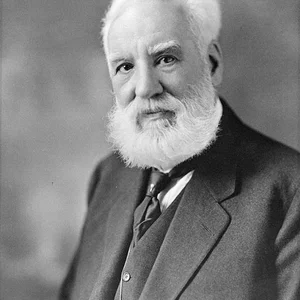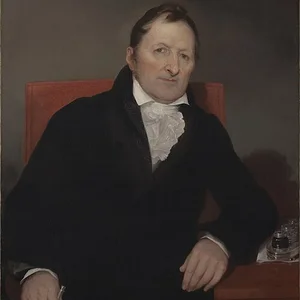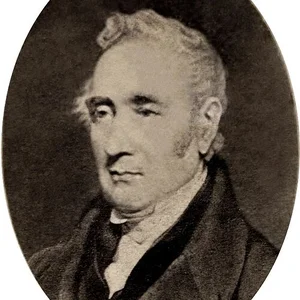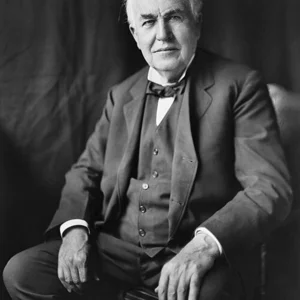

American inventor and industrialist (1847–1931), Edison is one of the greatest innovators in history. He filed more than 1,000 patents and created the incandescent light bulb, the phonograph, and the electrical distribution system.
Thomas Edison(1847 — 1931)
Thomas Edison
États-Unis
10 min read
Frequently asked questions
Famous Quotes
« Genius is one percent inspiration and ninety-nine percent perspiration.»
« I have not failed. I've just found 10,000 ways that won't work.»
Key Facts
- 1877: invention of the phonograph, the first device to record and reproduce sound
- 1879: development of the long-lasting incandescent light bulb
- 1882: opening of the first public electric power station in New York (Pearl Street Station)
- Filing of more than 1,093 patents in the United States during his lifetime
- 1876: creation of the first industrial research laboratory in Menlo Park (New Jersey)
Works & Achievements
The first device capable of recording and reproducing sound, the phonograph astonished the world when it recited 'Mary Had a Little Lamb'. Edison himself believed it would be used mainly for dictating mail, never imagining it would give birth to the global music industry.
After thousands of tests with hundreds of different materials, Edison developed a carbonized filament capable of glowing durably. This invention radically transformed daily life, replacing gas lamps in homes and making it possible to light streets, factories, and houses across the world.
Edison did not stop at inventing the light bulb: he designed the entire network needed to bring electricity into homes — dynamos, underground cables, meters, fuses, switches. Pearl Street Station was the prototype for the electrical grids that power the entire planet today.
This device allowed viewers to watch short sequences of moving images and is one of the direct precursors of cinema. Although Edison did not invent cinema single-handedly, the Kinetoscope and the Kinetograph (the associated camera) played a decisive role in the rise of this art form at the turn of the 20th century.
By radically improving Bell's telephone with a carbon powder microphone, Edison made the device genuinely usable over long distances. This improvement is one of the least known yet most impactful of his achievements, as it formed the technical foundation of telecommunications for over a century.
After ten years of tireless research, Edison developed a lightweight, sturdy, and long-lasting rechargeable battery intended for electric vehicles. The commercial success of gasoline-powered cars delayed its adoption, but this technology foreshadowed today's research into renewable energy storage.
Anecdotes
Thomas Edison had suffered from partial deafness since childhood, probably due to scarlet fever and chronic ear infections. Far from holding him back, he claimed that this disability actually helped him concentrate by shutting out ambient noise. This is the striking paradox: the man who invented the phonograph — the machine for reproducing sound — could barely hear at all.
In 1878, Edison triumphantly announced to the press that he had solved the problem of electric lighting before he had actually done so. This premature declaration caused the stock prices of gas lighting companies to plummet! It would take him more than another year of relentless experimentation to develop a lasting light bulb, in October 1879.
Edison waged a full-scale War of Currents against Nikola Tesla and George Westinghouse, who championed alternating current. To discredit this rival technology, public demonstrations of animal electrocution using alternating current were staged at Edison's laboratories, notably by Harold Brown in 1888. Despite this campaign, alternating current prevailed, as it could be transmitted far more efficiently over long distances.
The Menlo Park laboratory, opened in 1876 in New Jersey, was the world's first industrial research center. Edison employed a permanent team of scientists and technicians who sometimes worked around the clock. He declared his ambition to produce “a minor invention every ten days and a major invention every six weeks,” transforming individual creativity into a genuine organized industry.
Edison filed a total of 1,093 patents in the United States — an average of one patent per week during his most productive years. Yet some of his most celebrated inventions built on the work of collaborators such as Charles Batchelor and John Kruesi, which continues to spark debate about the true authorship of certain innovations and the meaning of collective invention in the nineteenth century.
Primary Sources
Be it known that I, Thomas Alva Edison, of Menlo Park, in the State of New Jersey, have invented an Improvement in Electric Lamps, and in the method of manufacturing the same. The object of this invention is to produce electric lamps giving light by incandescence, which lamps shall have high resistance, so as to allow of the practical subdivision of the electric light.
Just tried experiment with a diaphragm having an embossing point & held against paraffin paper moving rapidly. The indentations on paper by the speaking vibrations caused a perfect return of my speech. There is no doubt that I shall be able to store up & reproduce automatically at any future time the human voice.
I have accomplished all that I promised. The subdivision of the electric light is an accomplished fact. The same wire that brings the light into your house will also bring power and heat, and with one operation of a switch you will be able to regulate all three.
Confirmed again tonight : carbonized cotton thread filament held for over 13 continuous hours without failing. This settles the question. We now know it can be done. The problem is not whether it can be done but only how long and at what cost.
The phonograph will undoubtedly be liberally devoted to music. Letter writing and all kinds of dictation will be done with it. It will talk, tell the time, give us books. Teachers will record their lessons for the benefit of absent students. The phonograph will make everything permanent.
Key Places
Small town in Ohio where Thomas Edison was born on February 11, 1847. His preserved birthplace is now a museum tracing his childhood in a modest family.
The world's first industrial research laboratory, founded in 1876. It was here that Edison invented the phonograph and developed the incandescent light bulb, supported by a permanent team of researchers — a revolution in the way inventions were produced.
A scientific and industrial complex ten times larger than Menlo Park, built from 1887 onward and Edison's primary workplace until his death. It was here that the kinetoscope and alkaline batteries were developed; the site is now a National Historic Landmark.
The world's first electric power distribution station, inaugurated on September 4, 1882 in Manhattan. It supplied 59 customers with direct current and marked the beginning of the electrical age for the general public; it was destroyed by fire in 1890.
Edison's winter residence, where he conducted research on plants to produce domestic natural rubber during World War I. His villa and laboratory, adjoining those of his friend Henry Ford, are open to the public.
Typical Objects

A vacuum glass sphere containing a carbon filament that emits light when an electric current passes through it. Edison's 1879 bulb burned for more than 13 hours, paving the way for domestic electric lighting and transforming life after dark.

Invented in 1877, this device recorded sound vibrations onto a cylinder coated first with tin foil, then with wax. For the first time in history, it made it possible to capture and reproduce the human voice, giving birth to what would become the global music industry.

Perfected by Edison in 1874, this device transmitted four messages simultaneously over a single telegraph wire. The sale of this patent earned him $10,000 — a sum that directly funded the creation of his Menlo Park laboratory.

Developed in 1891, this device allowed a single viewer to watch short sequences of moving images by peering through an eyepiece. It is one of the direct forerunners of cinema and inspired the Lumière brothers, who went on to project images onto a large screen.

By replacing the Bell telephone's membrane with a transmitter using carbon powder, Edison greatly amplified and clarified the transmitted voice. This improvement made the telephone genuinely usable over long distances and remained the technical foundation of telephone communications for a century.

After ten years of research, Edison brought a lightweight and durable rechargeable battery to market in the 1910s. He hoped to use it in electric vehicles — anticipating by a century the current debates around the energy transition and the batteries powering electric cars.

Edison meticulously recorded every experiment in notebooks that today amount to thousands of digitized pages. These documents bear witness to his method: systematic, repeated trials and an industrial approach to research that gave rise to the modern concept of R&D.
School Curriculum
Vocabulary & Tags
Key Vocabulary
Tags
Daily Life
Morning
Edison rarely woke up early, as he often worked until dawn. His morning began around 8 or 9 o'clock with several cups of very strong coffee and the reading of scientific journals. He would quickly head to his workshops to examine the results of the night's experiments and give directions to his teams.
Afternoon
The afternoon was devoted to ongoing experiments and technical decisions: Edison moved between the various workshops, suggesting leads, correcting errors, rolling up his own sleeves to test an idea. He spent little time on meals and often snacked standing up, impatient to get back to work. Meetings with his engineers and investors bored him; he cut them short whenever possible.
Evening
Evenings and nights were his preferred working periods, when quiet reigned in the laboratory. He could stay awake for 36 hours during crucial experiments, recovering with short naps in an armchair in his workshop. He read extensively, particularly European scientific journals, and filled his laboratory notebooks until the early hours of the morning.
Food
Edison had very irregular and unbalanced eating habits. He consumed enormous quantities of coffee and smoked cigars constantly. During periods of intensive work, he would forget to eat or make do with bread, butter, and apple pies. He claimed, with humor, that eating too much was bad for thinking and slowed down work.
Clothing
Edison was known for his neglected and unkempt appearance. He wore simple, practical clothes, often stained with oil, coal, or laboratory chemicals. He paid no attention to his appearance — in stark contrast to the great financiers of his era who sported frock coats and top hats — and fully embraced this image of a working man of the people.
Housing
Edison spent most of his life in the immediate vicinity of his laboratories: in Menlo Park, and later in West Orange, New Jersey, where his family home adjoined his workshops. He also owned a villa in Fort Myers, Florida, where he spent winters with his family. These residences were comfortable without being lavish, befitting an inventor far more passionate about technology than the ostentation favored by the great magnates of the Gilded Age.
Historical Timeline
Period Vocabulary
Liens externes & ressources
Références
Œuvres
Le phonographe
1877
L'ampoule à incandescence
1879
Système de distribution d'électricité (centrale de Pearl Street)
1882
Le transmetteur à carbone pour téléphone
1877
L'accumulateur alcalin nickel-fer
1901-1910