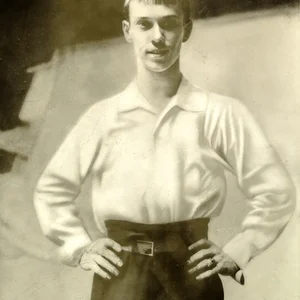

Russian dancer and choreographer of Polish descent, a leading figure of Sergei Diaghilev's Ballets Russes. His technical virtuosity and revolutionary choreographies (*The Rite of Spring*) profoundly reshaped dance in the early 20th century.
Vaslav Nijinsky(1889 — 1950)
Vaslav Nijinsky
Pologne, Union soviétique, Empire russe
6 min read
Frequently asked questions
Key Facts
- Born in **1889** in **Kiev** into a family of Polish dancers, trained at the Imperial Ballet School in **Saint Petersburg**
- Became a star dancer of **Diaghilev**'s Ballets Russes from **1909** in **Paris**
- Created the scandalous choreography for *Afternoon of a Faun* in **1912**, set to music by **Debussy**
- Choreographed **Stravinsky**'s *The Rite of Spring* in **1913**, whose premiere caused a famous scandal at the Théâtre des Champs-Élysées
- His career ended around **1919** due to mental illness (schizophrenia); he died in **London** in **1950**
Works & Achievements
The role that made his final leap through the window famous, which became legendary. He embodies the apparition of a dream in a young girl's bedroom.
He plays a fairground puppet endowed with a soul, demonstrating his genius as an actor as much as a dancer.
His first choreography, with poses inspired by Greek bas-reliefs; it caused a scandal and heralded modern dance.
A revolutionary choreography set to Stravinsky's music, breaking with the entire classical tradition; a riot broke out at the premiere.
A ballet set to music by Debussy evoking a game of tennis, one of the first ballets with a contemporary theme.
Nijinsky's last choreography, created during the Ballets Russes' American tour.
A private journal written on the threshold of his illness, an exceptional testimony to the mind of a brilliant artist.
Anecdotes
In 1912, when Nijinsky choreographed and danced *The Afternoon of a Faun*, his angular movements and a final gesture deemed too suggestive caused a scandal in Paris. The newspaper Le Figaro refused to publish its review, while the sculptor Auguste Rodin publicly came to his defense.
On 29 May 1913, the premiere of *The Rite of Spring* at the Théâtre des Champs-Élysées triggered an outright riot in the hall. Whistles, shouts, and brawls drowned out the orchestra to such an extent that Nijinsky, in the wings, had to shout out the beats to the dancers so they could keep time.
Nijinsky was nicknamed “the god of dance” because of his spectacular leaps. Legend has it that he seemed to hang suspended in the air, an effect owed to his technique and to the exceptional power of his thighs and calves.
In 1913, during a tour of South America, Nijinsky married the Hungarian dancer Romola de Pulszky. Furious, his patron and director of the Ballets Russes, Serge Diaghilev, immediately dismissed him from the company.
Suffering from schizophrenia, Nijinsky stopped dancing in public as early as 1919, at just thirty years old. He would spend the latter half of his life in institutions and clinics, leaving behind a deeply moving diary written on the threshold of his illness.
Primary Sources
I am God, I am God, I am God. I mean that I am love. I wrote these notebooks so that people would understand what feeling is.
We were given an incongruous faun, with the movements of an erotic beast and gestures of heavy indecency. The audience booed.
Vaslav seemed to defy gravity. When he leapt, he hung in the air a moment longer than any other dancer, as if suspended.
Nijinsky would cross the footlights and appear to the audience as a supernatural being. He had the grace of a wild beast and the power of an athlete.
Key Places
City where Nijinsky was born in 1889, into a family of itinerant Polish dancers.
Prestigious institution where Nijinsky was trained before becoming a soloist at the Mariinsky Theatre.
Venue where the riot over the *Rite of Spring* broke out on 29 May 1913, one of the most famous artistic scandals of the 20th century.
Alpine resort where Nijinsky gave his last public dance in 1919 and wrote his *Diary*.
City where Nijinsky died in 1950 after long years of illness.
Place where his ashes were transferred in 1953; his grave is crowned by a statue depicting him as Petrushka.
Typical Objects

Soft leather and canvas shoes that let the dancer glide and jump silently. A basic tool in Nijinsky's daily work.

A tight-fitting unitard printed with spots, completed by horns and a tail, designed by Léon Bakst for 'The Afternoon of a Faun'. It transformed the dancer's body into an ancient creature.

Painted backdrops and fabrics in vivid Oriental colors that were the visual signature of the Ballets Russes. They immersed audiences in exotic, dreamlike worlds.

A musical work by Igor Stravinsky with pounding, dissonant rhythms that served as the basis for Nijinsky's revolutionary choreography. Its brutal modernity shocked the audience of 1913.

Handwritten notebooks composed in 1919 in which Nijinsky set down his thoughts at the dawn of his illness. A deeply moving document about art, God, and war.

Nijinsky sought to invent a writing system to capture dance movements on paper, like a musical score. He devoted great effort to it in order to preserve his choreographies.
School Curriculum
Vocabulary & Tags
Key Vocabulary
Daily Life
Morning
Nijinsky's morning began with the daily 'class': exercises repeated at the barre to limber up and strengthen the body. No dancer, not even a star, could skip it without losing their form.
Afternoon
The afternoon was devoted to rehearsals with the Ballets Russes company. When he choreographed *The Rite of Spring*, he demanded hundreds of rehearsals, requiring entirely new and exhausting movements from the dancers.
Evening
In the evening came the performance before an elegant and international audience. After the show, Diaghilev and his artists frequented the Parisian salons and suppers where painters, musicians, and writers mingled.
Food
On tour, the dancers ate simply and in moderation to stay light. Nijinsky, focused on his art, paid little attention to food and often lived under the watchful wing of Diaghilev.
Clothing
In town, Nijinsky wore the elegant attire of the Belle Époque: a three-piece suit, hat, and coat. On stage, he donned the flamboyant, Oriental costumes designed by Léon Bakst.
Housing
With no fixed home during the Ballets Russes years, he lived in hotels as the European tours moved along. After his marriage, he settled for a time in Hungary, then in a villa in Saint-Moritz, Switzerland.
Historical Timeline
Period Vocabulary
Liens externes & ressources
Références
Œuvres
Le Spectre de la rose
1911
Petrouchka
1911
L'Après-midi d'un faune
1912
Le Sacre du printemps
1913
Till Eulenspiegel
1916