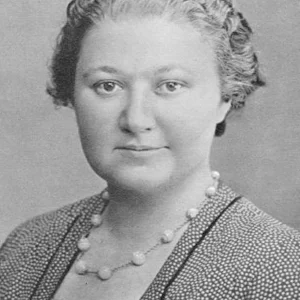

Vera Menchik was a Russian-British chess player of Czech origin, the first women's world chess champion. She dominated women's competition from 1927 until her death in 1944.
Vera Menchik(1906 — 1944)
Vera Menchik
Royaume-Uni, Tchécoslovaquie
6 min read
Frequently asked questions
Key Facts
- Born in 1906 in Moscow, in the Russian Empire
- Won the first women's world chess championship in 1927 in London
- Held her world title without interruption from 1927 to 1944 (seven-time champion)
- Faced and defeated several leading male masters of her time
- Died in 1944 in London during a German bombing raid (V1 flying bomb)
Works & Achievements
By winning the London tournament, she became the first official holder of the women's world chess championship title.
She retained her title across six consecutive Women's World Championships, remaining undefeated in this competition.
She defeated the Dutch master and future world champion, demonstrating her ability to compete with the male elite.
Her presence at tournaments such as Carlsbad paved the way for women players in competitions until then reserved for men.
Having become a chess legend, the list of masters she had defeated came to symbolize the recognition of her exceptional level of play.
Settled in England, she taught chess and contributed to British chess life through her analyses and demonstrations.
Anecdotes
In 1929, the Austrian master Albert Becker mocked Vera Menchik's participation in a men's tournament by proposing the creation of a "Menchik Club
: any player she defeated would become a member. The irony backfired
for he was among the first to lose to her
thus becoming the very first member of his own mocking club.
Vera Menchik won the very first Women's World Chess Championship in London in 1927, and remained undefeated in that title for seventeen years: she successfully defended it six times without ever losing it, holding on to it until her death.
Several leading male masters fell victim to Menchik's talent. She notably beat Max Euwe, the future world champion, as well as other top players such as Samuel Reshevsky, proving that a woman could compete at the highest level at a time when this was considered unthinkable.
Born in Moscow to a Czech father and an English mother, Vera learned chess at the age of nine. After the Russian Revolution, her family settled in England in 1921, where she perfected her game under the guidance of the Hungarian master Géza Maróczy, in Hastings, a high temple of British chess.
Vera Menchik died tragically on 26 June 1944 in London, along with her mother and sister, when a German V1 flying bomb struck their house in Clapham. The title of Women's World Champion remained vacant until 1950, so total had her dominance over women's chess been.
Primary Sources
Miss Vera Menchik won the first Women's World Championship with an overwhelming score, conceding practically no points to her rivals.
The witticism meant to ridicule her presence became the symbol of her strength: many renowned masters reluctantly joined the ranks of those defeated by Miss Menchik.
The death of Vera Menchik, killed by a flying bomb, deprives the chess world of its undisputed champion, who dominated the women's game for nearly two decades.
Key Places
Birthplace of Vera Menchik, where she was born in 1906 and learned chess around the age of nine.
An English seaside resort and a stronghold of British chess, where her family settled in 1921 and where she trained under Géza Maróczy.
The British capital where she won the first Women's World Championship in 1927 and where she died in 1944.
A district in south London where her house stood, destroyed by a V1 flying bomb on 26 June 1944.
The Argentine city where she defended her Women's World title at the 1939 championship, on the eve of the Second World War.
The Swedish capital where she retained her Women's World title at the championship held alongside the 1937 Chess Olympiad.
Typical Objects

A 64-square board on which the games are played. In Menchik's day, it was often made of wood and accompanied every table at international competitions.

The standardized piece design adopted by official tournaments, recognizable by its plain, understated shapes. It was the reference set for the competitions Menchik played in.

A double mechanical clock measuring each player's thinking time. Essential at tournaments to enforce the pace of play.

A document on which players record the game move by move. It allowed Menchik's matches to be archived and analyzed.

The award symbolizing the supreme title in women's chess, which she won as early as 1927. It embodied her dominance over the women's game.

A theoretical compendium cataloguing the opening moves of a game and their variations. An essential study tool for preparing against high-level opponents.
School Curriculum
Vocabulary & Tags
Key Vocabulary
Tags
Daily Life
Morning
The morning of a professional player like Vera Menchik was often devoted to study: analyzing games, reviewing openings, and preparing for future opponents. During tournaments, this time was also used to rest before the afternoon rounds.
Afternoon
The afternoon was the time for tournament games, which could last several hours in focused silence. Seated at the board across from her opponent, she recorded every move and managed her time on the clock.
Evening
Evenings were well suited to analyzing adjourned games, which were common at the time, and to exchanging ideas with other masters. In chess circles, discussions about positions stretched late into the night.
Food
Like most Britons in the first half of the 20th century, she followed a modest diet, marked by tea and simple meals. During the war, rationing imposed restrictions on sugar, meat, and butter.
Clothing
She wore the understated, elegant outfits expected of a woman of the 1920s to 1940s: long dresses, fitted skirts and blouses, in keeping with the respectability of the era in competitive circles.
Housing
A Russian émigrée of Czech origin, she lived in modest housing in the London area, first in Hastings and then in London. Her home in Clapham, where she lived with her mother and sister, was destroyed by a bombing in 1944.
Historical Timeline
Period Vocabulary
Liens externes & ressources
Références
Œuvres
Titre de première championne du monde féminine
1927
Défenses successives du titre mondial
1930-1939
Victoire sur Max Euwe
1930
Participation aux grands tournois internationaux masculins
1929-1930
Le « Menchik Club »
1929
Activité de pédagogue et chroniqueuse d'échecs
années 1930-1940