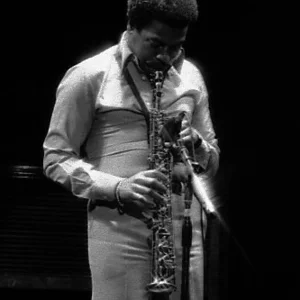

American jazz saxophonist (tenor and soprano) and composer, a major figure of modern jazz. He made his name with the Jazz Messengers, Miles Davis's second great quintet, and then the jazz-fusion band Weather Report, which he co-founded.
Wayne Shorter(1933 — 2023)
Wayne Shorter
États-Unis
6 min read
Frequently asked questions
Famous Quotes
« I never call it jazz music. I call it 'I dare you' music.»
Key Facts
- Born on August 25, 1933, in Newark (New Jersey), died on March 2, 2023, in Los Angeles.
- Saxophonist and musical director of Art Blakey's Jazz Messengers from 1959 to 1964.
- Member of Miles Davis's second great quintet (1964-1970), contributing to the modal jazz albums and then to the early days of jazz-fusion.
- Co-founded the band Weather Report with Joe Zawinul in 1971, a pioneer of jazz-rock fusion.
- Awarded numerous Grammy Awards (12 in total) over the course of his career.
Works & Achievements
A landmark quartet album for Blue Note, one of the peaks of his early music.
Considered his masterpiece as a leader, a perfect balance between mystery and lyricism.
An album by the Miles Davis Quintet for which he wrote the title track, a manifesto of the new jazz.
A composition that became one of the most widely covered jazz standards in the world.
The title track of a Miles Davis album, famous for its bold reversal of instrumental roles.
A poetic album recorded with the Brazilian Milton Nascimento, blending jazz and Brazilian music.
The biggest hit of the fusion band he co-led, driven by the smash “Birdland”.
An opera premiered at age 87 with Esperanza Spalding, a final testament to his tireless curiosity.
Anecdotes
As a child in Newark, young Wayne Shorter was passionate about comic books, science fiction, and drawing: he invented imaginary creatures and planets, which earned him the nickname “Mr. Weird” in high school. He only got seriously into music around the age of fifteen or sixteen, but quickly made up for lost time.
Within Miles Davis's quintet, Shorter became the group's great provider of compositions. His piece “Footprints,” a blues in an unusual time signature, became one of the most-played jazz tunes in the world, covered by thousands of musicians since the 1960s.
His composition “Nefertiti” (1967) turned the rules of jazz upside down: the trumpet and saxophone tirelessly repeat the theme while the drums and double bass improvise beneath them. This reversal of the usual roles left its mark on the history of modern jazz.
In the early 1970s, Shorter embraced Nichiren Buddhism (the Soka Gakkai movement). For the rest of his life, he recited the mantra “Nam-myoho-renge-kyo” every day, a practice he described as the source of his serenity and his creativity.
Until late in life, Shorter never stopped innovating: in 2021, at the age of 87, he created the opera “Iphigenia,” written with the young bassist and singer Esperanza Spalding, proving that he remained an explorer to the very end. Over the course of his career, he won twelve Grammy Awards.
Primary Sources
Wayne was the intellectual musical catalyst for the band.
For me, the word 'jazz' means, 'I dare you.'
Shorter recounts his childhood in Newark, his late discovery of music, and the importance of imagination and drawing in the way he composes.
Key Places
Wayne Shorter's hometown, where he grew up and discovered music as a teenager.
The arts-focused high school where the teenager nicknamed “Mr. Weird” first became passionate about music and drawing.
The university where he earned a music education degree in 1956 before his military service.
The legendary New York jazz club where the great bebop and hard bop groups that Shorter frequented performed.
The city where he settled in his final decades and where he died in 2023.
Typical Objects

His instrument of choice in his early years, with which he forged his recognizable sound within the Jazz Messengers and Miles Davis's quintet.

A straight, high-pitched saxophone he widely adopted from the 1970s onward, notably with Weather Report, becoming one of its greatest masters.

A small strip of cane fixed to the mouthpiece, which vibrates to produce the sound; a saxophonist like Shorter constantly tested them and wore them out.

Lead sheets on which he jotted down his often enigmatic compositions such as “Footprints” or “Nefertiti.”

The LPs he recorded for the Blue Note label in the 1960s rank among the classics of modern jazz.

Prayer beads used in the practice of Nichiren Buddhism that he followed, reciting “Nam-myoho-renge-kyo” each day.

From childhood and throughout his life, he drew creatures and imaginary worlds, a visual extension of his exploratory music.
School Curriculum
Vocabulary & Tags
Key Vocabulary
Tags
Daily Life
Morning
A touring and studio musician, Shorter often had late mornings, since his nights were devoted to concerts. Waking up might begin with his Buddhist practice: reciting the mantra "Nam-myoho-renge-kyo" before the altar, a moment of focus before anything else.
Afternoon
The afternoon was a time for creation: he would compose at the piano or write themes on manuscript paper, draw, and read science fiction. He also practiced his saxophone and prepared arrangements for the band.
Evening
The evening was the heart of his life: rehearsals, sound checks, then a concert in a club or a hall. Since jazz was often played late into the night, his evenings stretched on with musical exchanges and jam sessions with other musicians.
Food
Like many touring musicians, he ate on the move, backstage, in American diners, or in the restaurants of the cities he passed through. His cooking also reflected his travels, from Brazil to Japan.
Clothing
On stage in the 1960s, the elegant dark suit of hard bop musicians was the standard. With the fusion of the 1970s, his wardrobe opened up to freer, more colorful outfits, in the spirit of the times.
Housing
After his early years in Newark and in New York, the capital of jazz, he spent part of his life in California. His home was a place of work and reflection, filled with scores, records, and his drawings.