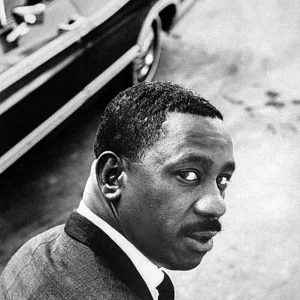

Wes Montgomery (1923-1968) was an American jazz guitarist, one of the most influential in the instrument's history. Recognizable by his thumb-picking technique and his melodies played in octaves, he left his mark on hard bop before achieving great popular success in the 1960s.
Wes Montgomery(1923 — 1968)
Wes Montgomery
États-Unis
5 min read
Frequently asked questions
Key Facts
- Born on March 6, 1923, in Indianapolis (Indiana), he taught himself guitar around 1943 by imitating Charlie Christian.
- He developed a distinctive technique: he plucked the strings with his thumb (without a pick), producing a warm, mellow tone.
- He popularized melodic playing in octaves, which became his signature and was widely imitated after him.
- His album *The Incredible Jazz Guitar of Wes Montgomery* (1960) established his reputation among jazz fans.
- He achieved mainstream success with orchestral albums and won a Grammy Award for *Goin' Out of My Head* (1966); he died of a heart attack on June 15, 1968, in Indianapolis.
Works & Achievements
His first album released under his own name on Riverside, which introduced him to the jazz world.
A cult album regarded as a high point of jazz guitar; it features his compositions “West Coast Blues” and “Four on Six.”
A live album recorded in concert, where his blazing playing meets the saxophone of Johnny Griffin.
His first album with a string orchestra on Verve, marking his shift toward a more mainstream jazz.
A record awarded a Grammy, which cemented his popularity beyond the circle of jazz enthusiasts.
His best-selling album, made up of covers of pop hits including the Beatles' title track.
Anecdotes
When Wes Montgomery took up the guitar seriously around 1943, he practiced late at night after work. To avoid waking the neighbors, he gave up the pick and plucked the strings with the flesh of his thumb. This gesture born of necessity became his signature: a warm, velvety sound, recognizable among all others.
Wes never really learned to read music. He learned almost everything by ear, replaying note for note the solos of Charlie Christian, the first great electric guitarist in jazz, until he knew them by heart.
His trademark was playing melodies “in octaves”: the same note doubled at the high and low pitch at once. This very difficult technique gave his solos a roundness and power all their own, imitated ever since by generations of guitarists.
In the 1950s in Indianapolis, Wes led an exhausting double life: a factory worker by day, in the evening he played two back-to-back club gigs until 2 in the morning, sleeping only a few hours. It was in one of these clubs, in 1959, that saxophonist Cannonball Adderley discovered him and recommended him to a record label.
Starting in the mid-1960s, Wes covered pop hits, including a Beatles song, and won a Grammy Award in 1967. These records made him very famous, but some jazz fans criticized him for becoming too commercial.
Primary Sources
I started playing with my thumb because I used to practice at night and the pick made too much noise; the neighbors complained. With my thumb, the sound was softer.
Passing through Indianapolis in 1959, the saxophonist heard Wes playing in a club and immediately alerted the Riverside record label: this guitarist absolutely had to be recorded.
Wes Montgomery is voted “New Star” on guitar by the magazine's critics, even though he has only just released his first records.
Wes Montgomery's album “Goin' Out of My Head” receives the Grammy for Best Instrumental Jazz Performance by a Large Group.
Key Places
Wes's hometown, where he grew up, worked by day, played the clubs by night, and where he died. He remained attached to it his whole life.
The capital of jazz, where he recorded his 1960s albums for the Riverside, Verve, and A&M labels.
The legendary jazz studio where several of his recording sessions were captured.
The region where he performed in the late 1950s with his brothers, in the groups The Mastersounds and The Montgomery Brothers.
Typical Objects

His signature instrument: a large hollow-body electric guitar (archtop) from which he drew a round, deep, warm sound.

Plugged into his amp, his electric guitar could fill the clubs and trade phrases with the horns and the piano.

The LP, the dominant format of the 1950s and 1960s, on which all his albums were released and which carried his fame.

Like all the jazzmen of his era, he took the stage in a sharp suit, shirt, and tie.

A heavy smoker — a common habit among musicians of the time that took a toll on his fragile heart.
School Curriculum
Vocabulary & Tags
Key Vocabulary
Tags
Daily Life
Morning
In the 1950s, Wes wakes up early for his job as a factory worker in Indianapolis. He spends the morning on the shop floor, far from any guitar.
Afternoon
After his workday, he comes home to his wife and seven children, rests a little, and goes over a few tunes before the round of club gigs.
Evening
The night belongs to him: he often plays two shows in a row in the clubs of Indianapolis, sometimes until 2 or 3 in the morning, before sleeping only a few hours.
Food
He eats simply, American-style, between family meals and the fast food of the clubs. A heavy smoker and a great coffee lover, that is how he keeps up with the exhausting pace of his days.
Clothing
During the week, he wears a factory worker's work clothes. In the evening, like all the jazzmen of the era, he puts on a sharp suit, shirt, and tie to take the stage.
Housing
He lives in a modest house in Indianapolis, his hometown, which he rarely leaves: he prefers to stay close to his large family rather than settle in New York.