Imaginary interview with An Lushan
by Charactorium · An Lushan (703 — 757) · Military · Politics · 6 min read
Under the campaign tent where the smell of leather and mutton fat lingers, the master of Fanyang receives us, his enormous belly propped on silk cushions. Outside, steppe horses trample the frozen mud. An Lushan, a general in the service of the Tang before daring to dream bigger, agrees to speak, his voice heavy with the weariness of a man who has known the favor of the Son of Heaven.
—Before taking up arms, what was your first trade in these northeastern borderlands?
I was born in Yingzhou, where the Chinese meet the Sogdian and the steppe man — my father of the blood of Central Asian merchants, my mother of the Turkish people. As a child, I learned to weigh wool and horses at the border markets, to haggle in six languages without ever making a mistake. They took me for a broker, an intermediary between the empire and the tribes, and I passed from tent to tent like water flows between stones. That Silk Road that others cross trembling, I knew by its smells and its tricks. A man who can speak to all is never quite disarmed; my tongue fed me before the sword raised me up.
My tongue fed me before the sword raised me up.
—They say that despite your corpulence, you danced before the emperor. How could that be?
Heaven made my belly so heavy that it takes two servants to lift my paunch when I am dressed in my embroidered silk robe. And yet, when the drums and strings from the steppes resounded, I danced before Xuanzong the huxuan, the whirling dance of my homeland, spinning so fast that the emperor laughed with pleasure. A man from the borderlands does not present himself at the court of Chang'an with only his fat: one must please, amuse, make others forget that one comes from the dust. The Son of Heaven likes to be astonished. My lightness on my feet was worth many victories in those days, for it opened doors that the sword alone could not force.
—Do you remember that ceremony where the favorite Yang Guifei made you her adopted son?
Ah, that courtly madness! Yang Guifei, the Son of Heaven's favorite and many years younger than I, wanted to call me her child. The palace ladies swaddled me like a giant newborn, carried me in a cradle through the halls, and the emperor laughed until his sides ached. A sensible man would see humiliation; I saw a ladder. To let oneself be rocked like an infant before the court was to enter the sovereign's own household, to become his kin through play. He who laughs with the master eats at his table. That guifei was both my cradle and my protectress, and I lay in that cradle with my eyes wide open.
He who laughs with the master eats at his table.
—How could one man unite the command of three border provinces?
The Son of Heaven first entrusted me with the commissioner's banner, that jiedushi which makes a subject master of the armies and lands of a march. Then he gave me a second, and a third: Fanyang, Pinglu, Hedong gathered in my single hand, around the year 751. Nearly one hundred and eighty thousand soldiers answered my banner — cavalry, mounted archers, an elite guard recruited from the steppe peoples. Never had a subject held so much iron. I did not ask for it by guile; the aging empire handed it to me, believing it honored a loyal servant. But he who gives three banners to one arm should not be surprised if that arm one day rises alone.
He who gives three banners to one arm should not be surprised if that arm one day rises alone.
—What did that military commissioner's banner mean to you?
That banner is not mere cloth. Handed over by the sovereign's hand, it carries the delegated authority of the Son of Heaven over men and borderlands. Under it, I levied taxes, judged, marched armies without waiting for orders from the capital. My headquarters at Fanyang mixed barracks, stables, and audience halls; I reigned there like a little emperor before my time. The lamellar armor of my cavalry, their composite bows of horn and sinew, all obeyed that banner. A man who commands one hundred and eighty thousand spears in another's name eventually asks why the other's name, and not his own.
—Tell us about that moment when you raised your troops against the empire.
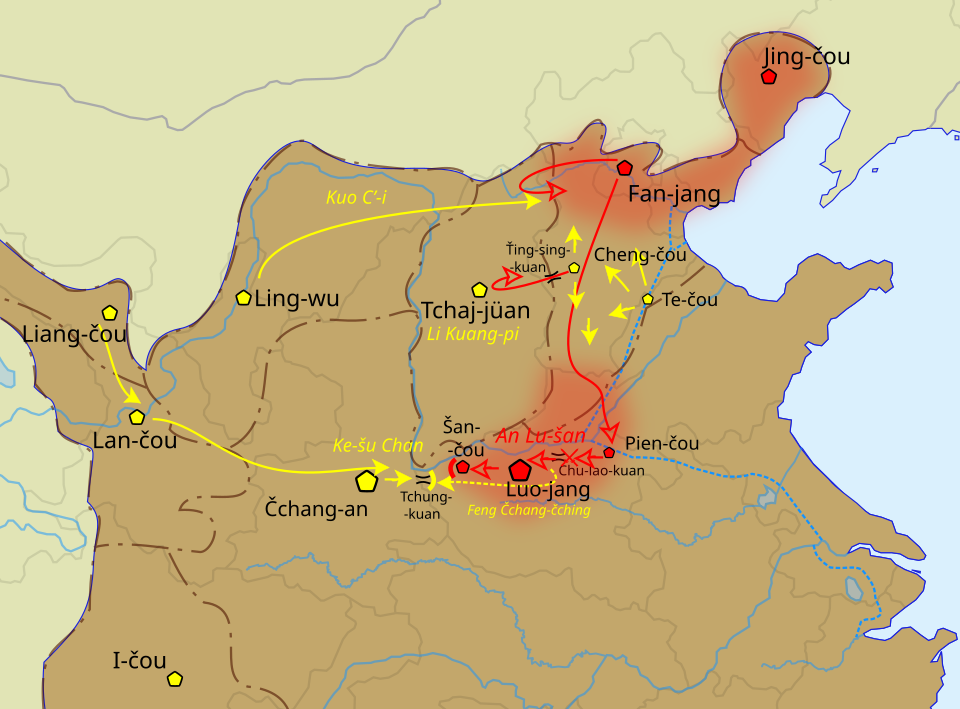
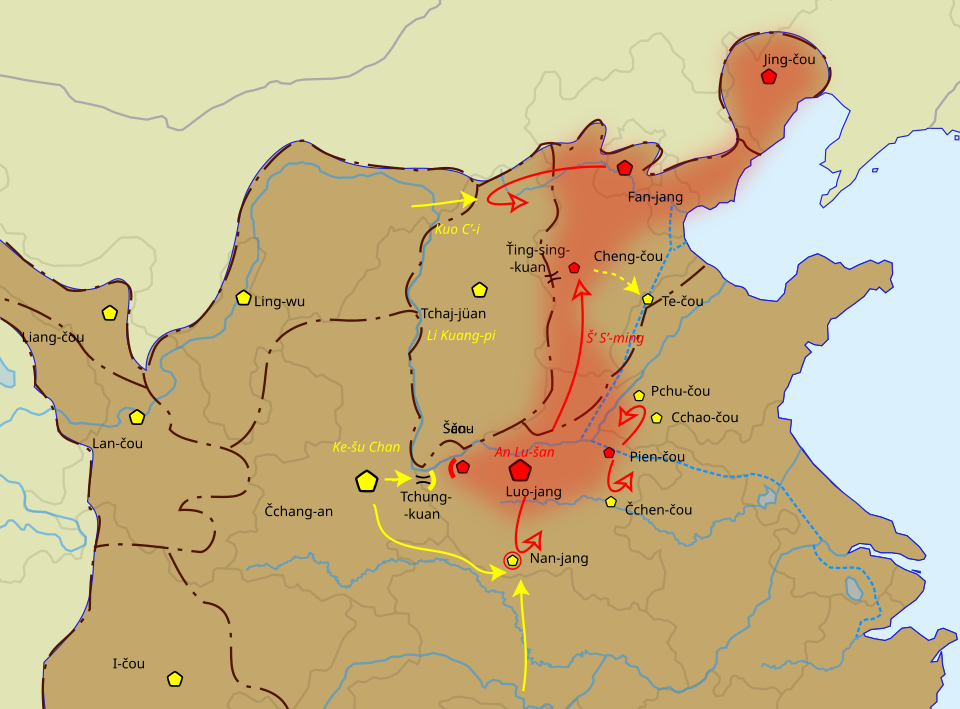
It was the winter of the fourteenth year of the Tianbao era, in 755. I had the great war drums beaten at Fanyang — that roll the people have since called the drums of Yuyang — and I marched south, pretending a secret edict to punish Minister Yang Guozhong, my old enemy. Peace had lasted so long that few men in the central provinces still knew how to string a bow. My steppe horsemen fell upon them like wind on ripe wheat. One does not rise against Heaven lightheartedly; one does it when the rotten court leaves no other path between disgrace and the sword.
Peace had lasted so long that few men still knew how to string a bow.
—Was the capture of the two capitals as swift as they say?
Swifter still. The Tong Pass, that stone lock guarding the road to Chang'an, fell because the imperial troops left their fortress out of foolishness, when they had only to hold. After it, nothing: Luoyang first, the eastern capital, then Chang'an, the greatest city under Heaven, that richest of cities where I had been given a residence near the palace. Xuanzong fled toward Sichuan, abandoning his throne and soon his favorite. To see the master of a golden empire flee — he who had cradled me like his son — was to touch with one's finger how thin the thread of Heaven's mandate is. The center was empty; one had only to enter.
—Why did you want to found your own dynasty, the Yan?
When you hold the two capitals and the banner of one hundred and eighty thousand spears, you need a name for what you hold. At Luoyang, in 756, I proclaimed myself emperor of the Yan dynasty and had a seal engraved — an insignia of jade and bronze — to stamp my sovereignty on edicts. The Mandate of Heaven, say the ancients, withdraws from the unworthy dynasty and gives itself to the virtuous. I believed Heaven was offering it to me. Perhaps I grasped only a shadow: my dynasty was still a fragile child, and we know what becomes of children whose father falls too soon.
—The emperor once asked you about the enormity of your belly. What did you answer him?
Xuanzong, amused, asked me what such a vast paunch could possibly contain. I answered that there was nothing inside but a loyal heart, entirely devoted to his service. The court laughed, the emperor was charmed, and I myself half-believed what I said. A man from the borderlands owes his word as he owes his sword: it cuts in the right direction as long as the wind blows fair. The years passed, the wind turned, and that heart I called loyal turned against the house that had fed me. I seek no excuse; I only say that a belly does not keep what is put into it.
There was nothing inside but a loyal heart.
—Your last years under the tent were, they say, marked by illness. How did you live them?
Heaven slowly avenges itself on those who touch its order. Having become emperor of the Yan, I felt my eyes go out one after the other, until I could no longer tell the day inside the tent from the night outside. Ulcers gnawed at my flesh and made my mood black, quick to strike servants and generals. Blind, suffering, locked inside my own body as in a prison, I now believe that the blindness of the body was only a sign of another, older blindness: that which had made me raise my hand against the Son of Heaven. One does not defy the order of the world without the world taking away, one by one, all one's torches.
—How do you envision this end that tradition attributes to you — killed in your own tent?
In that year 757, my own son, An Qingxu, found his father too slow to die. A eunuch of my household, one of those palace men I thought were mine, entered the tent and struck me in the darkness where my dead eyes saw nothing. So ends he who had made the earth tremble to the sound of the drums of Yuyang: by the hand of a servant, on the order of his son, in the disorder he himself had sown. He who breaks the bond between sovereign and subjects should not be surprised if the bond between father and son is broken in turn. The broken order always avenges itself through the very fault by which one sinned.
He who breaks the bond between sovereign and subjects should not be surprised if the bond between father and son is broken in turn.

This imaginary interview was generated by artificial intelligence from sources documented in An Lushan's profile. It dramatises what the figure might have said based on what we know about them, but does not constitute attested historical testimony. For primary sources and factual documentation, refer to the full profile.