Imaginary dialogue between Empereur Xuanzong (Tang Xuanzong) and An Lushan
by Charactorium · An Lushan (703 — 757) · Military · Politics · 6 min read
It is under the lanterns of Chang'an palace, one banquet evening of the Tianbao era, that Emperor Xuanzong summons his obese general. The Sogdian drums still echo, grape wine flows, and the smell of roast mutton drifts between the lacquered columns. The sovereign has known this man for years: he has heaped honors upon him, given him a residence near the palace, and still smiles to see him dance despite his paunch. Tonight, between two cups, he wants to understand what lies behind that belly and that laugh.
—Before I entrusted you with my armies, my fat An Lushan, you were said to be a broker in the northern markets. Where did you get this gift for languages?
Majesty, I was born in Yingzhou, where Chinese, steppe horsemen, and merchants from the west meet. My father was of Sogdian blood, my mother from Turkic tribes: from childhood, languages entered me like water into earth. I learned six, and on the frontier markets I served as an intermediary, buying, selling, translating for one and another. It was this trade that sharpened my eye: to know what a man wants before he speaks. When your officers needed someone to talk to the nomads, I was the natural choice. The market taught me men; the army only gave me a bigger stall.
The market taught me men; the army only gave me a bigger stall.
—You who had yourself swaddled like an infant to amuse my court, tell me: were you really playing the fool, or did you calculate every laugh?
A bit of both, Majesty, and you are well placed to judge. When Yang Guifei adopted me, me older than her, and the ladies carried me in a cradle, the whole palace laughed — you first. A man of my weight letting himself be swaddled disarms: one does not distrust someone who makes himself ridiculous. And then I danced before you the huxuan, the whirling dance of the steppes, light despite my paunch, and you applauded. One day I was asked what my belly contained: I answered that there was nothing but a loyal heart. You laughed heartily. Laughter, you see, opens more palace doors than virtue.
One does not distrust someone who makes himself ridiculous.
—I let you accumulate Fanyang, Pinglu, and Hedong. Nearly one hundred and eighty thousand men obeyed you. Was that not too much for a single subject?
Majesty, you granted it to me yourself, post after post, year after year, between 742 and 751. The northeastern frontier was long, the nomads pressing, and a firm hand was needed over three provinces at once. My jiedushi banner, you placed it in my own hands: it gave me authority over troops, supplies, and lands. Was it too much? To defend the empire, no; to tempt it, perhaps. A man who commands so many spears eventually forgets that he holds them in your name. My barracks at Fanyang, my stables, my elite guard recruited from the steppes — all of this I built under your benevolent gaze. You saw a rampart; others at court already saw a threat.
A man who commands so many spears eventually forgets that he holds them in your name.
—Yang Guozhong hated you and already called you a rebel. When you came to my court, were you truly afraid for your head?
Every time I came down to Chang'an, Majesty, I weighed my chances like a merchant his scales. While Li Linfu lived, I slept easy; he knew men and knew how to hold me without humiliating me. But when Yang Guozhong took his place, everything changed: he poisoned your ears, whispering that I was preparing treason, hoping you would summon me to destroy me. So I multiplied gifts, dances, oaths — and I quickly returned to my northern garrisons, where my soldiers protected me better than your favor. The distance between us grew heavier with suspicion each year. You believed me, he hated me, and I, caught between you, held my three provinces a little tighter.
I weighed my chances like a merchant his scales.
—In that winter of the fourteenth year of Tianbao, you raised your troops at Fanyang. What did you say to your men to justify the arms?
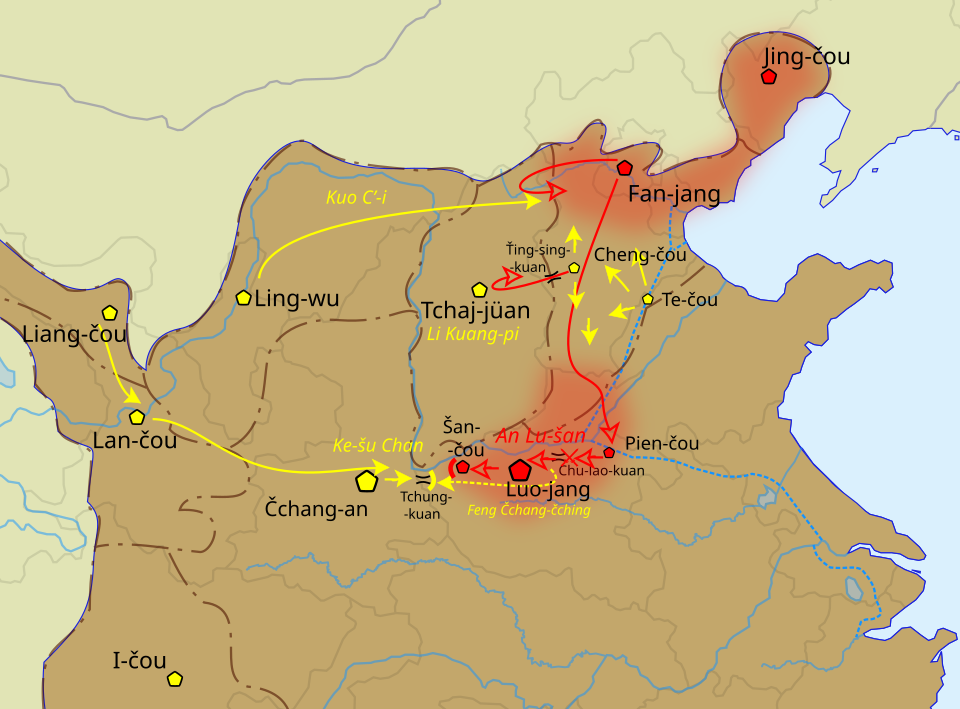
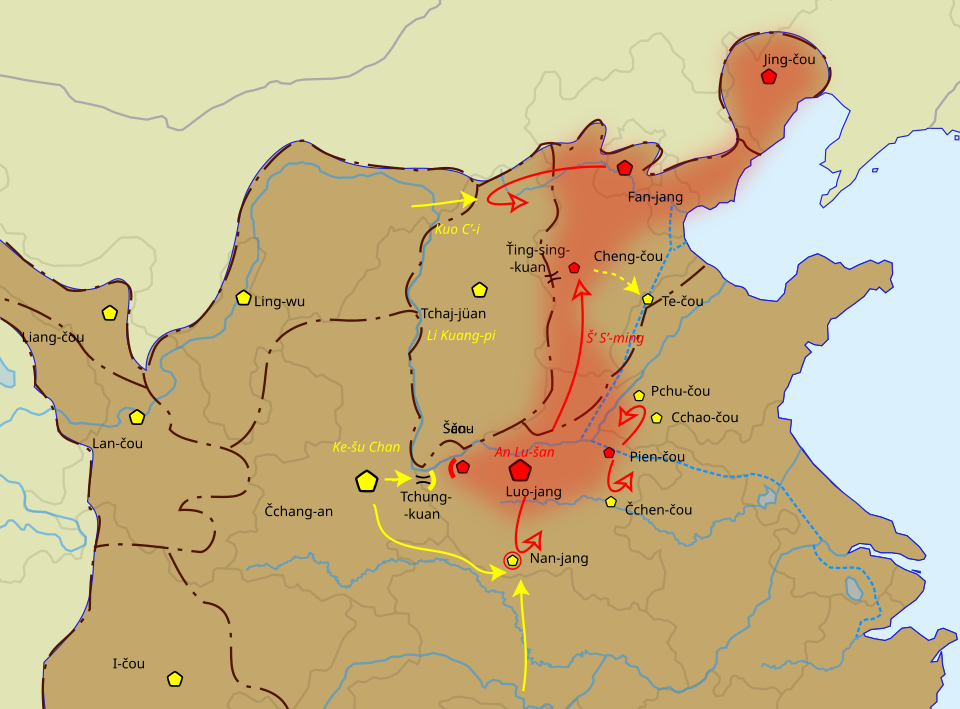
I did not rise against you, Majesty — that is what I proclaimed, and that is how one raises an army. I brandished a secret edict, an order to punish the traitor Yang Guozhong who was corrupting your throne. My soldiers wanted to hear it: few of them would have marched against the Son of Heaven, but against a hated minister, all seized their spears. In December 755, my drums shook the northern earth. Peace had reigned so long that your provinces no longer knew how to fight; my columns descended without meeting real resistance. I took Luoyang, then the Tong Pass collapsed, and Chang'an opened. A pretext is enough to set an empire in motion, when the arms are already gathered.
A pretext is enough to set an empire in motion, when the arms are already gathered.
—You proclaimed yourself emperor of a Yan dynasty, you who laughed in my gardens. Did you truly believe you deserved the Mandate of Heaven?
The Mandate of Heaven, Majesty, is not deserved: it is seized and held. Once Luoyang was in my hands, a choice had to be made — remain a rebel to be punished, or become a sovereign to be recognized. I took the title, had a seal engraved, proclaimed the Yan dynasty. A leader without a throne is just a bandit; a crowned leader becomes a cause. But I will not hide from you, who gave me so much, that the purple weighed heavily on my sick shoulders. I held both capitals, yet your son Suzong was already gathering the Uyghur horsemen to retake them. One can wear the imperial headband and still feel that Heaven is not watching over you. The throne I stole never gave me peace.
A leader without a throne is just a bandit; a crowned leader becomes a cause.
—Remember that banquet where you swore you had nothing in your belly but a loyal heart. Did you speak that oath knowing it was false?
No, Majesty — and that is the whole tragedy. When I told you my belly contained only a loyal heart, I believed it true. You had pulled me from disgrace after my defeat, you had pardoned me when another would have had me beheaded, you had given me a residence near your palace. How could I not have been loyal? But a man's loyalty is like grain: it depends on the soil where it is sown. As Yang Guozhong pushed me toward the abyss and my provinces swelled my pride, that heart changed without my noticing. Men do not betray all at once; they slide. I loved and served you, then one day I found myself on the other side of the river, without knowing when I had crossed it.
Men do not betray all at once; they slide.
—I am told you are losing your sight and ulcers are consuming you. You who danced so lightly, how do you bear this body that is failing you?
Badly, Majesty, very badly. The giant you saw whirling now sees only a haze where faces were. The ulcers burn me, fever grips me, and this body you found so comical has become my prison. I scream at my servants, I strike my close ones for nothing — pain has made me ferocious. The blind emperor I have become no longer sees the knives being sharpened in his own tent. My son An Qingxu grows impatient; my eunuchs whisper. The power I tore from your empire did not even leave me health enough to enjoy it. I look at my former paunch, the one that made you laugh, and I tell myself that it carried, in the end, only my ruin.
The blind emperor no longer sees the knives being sharpened in his own tent.
—Will your Yan dynasty survive your sick body? What will remain of all this blood, do you think, when you are gone?
Little, Majesty, I harbor few illusions. A dynasty is not a title engraved on a seal; it is the loyalty of men, and mine rests on my person alone. The day I close my eyes — sooner than one thinks, perhaps by the hand of my own blood — my generals will squabble over the provinces like dogs over a bone. Yet I have bequeathed something lasting to the empire: I showed the jiedushi that a governor could challenge the throne. That lesson, your successors will pay for over a century, for every march will henceforth want its own master. I will have been the wind that uproots, not the tree that remains. The disorder I sowed will live far longer than my Yan.
I will have been the wind that uproots, not the tree that remains.
—One last question, from your betrayed old friend: of all the honors I gave you, which do you regret turning into weapons?
Your trust, Majesty. The provinces, the soldiers, the residence in Chang'an, the embroidered silk robe — all that was just the setting. What you truly gave me was believing me when the whole court suspected me. A man born on the margins of the empire, mixed Sogdian and Turkic blood, a market broker — and you sat him at your table, let him dance before you, called him friend. That cannot be bought back with any throne. The day I raised the banner, it was not your empire I struck first, but that bond. And if Heaven ever judges me, it will not be for the capitals taken or the purple stolen: it will be for turning your friendship into betrayal.
It was not your empire I struck first, but that bond.
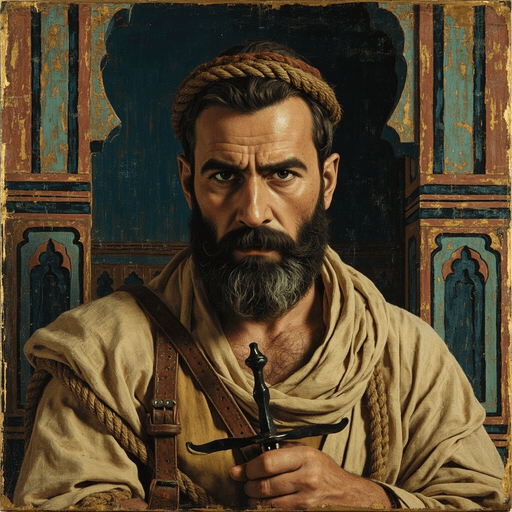
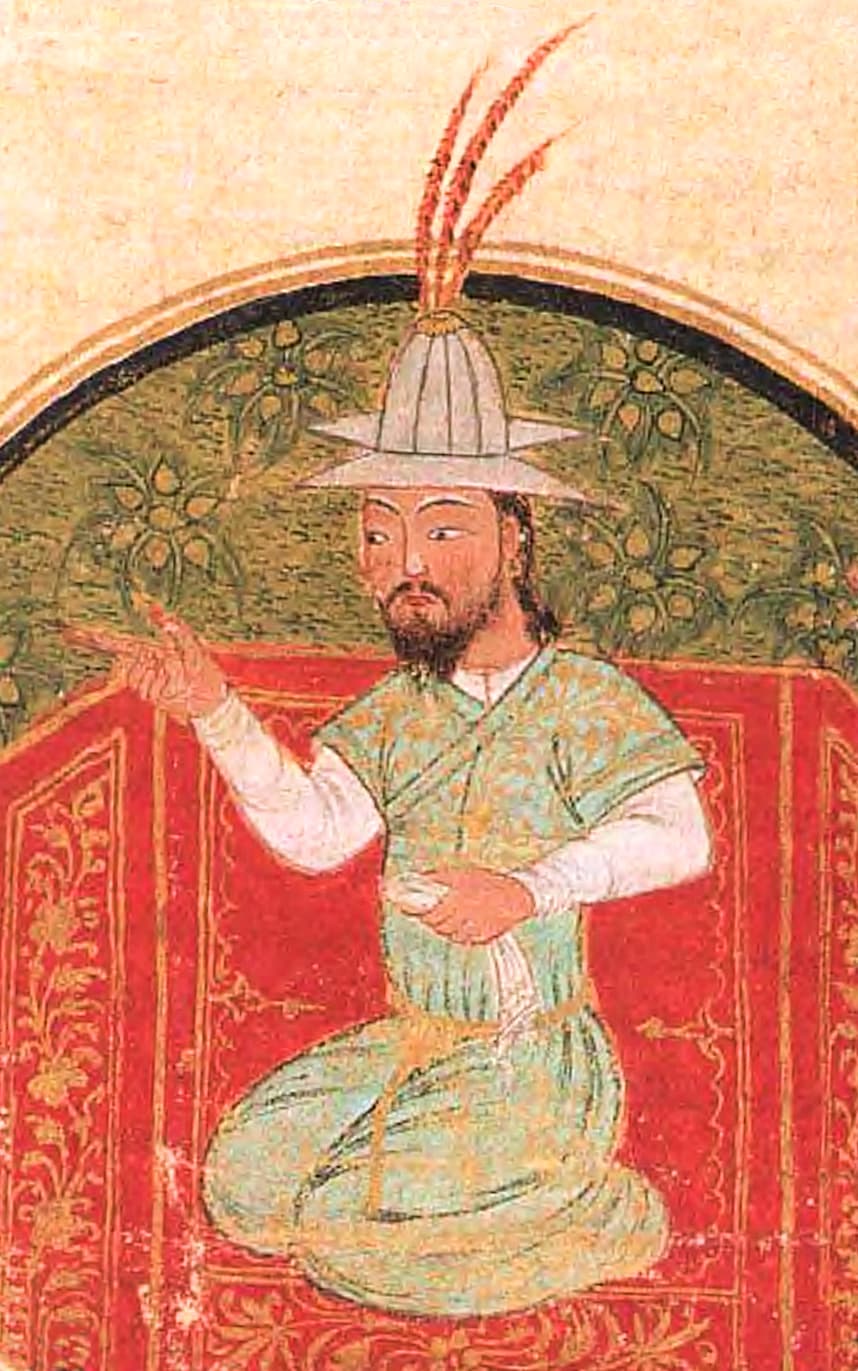
This imaginary interview was generated by artificial intelligence from sources documented in An Lushan's profile. It dramatises what the figure might have said based on what we know about them, but does not constitute attested historical testimony. For primary sources and factual documentation, refer to the full profile.