Imaginary interview with Annie Smith Peck
by Charactorium · Annie Smith Peck (1850 — 1935) · Exploration · Sports · 5 min read
New York, winter 1932. Annie Smith Peck, eighty-two years old, receives in a modest furnished apartment cluttered with Andean maps and yellowed newspaper clippings. On the table, an old altimetric barometer and an embroidered banner wait, silent witnesses to a life spent defying gravity and convention.
—Before the summits, there were books. How does a Latin teacher become a mountaineer?
People always forget that part of me. I was one of the first women admitted to the University of Michigan in Ann Arbor in 1878, then I crossed the Mediterranean to the American School of Classical Studies in Athens. I taught Latin at Purdue, recited Virgil, and they thought I was in my proper place — seated. But a mind that has tasted emancipation in ancient texts cannot bear to be denied the rest of the world. The Greeks placed their gods on Olympus; I wanted to climb up and see. The rigor of a declension and that of a rope team are not so different: neither tolerates any approximation.
The rigor of a declension and that of a rope team tolerate no approximation.
—In 1895, it wasn't your ascent of the Matterhorn that caused scandal, but your attire. Why?
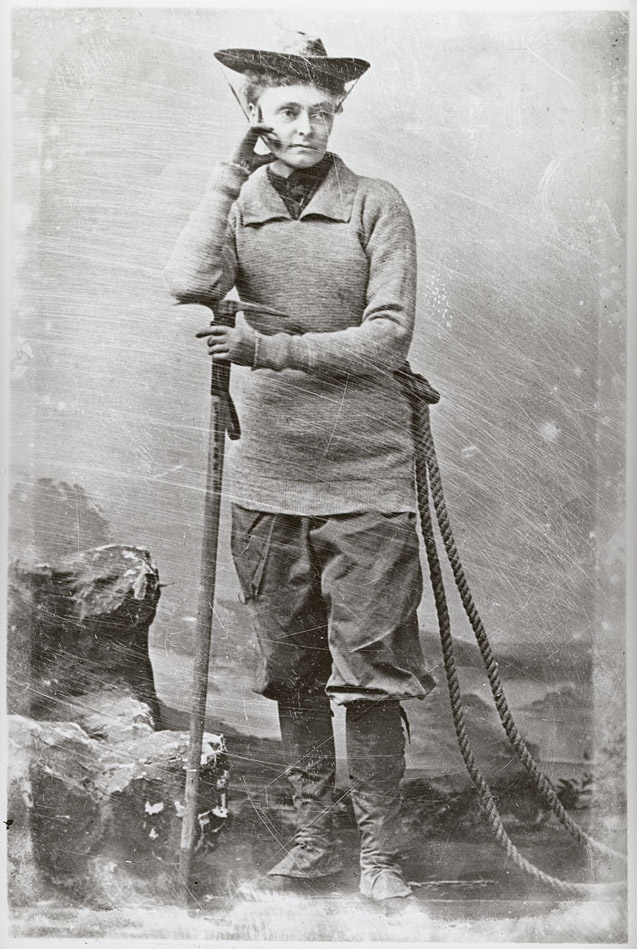
The Matterhorn in 1895 — a face that even men feared. I climbed it in knickerbockers, those puffy breeches gathered below the knee, and believe me, it wasn't the crevasses that made the newspapers scream, but my visible legs. Cartoonists drew me grotesquely. Let them laugh. A long skirt on ice is an invitation to fall and die; I said it and repeated it to anyone who would listen. Safety in the mountains tolerates no false modesty. I wore those trousers as others carry a flag, and I never apologized for it.
It wasn't the crevasses that made the newspapers scream, but my visible legs.
—Do you remember September 2, 1908, on the north summit of Huascarán?
How could I forget. I was fifty-eight years old — the age at which they would have liked me by the fireside — and behind me more than a decade of failures on that mountain, since my first attempt in 1897. On September 2, 1908, with my Swiss guides, I reached the north summit, nearly six thousand six hundred meters of wind and ice, the altitude record for the entire Western Hemisphere. The panorama defied speech: a sea of peaks and glaciers to the horizon. I later recounted it in A Search for the Apex of America. After so many years of effort and hardship, the summit was finally ours.
I was fifty-eight years old — the age at which they would have liked me by the fireside.
—Your rival Fanny Bullock Workman contested your measurements. How did you experience that?
Ah, Mrs. Workman. She refused to believe that my Huascarán surpassed her Pinnacle Peak in India, and she spent a fortune funding a French geodesy expedition to come measure my mountain and lower my figure. Think of it: two women fighting over an altitude record with theodolites and barometers, just as the gentlemen fight over theirs! My old altimetric barometer was not a perfect instrument, I admit — but the quarrel itself was a victory. We proved that a woman could have ambition, and even vanity, exactly like a man. No one dreams of denying that to those gentlemen.
The quarrel itself was a victory: we proved that a woman could have ambition.
—In 1911, on the summit of Coropuna, you planted something more than a simple banner. What did that gesture mean?
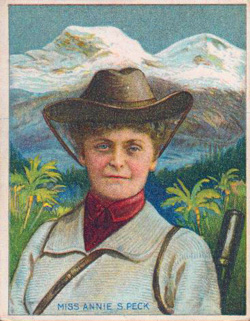
On the summit of Coropuna in 1911, at over six thousand meters, I unfurled a small banner embroidered with three words: Votes for Women. The Andean wind caught it, and the image went around the world's press. I had promised in a letter to the great suffrage association: what I accomplished on those heights, I accomplished as a woman, for all those who would come after me. No summit should be deemed too high for our ambition. At sixty-one, I was still climbing — no longer just for a record, but for a cause.
No summit should be deemed too high for our ambition.
—Would you say the mountain was a political platform for you?
It became one. For a long time I climbed for the beauty of it and for the joy of conquering. But a feat seen only as a prowess fades; a feat that carries a word endures. When the American and European press seized on my Coropuna banner, I understood that an ice axe planted at six thousand meters could serve the same cause as the parades of our suffragists in the streets of Washington. The knickerbockers of the Matterhorn already said the same thing: that a woman controls her body, her legs, her courage. The mountain was my platform because I could not be silenced there.
A feat seen only as a prowess fades; a feat that carries a word endures.
—You speak of Virgil and crampons in the same sentence. Did this double life cost you?
I was often told to choose: knowledge or audacity, the classroom or the cordillera. As if a woman could not hold a Greek text in one hand and an ice axe in the other. I refused that bargain all my life. My degree from Michigan and my Andean ascents spring from the same appetite: to understand the world from top to bottom, in its dead languages as in its living reliefs. It cost me a home, a fortune, a rest — I never had a fixed residence, only furnished apartments between expeditions. But I prefer a hundred times a life without a roof to a mind under a bell jar.
I prefer a hundred times a life without a roof to a mind under a bell jar.
—At eighty-two, you fly over South America in an airplane. What were you looking for?
Perhaps you thought I had hung up my crampons? Those same Andes that I had climbed inch by inch, in the ice and short of breath, I saw them from above, through the porthole of an airplane. From the sky, the great cordillera appeared to me as the wrinkled backbone of the continent, its summits sparkling white — familiar, yet of a completely new magnificence. I turned it into Flying Over South America, my last book. I knew the hemp rope and the barometer; now I am a passenger of flying machines. A curious person never refuses a new point of view, even at eighty-two.
From the sky, the cordillera appeared to me as the wrinkled backbone of the continent.
—These mountains climbed on foot then seen from the sky: what did this change of perspective teach you?
That there is never a final truth about a mountain. On foot, Huascarán was an adversary — every meter wrested at the cost of exhaustion, every night under a cotton tent battered by winds. Seen from the sky, that same summit became almost gentle, a simple white ridge among others. I spent a lifetime measuring heights with my barometer, arguing over meters; the airplane reminded me, with gentle irony, how tiny our records are in the face of immensity. But I regret none of my quarrels. It is by fighting for a few meters that one opens the sky to those who follow.
It is by fighting for a few meters that one opens the sky to those who follow.
—What do you reply, even today, to those who judged a woman incapable of such feats?
I oppose my summits to them, quite simply. They laughed at my knickerbockers on the Matterhorn in 1895; they doubted my figures on Huascarán in 1908; they found it indecent that an old lady would plant a Votes for Women banner on Coropuna. And yet, each time, the mountain proved me right, she who knows neither the sex nor the age of those who climb her. A woman's body can endure cold, altitude, and fear as well as a man's — I am living proof of it, at eighty-two. Let them stop asking us if we are capable. We have already done it.
The mountain proved me right, she who knows neither the sex nor the age of those who climb her.
This imaginary interview was generated by artificial intelligence from sources documented in Annie Smith Peck's profile. It dramatises what the figure might have said based on what we know about them, but does not constitute attested historical testimony. For primary sources and factual documentation, refer to the full profile.