Kids interview Annie Smith Peck
by Charactorium · Annie Smith Peck (1850 — 1935) · Exploration · Sports · 4 min read
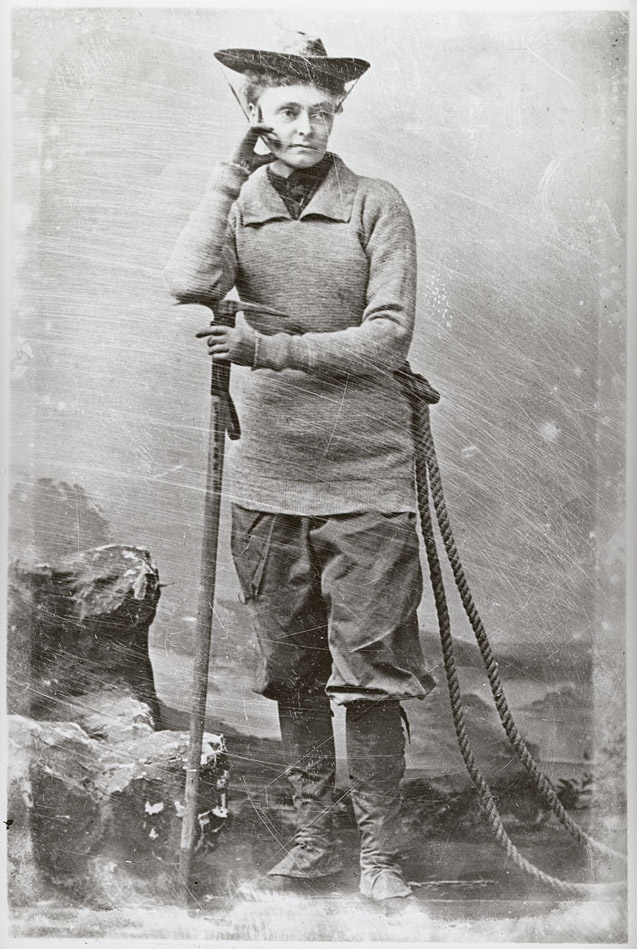
Two twelve-year-old students visit an exhibition on great women explorers. In front of a photo of a woman in pants, standing on a glacier, they stop, intrigued. Then the old lady in the image seems to answer them, and tells her story.
—Before the mountains, what did you do? Were you already an adventurer as a child?
Oh no, my child, not at all! I was first a serious student, bent over my books. I studied Latin and ancient Greek—the languages of the Romans and Greeks of old. In 1878, I earned my degree at the University of Michigan in Ann Arbor. Imagine: at that time, girls had only just been accepted into these great schools. I even taught Latin to students, like a real teacher. You see, before climbing peaks, I first climbed the ladder of knowledge, step by step.
Before climbing peaks, I climbed the ladder of knowledge.
—It's odd, a Latin teacher who climbs mountains. What did people say to you?
They told me to choose, you see! In my time, a woman had to be either learned and wise, or nothing at all. The idea that she could be both a professor AND an adventurer upset many people. I refused that choice. In the morning, I could recite a Greek poem; in the afternoon, dream of glaciers. One day, I saw a European mountain, immense and white, and my heart began to beat. I was already past thirty. And I said to myself: why couldn't a full head also carry an ice axe?
Why couldn't a full head also carry an ice axe?
—Why did your pants cause a scandal? They're just clothing, right?
Ah, you can't imagine! In 1895, I climbed the Matterhorn, a sharp and terrible mountain in the Alps. And there, instead of a long skirt, I wore knickerbockers—baggy pants gathered below the knee. For a woman, that was huge! The newspapers published mocking cartoons of me. But think: on ice, a skirt catches, makes you fall, can kill you. I stood firm. As I wrote then: "Safety in the mountains tolerates no false modesty." You don't die to look pretty.
You don't die to look pretty.
—And up there, what was it like? Were you cold dressed like that?
Terribly cold, my child! Imagine a wind that cuts your face like a blade. I wore a thick wool shirt, a waterproof coat, wool gaiters, and heavy nailed boots to grip the ice. On my feet, screw-on crampons; in my hand, an ice axe—that pick that serves as a support and brakes if you slip. In the morning, we got up before dawn, in subzero temperatures. We ate dried meat, biscuits, chocolate, a little hot tea. Believe me, the mountain gives no quarter to those who underestimate it.
The mountain gives no quarter to those who underestimate it.
—How old were you on your highest mountain? That must have been hard!
I was fifty-eight years old, believe it or not! An age when, in my time, most climbers had long since put away their crampons. It was September 2, 1908, on the north summit of Huascarán, in Peru. Almost six thousand seven hundred meters! I had tried, failed, started again for more than ten years. Ten years, imagine the patience! The air up there is so thin you breathe like a fish out of water. But I had my Peruvian guides, my hemp rope, my will. And an old body can hide a heart as stubborn as a mule.
An old body can hide a heart as stubborn as a mule.
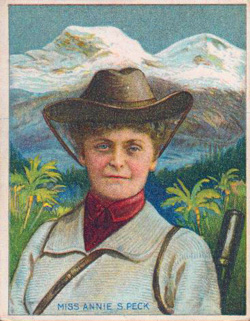
—What did you feel at the very top, when you succeeded?
Immense happiness, my child, almost too great for words. In my book A Search for the Apex of America, published in 1911, I tried to express it. I wrote: "We had conquered Huascarán. After years of effort, failures, and trials, the summit was ours." Around me, imagine a sea of peaks and glaciers stretching to the end of the world. The silence, the white, the sky so close. After so many attempts, that moment was worth every fall, every frozen finger. Some joys are only won at the cost of a thousand failures.
Some joys are only won at the cost of a thousand failures.
—Someone said you lied about the height? Did that annoy you?
Oh, it upset me a lot! Another great mountaineer, Fanny Bullock Workman, wanted the same record as me. She paid for an entire expedition of French scientists to come and remeasure my Huascarán! Can you imagine the expense, just to verify my figures. We measured altitude with an altimetric barometer—an instrument that calculates height from air pressure. It's not perfect, so we argued. But deep down, it was a magnificent sign: for the first time, two women were competing for a sports record, just as men already did.
For the first time, two women were competing for a record.
—Is it true that you planted a special flag on top of a mountain?
It's absolutely true! In 1911, I climbed Coropuna, a Peruvian volcano over six thousand meters. At the summit, I took out a small pennant and planted it in the snow. On it, a few words in English: "Votes for Women." Because at that time, my child, women did not have the right to vote, to choose those who govern. I was sixty-one years old, and I was climbing as much for my ideas as for records. A flag at the top can be seen from very, very far away.
A flag at the top can be seen from very far away.
—Why mix mountain climbing and the right to vote? They're not the same, are they?
You ask a great question! For me, they were the same, precisely. Every peak I conquered proved that a woman could do what she was forbidden to do. To a women's association, I once wrote: "What I have accomplished on the heights of the Andes, I have done as a woman. I plant this flag for all those who will come after me." You understand? I was not climbing only for myself. I was climbing to show the way. Every step I dared, another could dare after me.
Every step I dared, another could dare after me.
—When did you stop? You can't climb your whole life, can you?
Don't be so sure, my child! I never really stopped exploring. At eighty-two, I flew over South America to write my last book, Flying Over South America, in 1932. Seen from above, the Andes cordillera looked like the wrinkled backbone of the continent, all white against the blue sky. I still gave lectures, I still wrote, even when my body tired. I passed away in New York in 1935. If I leave you one thing, it's this: you are never too old to raise your eyes toward a new summit.
You are never too old to aim for a new summit.
This imaginary interview was generated by artificial intelligence from sources documented in Annie Smith Peck's profile. It dramatises what the figure might have said based on what we know about them, but does not constitute attested historical testimony. For primary sources and factual documentation, refer to the full profile.