Imaginary dialogue between Fanny Bullock Workman and Annie Smith Peck
by Charactorium · Annie Smith Peck (1850 — 1935) · Exploration · Sports · 6 min read
It is in a modest furnished apartment in New York, this autumn of 1913, that Fanny Bullock Workman comes to meet Annie Smith Peck, a few months after the great suffragist march in Washington. On the table, an altimeter barometer sits alongside annotated maps of the Andes and an oil lamp glowing against the window. The two women have known each other by reputation for years: declared rivals for the women's altitude record, they have contested peaks and numbers with a bitterness tempered only by mutual respect. Fanny has come, not without ulterior motives, to understand what drives this sixty-three-year-old Latin scholar to keep climbing.
—Annie, before the peaks you taught Latin at Purdue. How does one go from Virgil's verses to the glaciers of Peru?
You know, Fanny, for a long time I was told to choose: knowledge or daring, the classroom or the cliff face. I refused that bargain. Graduated from the University of Michigan in 1878, among the first women admitted, then at the School of Classical Studies in Athens, I learned to read the Ancients in the original. Now the Ancients already climbed Olympus in thought. Latin gave me rigor, patience for detail, that distrust of approximation that serves as much to translate an ode as to measure an altitude. When I climbed Mount Shasta at thirty-eight, I did not leave my books behind: I simply carried my discipline higher. A woman is not condemned to be only one thing.
I was told to choose between knowledge and daring: I refused that bargain.
—Let's talk about the Matterhorn, in 1895. You knew a woman in trousers would cause a scandal. Was it a calculated challenge or simple necessity?
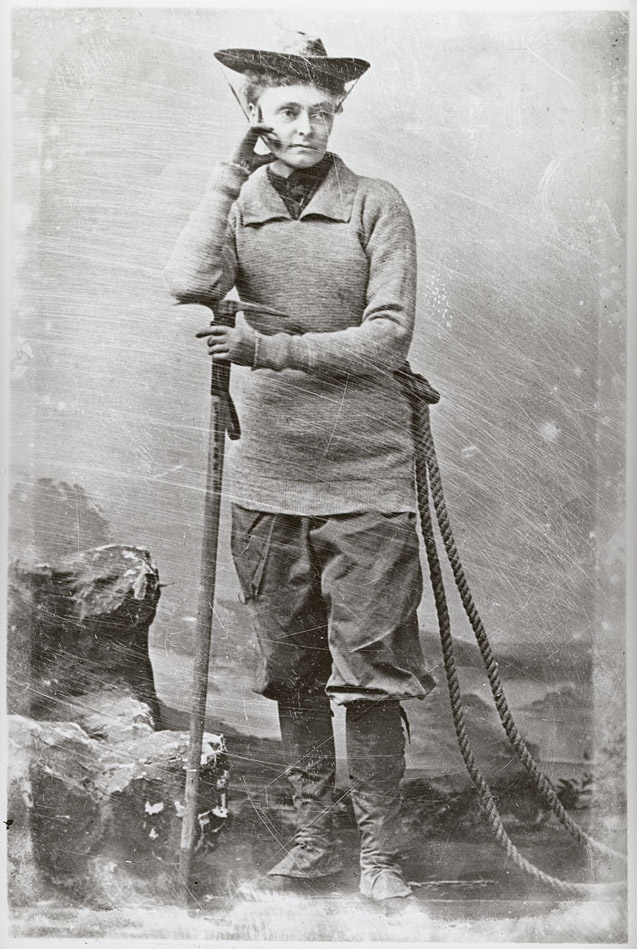
Both, if I am honest. A long skirt on an icy slope is not decorum, it is a death trap: it catches the wind, snags on the ice axe, makes you topple into the void. So I wore the knickerbockers, and I do not apologize; safety in the mountains brooks no false modesty. The newspapers published caricatures, drew me as a scarecrow, an unnatural woman. I let them talk. What I knew was that I had reached the summit alive, when propriety would have killed me. It took a woman to show that the fabric of a dress weighs more than all prejudices combined. You who also climb, Fanny, know that the mountain does not forgive coquetry.
The fabric of a dress weighs more than all prejudices combined.
—Huascarán, September 2, 1908. Fifty-eight years old, more than a decade of failures. What kept you from giving up?
Stubbornness, no doubt, and a certain idea of keeping a promise to oneself. I had attempted that summit as early as 1897; it turned me back time after time. At an age when I was urged to hang up my crampons, I went back up with my Peruvian guides, in that cold that bites the lungs. When we finally touched the north summit, at nearly six thousand six hundred fifty meters, I later wrote that the summit was ours — after years of effort, failures, and trials. The panorama defied description: a sea of peaks and glaciers to the horizon. It was not the vanity of a record. It was proof, offered to all, that a mature woman could accomplish what young men already deemed beyond her reach.
At an age when I was urged to hang up my crampons, I went back up.
—You know why I bring this up, Annie: I funded a French geodetic survey to verify your altitude on Huascarán. Have you ever forgiven me?
Forgiven? Fanny, I was almost grateful to you, though it pains me to admit it. You contested my measurements, dispatched your engineers, questioned my barometer before the whole world. It stung, I won't deny it. But think what it meant: two women disputing an altitude record with the same ferocity as men, numbers against numbers, altimeter against theodolite. Together, we proved that women had entered scientific and athletic competition on equal footing. You may have trimmed a few hundred meters from my claim, but above all you treated me as a serious adversary, not a parlor curiosity. That is a tribute many men never paid me. Our rivalry was worth more than condescension.
You treated me as a serious adversary, not a parlor curiosity.
—On Coropuna, in 1911, you planted a 'Votes for Women' banner at six thousand meters. Why mix politics with achievement?
Because for me, they were never separate. I was sixty-one, still climbing, and I wanted every summit to say something. I unfurled that little banner on the volcano, so high that no one could pretend not to see it. What I accomplished on the heights of the Andes, I did as a woman — and I planted that flag for all those who would come after me, so that no summit would be deemed too high for our ambition. Newspapers around the world reported the gesture; so much the better. A record is forgotten, an image endures. I wanted a young girl somewhere to understand that the right to vote and the right to climb stem from the same denied freedom.
A record is forgotten, an image endures: I planted that flag for those who would come after.
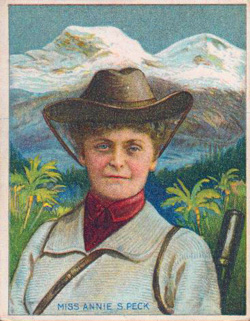
—Between us, did those altimeter controversies hurt you, or sharpen you? The press reveled in them at our expense.
A bit of both, again. Seeing my numbers dragged through the gazettes, discussed by men who had never set foot on a glacier, exasperated me. The altimeter barometer is a finicky instrument: pressure varies, cold distorts it, and then you are accused of vanity or lying. But that harshness forced me to be better, more meticulous, to document every ascent with photography and readings. You kept me on my toes, Fanny — I could afford no negligence knowing you were on my heels. Rivalry, when it remains fair, is better than flattery. It forced me to raise not only my body but my rigor as high as possible. Our disputes advanced the measurement of the Andes faster than any official expedition.
I could afford no negligence knowing you were on my heels.
—Those caricatures, that public hostility — did you never, once, consider giving in and putting the skirt back on?
Never on the mountain face, no. Yielding would have been lying about what the mountain demands. The Matterhorn requires not only physical strength but absolute composure; you do not climb it dressed as a society lady. In town, I gladly followed Victorian fashion, long dresses and high collars — I had no desire to cause a scandal at dinner. But on the snow, the question did not arise: life first. What pained me was not being laughed at, but that people would rather see me fall properly dressed than survive in trousers. That hypocrisy I found more dizzying than any precipice. So no: on the peaks, I never put the skirt back on, and I will not regret it with my last breath.
People would rather see me fall properly dressed than survive in trousers.
—That double life of professor and adventurer — did it ever bring you loneliness, the feeling of belonging to neither world?
Often, yes. Academics considered me an eccentric wasting my Latin on glaciers; alpine clubs tolerated me as an intruder in skirts. I was never fully at home in either the lecture hall or the rope team. But that solitude was also a freedom. Belonging to no clique, I owed no one an account. I taught Virgil in the morning and dreamed of summits in the evening without asking permission. I believe, Fanny, we share this: women who refused their assigned place always end up a bit stateless. But I prefer that wandering a thousand times to the tepidity of a settled existence. I was offered to be a proper lady; I chose to be an ill-mannered explorer, and I am perfectly fine with that.
I chose to be an ill-mannered explorer, and I am perfectly fine with that.
—Do you truly believe suffrage will come? We have been campaigning for decades and the ballot box remains closed to women.
I firmly believe it, and I believe it is near. At Seneca Falls in 1848, the year before I was born, a few women dared to demand the vote when they were called mad. Today, thousands march in the streets of Washington. In my lifetime, I have seen the cause go from ridicule to respectability. What I did on Coropuna was just one more stone in the edifice: to show that no terrain, not even the highest summit of the continent, is forbidden to our will. A nation that lets its women conquer the Andes will eventually open the voting booth to them. The mountain taught me patience: you do not climb a six-thousander in a day. Suffrage will be our summit, and we will plant our flag there, believe me.
In my lifetime, I have seen the cause go from ridicule to respectability.
—One last question, Annie: at your age, do you really plan to go again? Or was Huascarán your last great summit?
My last? Do you not know me better, Fanny? As long as my legs carry me and my mind stays clear, I will go again. The Andes have not yet yielded all their secrets, and there are entire cordilleras no woman's eye has measured. Huascarán was a crowning achievement, not a final period; one does not hang up one's crampons because an almanac suggests it. I will continue to give lectures, to write, to climb as long as I can. And the day my strength finally betrays me, I will find another way to gaze at those summits — even in a manner we cannot yet imagine. Exploration is not a matter of age, but of temperament. Mine will die only with me.
One does not hang up one's crampons because an almanac suggests it.
This imaginary interview was generated by artificial intelligence from sources documented in Annie Smith Peck's profile. It dramatises what the figure might have said based on what we know about them, but does not constitute attested historical testimony. For primary sources and factual documentation, refer to the full profile.