Kids interview Bong Joon-ho
by Charactorium · Bong Joon-ho (1969 — ?) · Performing Arts · 5 min read
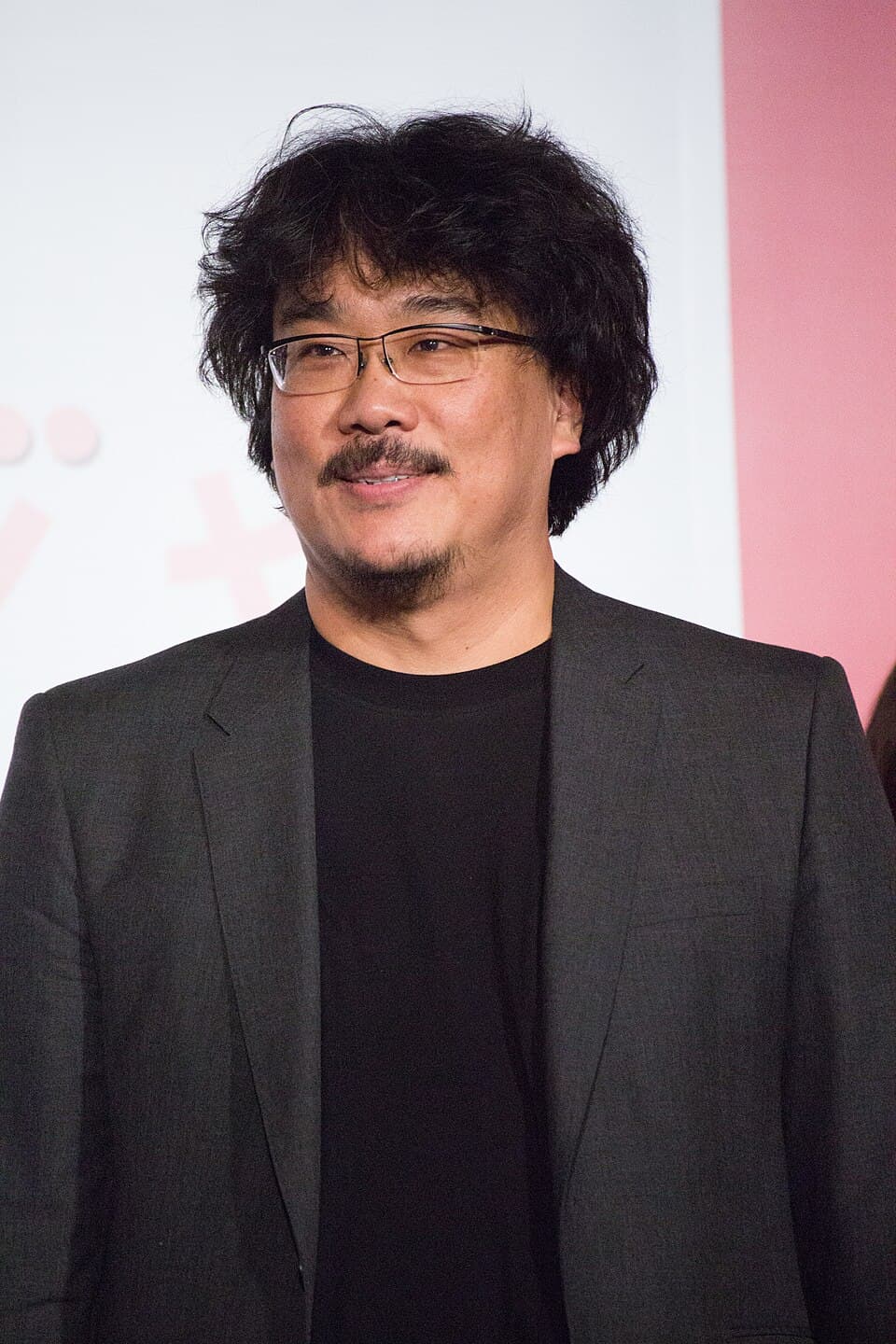
That morning, two students from a school trip push open the door of a film studio. Before them, a man with a shy smile waits, a sketchbook in hand. It's Bong Joon-ho, and he has agreed to answer all their questions.
—Did you have a famous grandfather? It's said that he was a secret in your family.
You know, my child, my grandfather was Park Tae-won. He was a great novelist of the 1930s, a writer who invented modern stories. But during the war, he left for the North of my country. And afterward, no one dared to talk about him at home anymore. Imagine: you have an ancestor whose name is whispered, as if he must be hidden. I grew up under a dictatorship, at a time when certain words were dangerous. So for a long time, this man remained a shadow. Today I believe that telling stories comes from him. The blood of a storyteller cannot be hidden.
The blood of a storyteller cannot be hidden.
—Where exactly were you born? What was Korea like when you were little?
I was born in 1969 in Daegu, a city in southern Korea. It was a very different country from today. A military regime commanded everything, and we couldn't say what we thought. When I was eleven, there was a terrible uprising in a city, brutally suppressed. It marked my entire generation. Imagine children growing up feeling fear in the air, without fully understanding why. Later, at university, we finally won the freedom to speak. I chose to speak with images, with films. It was my way of no longer being silent.
—Is it true they call you "Bong Tae-il"? What does it mean?
Ah, you've done your research! My teams gave me that nickname, Bong Tae-il. It's a little play on the English word detail. Because I'm crazy about details, you see. Before filming, I draw every shot of my film on paper. Every character, every object, where it's placed, how we look at it. That's called a storyboard: a series of small drawings that tell the film in advance. When I arrive on set, everything is already framed in my head and on my sheets. It's like building a house: you don't put up walls without a plan.
You don't put up walls without a plan.
—What's the point of drawing everything beforehand? Can't you just shoot?
Good question! Imagine going on a trip without knowing where you're going. You waste time, you argue, you panic. A shoot is the same: there are dozens of people around me waiting. So in the morning, often in a café in Seoul, I calmly draw my shots. That way, on set, everyone knows exactly what to do. My pencil has already made the film once. The camera only confirms it. It might seem rigid, but on the contrary: when everything is planned, we're free to play with surprises. Calm comes from preparation.
My pencil makes the film once.
—Did you make a film with a monster? What kind of monster was it?
Yes! The film is called The Host, in 2006. A huge monster emerges from the Han River in Seoul and grabs a little girl. But careful, my child: it's not just a story to scare. Behind the creature, I was talking about the powerful who abandon ordinary people. I asked foreign special effects studios for help to build the beast. And I took a crazy gamble: show the monster in broad daylight, under the sun. Usually, you hide these creatures in the shadows, because they're less scary in full light. I wanted us to see it whole. True fear comes from what we understand, not from what we guess.
True fear comes from what we understand, not from what we guess.
—Were you scared yourself while filming monster scenes?
You know, what scared me wasn't the creature — I had drawn it myself! No, my real worry was messing up the mix. In The Host, I had to scare, make laugh, and make think, all at once. Imagine preparing a dish where you put spicy, sweet, and bitter: if you get the doses wrong, it's inedible. A monster film that also talks about politics was risky. But the Korean public loved it; it was a huge success. That day I understood that you can entertain people and tell them something serious at the same time.
—What is a "banjiha" house? We see one in one of your films, right?
Yes, in Parasite, in 2019. A banjiha is a half-buried dwelling, a basement. The window is at the top of the wall, at sidewalk level. You see pedestrians' feet and wheels rolling in the street. When it rains heavily, water can come in. Many poor families live there, in Seoul. In my film, one family lives in this dark basement, and another lives in a beautiful bright house, high up. I didn't invent anything: these two worlds really exist, in the same city. Cinema is also for that: showing what we prefer not to look at.
Cinema is for showing what we prefer not to look at.
—Why do you make films about the rich and the poor? Does it affect you?
A lot, yes. In my country, there was a big crisis in 1997: Korea had to ask the whole world for help to avoid collapse. People lost everything overnight. I was young, and I saw how money separated families, neighborhoods, lives. There are even giants, the chaebol, those huge family-run companies that control almost everything. So when I film, I think about those who live below and those who live above. I don't preach. I simply show, and let the viewer feel the injustice.
—Is it true your film won lots of awards? Were you happy?
Ohhh, it was a dream come true! In 2019, Parasite received the Palme d'Or at Cannes, in France. It's the most prestigious award in cinema, and no Korean film had ever won it before. I was overwhelmed. Then, in February 2020, my film won four Oscars in Los Angeles, including Best Picture. And listen carefully: it was the very first time a non-English-language film won that award. Imagine a little basement in Seoul rising to the biggest stage in the world. I thought of my country, my grandfather, the whole journey.
A little basement in Seoul, risen to the biggest stage in the world.
—You said a phrase about subtitles that went around the world. What was it?
Ah, you know it! It was in January 2020, at a big awards show called the Golden Globes. Many people don't like reading subtitles, you know, those little lines of translation at the bottom of the screen when a film comes from another country. So I said, through my translator: "Once you overcome the one-inch-tall barrier of subtitles, you will be introduced to so many more amazing films." One or two inches, that's tiny! But in our minds, it can be a huge wall. I was inviting everyone to jump over that tiny wall. Behind it, there are treasures of stories from around the world.
Overcome the one-inch barrier of subtitles, and the world opens up.
—If a child wants to make films like you someday, what do you tell them?
I would tell them: start right now, with what you have. In university, I ran a small film club and watched films nonstop. I was a lover of world cinema, Korean, French, American, it didn't matter. Even today, in the evening, I watch films like a curious child who never gets tired. So draw your ideas, observe the people around you, listen to their stories. Don't think you have to come from a big country or speak the right language to be heard. Tell what only you can tell. The most personal is often the most powerful.
Tell what only you can tell.

This imaginary interview was generated by artificial intelligence from sources documented in Bong Joon-ho's profile. It dramatises what the figure might have said based on what we know about them, but does not constitute attested historical testimony. For primary sources and factual documentation, refer to the full profile.