Imaginary dialogue between Éginhard (Einhard) and Charlemagne
by Charactorium · Charlemagne (742 — 814) · Politics · 6 min read

It is in a gallery of the palace of Aachen, in this winter of the year 813, that Einhard finds the emperor Charles, wrapped in his marten cloak near a brazier. The steam from the baths still rises from the nearby springs, and in the distance one can hear the elephant Abul-Abbas trumpeting. They have known each other for years: Einhard has shared the imperial table, observed the writing tablets slipped under the pillow, gathered a thousand confidences. Today, the cleric comes not to serve, but to understand the man behind the emperor, before memory freezes him.
—My lord, I was in Rome that Christmas Day of the year 800. They say the gesture of Pope Leo displeased you. Is it true?
You who saw me come out of Saint Peter's Basilica, Einhard, you know what my face betrayed. The crown placed on my head, the acclamation of the Roman people — great and peaceful emperor — all of it seized me without my having wished it in that manner. Not that I refused the imperial dignity: I already bore it in my deeds. But I did not wish to appear to hold it from the hand of a pontiff, like a gift received on one's knees. An emperor does not receive his title; he earns it by his works and by God. Had I known Leo's intention that day, perhaps I would not have entered the church. But what is done serves the Empire, and it is the Empire that counts.
An emperor does not receive his title; he earns it by his works and by God.
—You have often seen me, at night, tracing letters on my tablets. Why demand schools everywhere, you who struggle to write?
Precisely because I struggle, Einhard. You have surprised me often enough, at dawn, my fingers clumsy on the wax — I started too late, and the hand no longer follows the mind. But what God has denied me, I want to offer to the sons of this kingdom. In the Admonitio generalis, I ordered that schools be created to teach children to read, not only the sons of nobles, but also children of servile condition. Without clerics who read correctly, how will the priests pray without mistakes? How will Scripture be understood? Alcuin showed me that a kingdom without learning is a blind kingdom. I wanted to make writing clear, legible from one end of the Empire to the other. What I do not master, my people will master after me.
What God has denied me, I want to offer to the sons of this kingdom.
—Emperor, your capitularies regulate even the gardens — lilies, roses, cucumbers. Must a master of the West descend to such details?
Do you think one governs an empire by great battles alone, Einhard? A kingdom holds together by the order of small things as much as great ones. In the Capitulare de villis, I wanted each estate to know what it must cultivate, how to feed the men, how to keep its accounts. A negligent steward starves a province. And since I cannot be everywhere, I send my missi dominici, two by two, a layman and a cleric, to see with my eyes through theirs: they oversee the counts, listen to complaints, enforce my decisions up to the border marches. The county, the march, the assembly — all form a single body. To rule is to ensure that the grain grows as well as that justice is done.
A kingdom holds together by the order of small things as much as great ones.
—Remember the day Abul-Abbas arrived at court. Why did you choose Aachen as your capital, and care so much for these waters?
Ah, the elephant! You recall the excitement at court, Einhard, when that gift from Caliph Harun al-Rashid entered the gates in 802 — never had such a beast been seen in Frankish lands. I chose Aachen for its hot springs, I admit it without shame. Nothing relaxes me like swimming in these waters, and I invite my guards, my sons, my close companions — sometimes we are more than a hundred splashing together. An emperor needs a place to lay down his armor. I built my palace here, my chapel inspired by Ravenna, my baths. In the morning, I conduct business while dressing; in the afternoon, I hunt or swim; in the evening, I listen to readings of Saint Augustine. Aachen is the heart from which my decisions beat.
An emperor needs a place to lay down his armor.
—Your subjects now all swear oaths of fidelity. Is it not asking too much of a free man to swear thus into your hands?
The oath does not chain the free man, Einhard; it binds him. Since the year 789, I have wanted all my subjects to swear fidelity, not out of caprice, but because so vast an empire holds together only through bonds between men. The vassal swears to his lord, the lord to the emperor, and from link to link the whole body holds. Without this, every count would become a petty king, every march a hostile frontier. I have seen what a divided kingdom becomes — my father and my uncle shared it upon Pepin's death. The oath is the thread that prevents the Empire from tearing apart. He who swears does not lose his freedom: he accepts to answer for his deeds before one greater than himself.
The oath does not chain the free man; it binds him.
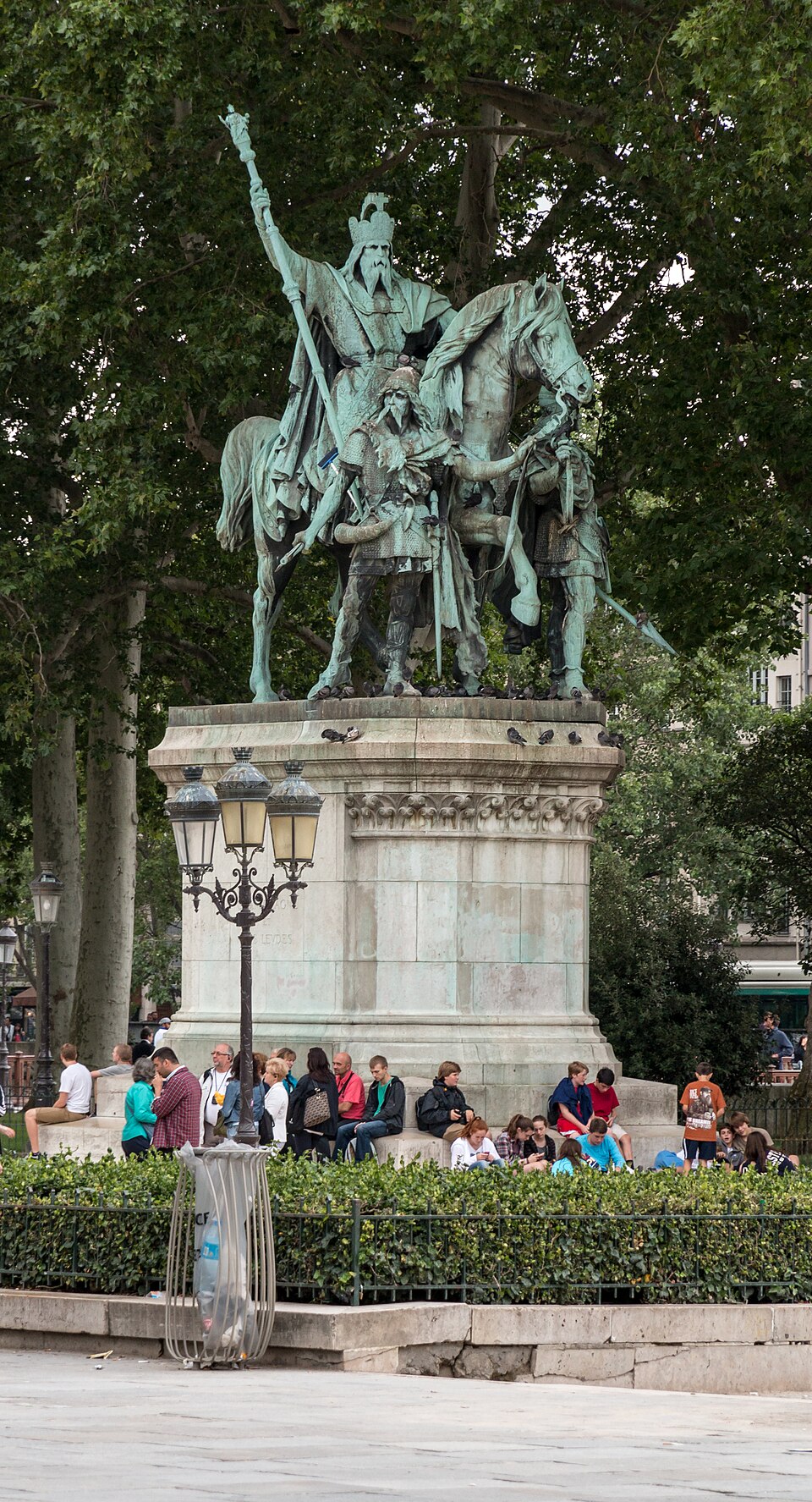
—I dare ask you only in a whisper: Roncevaux, in 778. Does the loss of your rearguard in the Pyrenees still weigh on you?
You touch an old wound there, Einhard. Yes, in those Pyrenean passes, my rearguard was ambushed and annihilated by the Basques — mountaineers who strike and vanish into the heights. I lost good men there, counts I loved. Already, in the camps, they are singing of their courage, embellishing the tale of their end. What matter: the valor of those warriors deserves to be remembered. But I do not delude myself with legends. The truth is harsher than a song: one cannot hold a mountain as one holds a plain, and I learned at my own expense that no army is invincible in narrow passes. Glory consoles the living; it does not bring back the dead.
Glory consoles the living; it does not bring back the dead.
—You brought Alcuin from York to your court. What does an emperor truly expect from a schoolmaster?
More than you think, Einhard. When Alcuin arrived in 782, I understood that a kingdom is conquered by the sword but preserved by learning. He taught me to love the calculation of dates, grammar, the proper way to pray. Around him, at my table, we debated like schoolboys, and I enjoyed being corrected. I wanted ancient texts to be copied in the scriptoria, saved from oblivion, written in a legible hand — that minuscule your fellow clerics now trace. An empire that no longer reads falls back into darkness. Alcuin was for me less a servant than a guide; what he sowed in our monasteries will germinate long after my sword falls silent.
A kingdom is conquered by the sword but preserved by learning.
—You long waited for Byzantium to recognize you. What did the gesture of Emperor Michael last year change for you?
You know how much this point mattered to me, Einhard. As long as the Greeks of Constantinople considered me a usurper, my imperial title remained contested in the East. When Michael finally recognized my imperial dignity last year, it was not vanity that rejoiced me, but peace. Two Christian empires tearing each other apart delight their common enemies. I never claimed to rule over the Eastern Rome; I wanted them to stop denying what I am in the West. This recognition seals what the coronation of 800 opened. Henceforth, my successors will bear the title without dispute. An emperor does not work for his reign alone, but for those who come after him.
Two Christian empires tearing each other apart delight their common enemies.
—At table, I have seen you refuse your physicians' fasts and prefer roasted game. What kind of man are you away from ceremonies?
A Frank, Einhard, nothing else. You have seen me often enough push aside the elaborate Roman garments, which I wear only reluctantly, preferring my linen tunic, my breeches, and my leg wraps. At table, I love game brought back from the hunt, I drink my wine mixed with water, and I rage when my physicians prescribe fasts — they would have me eat boiled when I love roasted! I gladly listen, during meals, to readings of ancient histories or Saint Augustine's City of God. Pomp does not make me greater; it disguises me. Before God and before my close ones, I prefer to remain what I have always been: a horseman, a swimmer, a man who loves his land and his own.
Pomp does not make me greater; it disguises me.
—Last year, in the Divisio regnorum, you planned to divide the Empire among your sons. What becomes of that plan today?
Death has undone my calculations, Einhard, as it undoes those of all men. In 806, I had arranged the division among my three sons, following Frankish custom: to each his share, to avoid wars. But God decided otherwise, and only Louis remains to me. Perhaps this is a sign: what my father and his ancestors constantly divided, the Empire now wants as a single whole. A body has but one head. I have associated Louis with the imperial dignity by my own hands, without waiting for Rome this time — the Empire must no longer depend on a foreign coronation. I leave my son a complete inheritance, and the burden of holding it. Pray that he has the strength for it, you who know the weight of this crown.
What my father constantly divided, the Empire now wants as a single whole.

This imaginary interview was generated by artificial intelligence from sources documented in Charlemagne's profile. It dramatises what the figure might have said based on what we know about them, but does not constitute attested historical testimony. For primary sources and factual documentation, refer to the full profile.