Kids interview Charlemagne
by Charactorium · Charlemagne (742 — 814) · Politics · 6 min read

Two young visitors of twelve push the heavy door of the palace of Aix-la-Chapelle. Before them, seated near a brazier, an old emperor with a white beard invites them to approach. He smiles, glad that children have come to listen to him.
—What was your home in Aix-la-Chapelle like? What did it look like?
Come closer, my child. My palace in Aix-la-Chapelle was not a simple house. There was a great hall for receiving guests, an octagonal chapel, and above all, hot baths. Do you know why I chose this place? For its hot springs that came out of the earth on their own. Imagine a large stone pool, where the water steamed even in winter. I swam there almost every day. I loved it! I invited my guards, my friends, my daughters to join me. Sometimes there were more than a hundred of us splashing together. An emperor who swims—that surprises you, doesn't it?
I built my capital around a hot water spring that I loved.
—They say you had an elephant. Is that true?
Ah, you've heard of Abul-Abbas! Yes, my child, it is quite true. Far to the East lived a great prince, Caliph Harun al-Rashid. We exchanged messengers and gifts, even though thousands of roads separated us. And one day, he gave me an elephant. Imagine the look on my court's faces when that huge beast arrived in Aix in 802! No one here had ever seen such an animal: those big ears, that long nose that grabs things. He lived with us for nearly eight years. He was the wonder of the whole Empire. A gift from the end of the world, just for me.
An elephant from the Orient was the wonder of my entire Empire.
—Were you happy when the pope crowned you emperor?
You ask a good question, and the answer will surprise you. It was Christmas Day, December 25 of the year 800, in the great church of Rome. I was at prayer. And there, Pope Leo III placed a crown on my head, without warning. All the people shouted: 'To Charles Augustus, crowned by God, great and peaceful emperor of the Romans, life and victory!' Do you think I was delighted? Well, no, not really. My friend Einhard says I was displeased. Why? Because I did not want to owe my title to the pope. I wanted to owe it to my own efforts. A gift you didn't ask for can sometimes weigh heavily.
I wanted to owe my crown to my efforts, not to a surprise.
—But why was it so important to be emperor, and not just king?
Think with me, my child. King of the Franks I had been for a long time. But the title of emperor was something else. It recalled the ancient Roman emperors, those who reigned centuries before my birth. Becoming emperor was like saying: here, in the West, the greatness of Rome is not dead; it lives again. Imagine relighting a fire that had been thought out for a very long time. That is what this title meant. Later, in 812, even the distant emperor of Byzantium finally recognized my title. That meant that everywhere, I was taken seriously. An emperor is a king whose shadow stretches very far.
Becoming emperor was like relighting a fire that had been thought out.
—Were you afraid, all alone before the pope and all those people?
Afraid, no. But surprised, yes! You know, I was a tall, strong man. My biographer Einhard said I had large, lively eyes and that, standing or sitting, I gave a strong impression of authority. When you open old books, you even read that I was nearly one meter eighty tall. That was enormous for my time! The people around me looked up at me. So, before the crowd in Rome, I was not afraid of being small or weak. What bothered me was not having decided that moment myself. A strong man doesn't like others choosing for him.
A strong man doesn't like others choosing for him.
—How did you manage to command such a vast country?
Excellent question, my child. My Empire was immense, and I could not be everywhere at once. So I had an idea. I sent trusted inspectors, called the missi dominici, which means 'the master's envoys.' They always traveled in pairs: a churchman and a swordsman. Imagine two horsemen arriving in a region to check that the counts were doing their job, that justice was being done. In 802, I organized all this very seriously. Thus, even far from me, my gaze reached into the villages. It was like having dozens of eyes throughout the Empire.
My envoys were my eyes, even in the smallest villages.
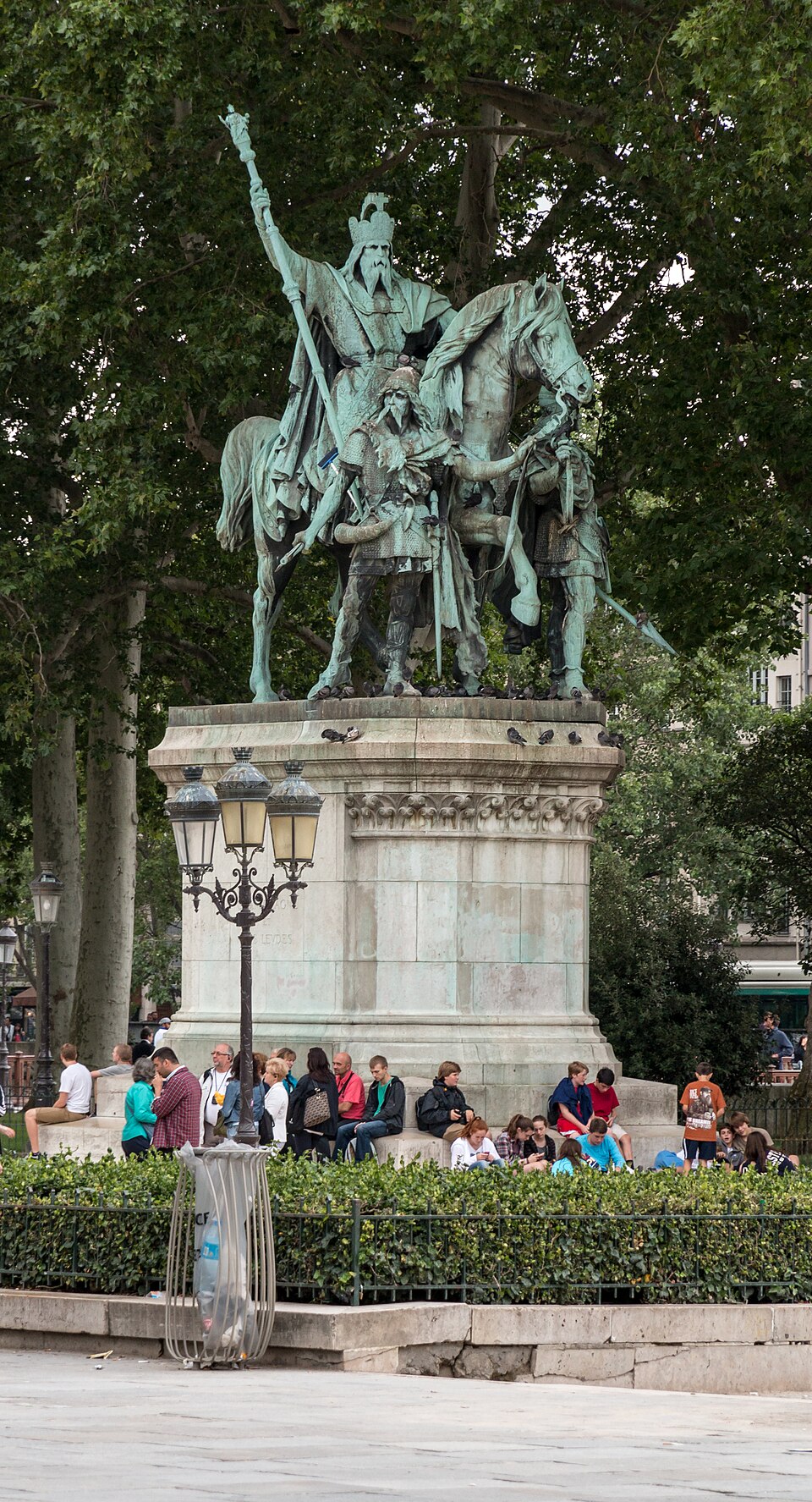
—And your laws, how did you write them? Were they big books?
Not really books, my child, but texts called capitularies. This word comes from capitula, meaning 'little chapters.' My orders were divided into chapters, a bit like a well-ordered list. As early as 779, with the capitulary of Herstal, I began to bring order to justice and the Church. In the morning, I received my counselors while dressing, and we decided urgent matters. Then my envoys carried these texts to the four corners of the Empire. You see, governing is not shouting orders. It is writing things clearly so that everyone, even far away, knows what to do.
Governing is writing things clearly enough to be understood from afar.
—They say you lost a battle at Roncesvaux. How did it happen?
You touch on a painful memory. In 778, I was returning from Spain with my army. To cross the Pyrenees mountains, you have to go through narrow passes, squeezed between high cliffs. At Roncesvaux, my rearguard—the soldiers closing the march—fell into an ambush. The mountaineers sprang from the heights. Everyone was massacred, including Count Roland. Imagine a path so narrow that you can neither flee nor defend yourself. That day, despite all my victories, I tasted the bitter taste of defeat. Even an emperor cannot escape misfortune.
Even an emperor sometimes tastes the bitter taste of defeat.
—And is it true that people made songs about that battle?
Yes, my child, and it is a beautiful lesson. That disaster at Roncesvaux was told and retold for hundreds of years after me. The storytellers turned it into a great story, the Song of Roland. In that story, Count Roland becomes a magnificent hero. Imagine an evening vigil by the fire: a man sings the exploits of warriors, and everyone listens, hearts tight. Strange, isn't it? My greatest conquests, like that of the Lombard kingdom in 774, have been almost forgotten. But my worst defeat became an immortal song. Misfortune, sometimes, is remembered better than glory.
My worst defeat became a song, more immortal than my victories.
—Is it true that you opened many schools? Did you like school?
Ah, this is what I am most proud of! In 789, I had the Admonitio generalis written. In it, I ordered the creation of schools in monasteries and bishoprics, to teach children to read. Not only the sons of lords: poor children too. Do you know why this mattered so much? Because without school, knowledge dies out. Imagine a candle that you forget to light: everything remains in darkness. I brought a great teacher, Alcuin, to help me. Together, we awakened the desire to learn throughout the Empire. We even copied old ancient texts to save them. Teaching a child to read is giving them a light for life.
Teaching a child to read is giving them a light for life.
—But you, could you at least write well?
You'll laugh, my child: not really! That is my big secret. I who ordered schools to be opened everywhere, I could barely write. I had started too late, already an adult, and my big warrior hands had trouble tracing letters. My friend Einhard says I kept writing tablets under my pillow. At night, when I couldn't sleep, I practiced silently forming letters. But I never really succeeded. You see, I wanted to give children what I had not had myself. Perhaps that is the most beautiful gift: giving others what we lacked.
I wanted to give children what I had lacked myself.
—And that writing still taught today, did you invent it?
Not invented alone, my child, but willed, yes! In my time, each region wrote in its own way. Letters were twisted, cramped, sometimes impossible to read. Imagine receiving a message so tangled that no one understands it. So, with Alcuin, we created a clear, neat script, the Caroline minuscule. It was so beautiful and legible that it was copied everywhere in the Empire. And hold on: those tiny letters you still trace in your notebook today descend directly from that one. Twelve hundred years later, a bit of my work still lives at the tip of your pen.
Twelve hundred years later, my writing still lives at the tip of your pen.


This imaginary interview was generated by artificial intelligence from sources documented in Charlemagne's profile. It dramatises what the figure might have said based on what we know about them, but does not constitute attested historical testimony. For primary sources and factual documentation, refer to the full profile.