
Charlemagne (742-814) was a Frankish king who became the first Emperor of the West. He founded the Carolingian Empire and established an education policy that shaped the Middle Ages. His reign was marked by major territorial conquests and cultural reforms.
Frequently asked questions
Key Facts
- 768: Becomes King of the Franks upon the death of Pepin the Short
- 800: Crowned Emperor of the West by Pope Leo III in Rome
- 772-777: Saxon Wars marking territorial expansion
- 789: Capitulary of Herstal establishing compulsory education for the clergy
- 814: Death in Aachen, end of his reign and of the Carolingian Empire in the strict sense
Works & Achievements
Major capitulary ordering the establishment of schools in monasteries and bishoprics. This text is at the origin of the Carolingian Renaissance and Charlemagne's educational policy.
Architectural masterpiece inspired by the Church of San Vitale in Ravenna. It served as the emperor's personal chapel and became the coronation site of Germanic kings.
Capitulary regulating in detail the management of royal estates, from agriculture to food supply, reflecting the Empire's rigorous administrative organization.
Standardization of script throughout the Empire under the impetus of Alcuin. This clear and legible script is the direct ancestor of our modern printed typefaces.
One of Charlemagne's first major capitularies, reorganizing the judicial and ecclesiastical administration of the Frankish kingdom.
Systematization of the dispatch of royal inspectors (missi dominici) in pairs throughout the Empire to oversee counts and enforce imperial decisions.
Anecdotes
Charlemagne stood approximately 1.84 m tall, which was exceptionally large for his era. The opening of his tomb in Aachen in the 19th century confirmed this imposing stature, which impressed his contemporaries and reinforced his natural authority.
Contrary to the legend that credits him with inventing the school, Charlemagne could barely write. His biographer Einhard recounts that he kept writing tablets under his pillow to practice at night, but that he had started too late to ever fully master writing.
Charlemagne was crowned emperor by Pope Leo III on December 25, 800, in Rome. According to Einhard, he was displeased by this surprise coronation, as he did not want to appear to owe his title to the Pope rather than to his own merits.
Charlemagne had a passion for swimming and chose Aachen as his capital partly for its hot springs. There he had a vast pool built where he invited courtiers, guards, and even his daughters to join him, sometimes gathering more than a hundred bathers at once.
Charlemagne exchanged embassies with the Abbasid caliph Harun al-Rashid. Among the gifts he received was an elephant named Abul-Abbas, who arrived in Aachen in 802 and became the wonder of the court. The animal lived for about eight years in Frankish lands.
Primary Sources
He had a round head, large and lively eyes, a nose slightly longer than average, beautiful white hair, a cheerful and good-humored face. Whether seated or standing, he gave a strong impression of authority and dignity.
Let the priests draw to themselves not only children of servile condition, but also the sons of free men. We wish that schools be established to teach children to read. Let every monastery and every bishopric teach psalms, musical notation, chant, arithmetic, and grammar.
The most venerable pontiff Leo, on the day of the most holy Nativity of the Lord, placed a crown upon his head, and all the Roman people acclaimed: To Charles Augustus, crowned by God, great and peaceful Emperor of the Romans, life and victory!
We wish that in our gardens the following plants be cultivated: lilies, roses, fenugreek, sage, rue, cucumbers, melons, gourds, beans, cumin, rosemary, caraway, chickpeas, and many other herbs.
Key Places
Capital of the Carolingian Empire chosen by Charlemagne for its thermal springs. He had a sumptuous palace and the palatine chapel built there, a masterpiece of Carolingian architecture.
Site of Charlemagne's imperial coronation by Pope Leo III on December 25, 800, in the Basilica of Saint Peter. This symbolic act restored the Western Roman Empire.
Pyrenean mountain pass where the rear guard of the Frankish army was annihilated by the Basques in 778. This episode inspired the famous Song of Roland.
Royal abbey near Paris where Charlemagne attended as a child the coronation of his father Pepin the Short by Pope Stephen II in 754, legitimizing the new Carolingian dynasty.
Royal palace where Charlemagne received Pope Leo III in 799, preparing the political conditions for the future imperial coronation. Site of great Frankish assemblies.
Typical Objects

Legendary sword attributed to Charlemagne, long preserved among the regalia of the kings of France. It was used during coronation ceremonies until the 19th century.

Reliquary in gold and precious stones containing a fragment of the True Cross, which Charlemagne is said to have worn around his neck. It is today preserved at the Palais du Tau in Reims.

Metal seal depicting a crowned Charlemagne, used to authenticate official acts and capitularies of the Carolingian Empire.

Illuminated manuscript of psalms, representative of the artistic output of Carolingian scriptoria and the cultural renewal sought by the emperor.

Symbol of imperial dignity restored in the West, placed on Charlemagne's head by Pope Leo III during the coronation of the year 800.

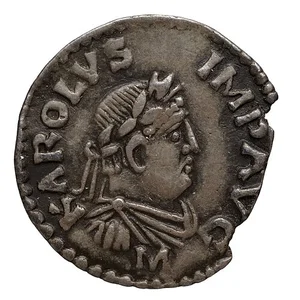
Silver coin minted under Charlemagne bearing his monogram, standardized throughout the Empire to facilitate commercial exchange.
School Curriculum
Vocabulary & Tags
Key Vocabulary
Daily Life
Morning
Charlemagne rose early and attended morning Mass in his palatine chapel. He would then receive his advisors and missi dominici to handle urgent affairs of the Empire. Einhard reports that he dressed during these audiences, combining his toilet with political business.
Afternoon
The afternoon was devoted to public audiences, judgments, and the reception of foreign embassies. Charlemagne also enjoyed hunting, the noble pursuit par excellence, which he practiced in the game-rich forests surrounding Aachen. He regularly visited the thermal baths, of which he was very fond.
Evening
In the evening, Charlemagne presided over a banquet where roasted meats were served alongside historical recitations or readings. He had the works of Saint Augustine read aloud, particularly The City of God. Before sleeping, he practiced writing on his tablets, striving to improve a skill he had acquired late in life.
Food
Charlemagne was fond of roasted meats, particularly game brought back from the hunt. Einhard notes that he ate in moderation but detested the fasts imposed by his physicians. He drank wine diluted with water and consumed bread, cheeses, and fruits from his estates.
Clothing
In ordinary times, Charlemagne wore the traditional Frankish costume: a linen tunic, a doublet fastened with a belt, breeches, and leg wrappings. He wore a cloak of otter or marten fur in winter. He only donned Roman ceremonial attire reluctantly during formal occasions.
Housing
The palace of Aachen was the center of Carolingian power, comprising a large reception hall (the aula regia), the octagonal palatine chapel, and thermal baths fed by hot springs. The complex drew inspiration from late Roman and Byzantine architecture, with marble columns brought from Italy.
Historical Timeline
Period Vocabulary
Visual Style
Un style visuel inspiré des manuscrits enluminés carolingiens, mêlant or, pourpre et bleu profond, avec des éléments architecturaux romano-byzantins et l'esthétique des arts précieux du Haut Moyen Âge.
Sound Ambience
L'ambiance sonore du palais d'Aix-la-Chapelle mêle chants grégoriens, bruits de la cour impériale et activités des scriptoria, reflétant la double dimension politique et culturelle du règne de Charlemagne.
Liens externes & ressources
Références
Œuvres
Admonitio generalis
789
Chapelle palatine d'Aix-la-Chapelle
790-805
Capitulare de villis
vers 800
Réforme de l'écriture : la minuscule caroline
vers 780-800
Capitulaire de Herstal
779
Organisation des missi dominici
802