Imaginary interview with Chrétien de Troyes
by Charactorium · Chrétien de Troyes (1135 — 1181) · Literature · 6 min read

It is in Troyes, on a winter evening when candles light the great hall of the court of Marie of Champagne, that we meet the master clerk. The vielle has fallen silent, the lords have returned to their lodgings. Chrétien, the parchment still stained with ink, agrees to look back on a life spent giving the knights of King Arthur a new language.
—Before singing of King Arthur, where did you learn your craft as a storyteller?
Before singing of Arthur, I studied with the Ancients. As a young clerk, I turned several books of Ovid into our language — the Art of Love and the Commandments — for that Latin master knew the heart's ruses better than anyone. These youthful works have been lost, alas, like the wax that is scraped from tablets to start anew. But they taught me that love is a matter that can be turned into art, into rules, into fine verses. Without the Latin learned at school, without Ovid or the old chronicles, I would never have known how to weave my romances. The clerk draws from ancient sources; he creates nothing from nothing, he decants and adorns, bringing to France what was once the honor of Rome.
—What did you mean by saying that learning passed from Greece to Rome and then to France?
In the prologue of Cligès, around 1176, I wrote what is closest to my heart: learning and chivalry first flourished in Greece, then passed to Rome, and now they have come to France. May it please God that they remain here! For it is a great honor for our kingdom to welcome what the Ancients possessed. My Cligès himself is half Greek by its matter, half Breton by its spirit, and entirely French by its language: I blend Constantinople and Arthur's court, the love of Cligès and Fenice. Thus the translator is not a mere copyist: he is the ferryman who carries the torch from one age to another, from one land to another.
The translator is not a copyist: he is the ferryman who carries the torch from one age to another.
—How did you come to compose Erec and Enide, said to be the first Arthurian romance in our language?
The tale of Erec was then passed from mouth to mouth, and each storyteller tore it apart as he pleased to earn his bread before the lords. I, a clerk of Troyes, wanted to draw from it a beautiful conjointure — to assemble the scattered limbs of the story into a body that stands firm. Around 1170, on parchment, I wove the love of Erec and Enide with the test of prowess, for a knight who falls asleep in his lady's arms forgets his duty. It is right that he to whom God has given knowledge and eloquence should not remain silent, but sow his learning. Thus was born, I believe, the first romance where the knights of King Arthur speak our Romance tongue, and no longer only the Latin of clerks.
—Why do you insist that your stories hide a meaning beneath the adventure?
The common folk think a story is merely a pastime for the evening. But beneath the bark of adventure always lies a senefiance, a meaning that the wise must dig out like the almond from its shell. At the court of Champagne, I carve my verses in octosyllables — eight syllables with rhyming couplets — for this short meter matches the horse's gallop as well as the thread of speech. The Matter of Britain, those Celtic tales of fairies and fountains, offers me the warp; but it is the conjointure, the art of arrangement, that makes the work. An ignorant storyteller tears and fragments his story for a few coins; the clerk, on the other hand, orders and gives meaning. That is why speaking well, in my eyes, is as demanding an art as fighting well before King Arthur.
—Do you remember the commission Marie of Champagne gave you for Lancelot?
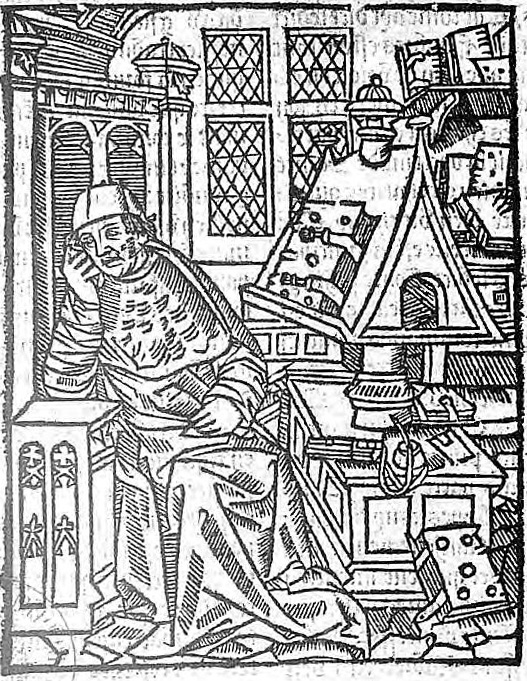
My lady Marie of Champagne, daughter of the great Eleanor, gave me the matter and meaning of this romance; I contributed only my labor and application. Such is the truth, and I stated it frankly in my prologue. She wanted us to sing of Lancelot's love for Queen Guinevere — a love so lofty that the knight mounts without shame the cart of infamy, which he should flee, so as not to lose the hour of finding his lady. At the court of Troyes, a lady's command is not disputed: one bows. So I took the reed pen, and I served as a clerk serves his lord, keeping silent about what I truly thought.
—Why did you let another finish that Knight of the Cart?
I will not hide from you that unease stayed my hand. That Queen Guinevere should give herself to Lancelot against the faith sworn to her husband King Arthur — this offended the churchman in me, for adultery is sin and the order of marriage is sacred. So I let another, Godefroi de Leigni, guide the Cart to its end — with my consent, he says, and following my indications. Perhaps. It is whispered that I had grown weary of a matter that did not suit me. A clerk may serve his lady without embracing all her fancies; there are stories one finishes by the hand of a companion, as one entrusts to another the end of a work one no longer has the heart to polish.
A clerk may serve his lady without embracing all her fancies.
—What made Troyes so conducive to your art?
Troyes is not an ordinary town. Twice a year, its fairs attract merchants from Flanders, Italy, and beyond the mountains, who bring cloth, spices, and with them news and tales of distant lands. At the court of Marie of Champagne, this crossroads becomes a nursery of clerks and poets. I hear talk of the Breton tales that Welsh storytellers have sown as far as here; I meet scholars who discourse on fin'amor and the Matter of Britain. Without this town of fairs and parchments, without the patronage of a lady fond of fine letters, my romances would have had neither matter nor audience. A work is always born of a place as much as of a man.
—What were the evenings like when your romances were discovered?
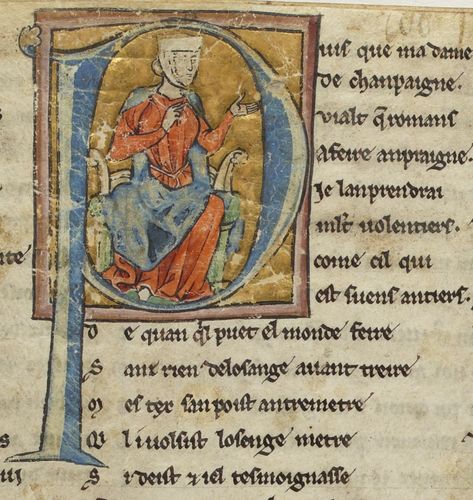
My romances are not made for the silence of the study, but for voice and ear. When the Champagne winter falls and night comes early, the candles are lit on the iron chandeliers, and the great hall fills with lords and ladies. A jongleur takes my Cart or my Yvain and recites it aloud, while a bowed vielle moans its strings at passages where the knight weeps or fights. I watch their faces: they laugh, hold their breath, are moved. That is my true reward, more than parchment stored in a chest. A romance lives only when carried by a voice, before an assembly that keeps vigil by the flickering light of flames.
—How do you explain praising Count Philip of Flanders so ardently?
I dedicated Perceval to Count Philip of Flanders, and I did not stint my praise: I said his charity surpasses that of all the great of this world, and that he is worth more than Alexander, whose virtues are so celebrated. Some may reproach me for the flattery of a clerk seeking his bread. But consider that a romancer without a lord is a bird without a branch: it was the count who gave me the book where, he said, this story of the Grail was written, and from his hand comes the matter. Fin'amor governs knights; the prince's largesse, on the other hand, feeds poets. Without Philip of Flanders, this tale of the Grail would never have left the silence of the Welsh forests.
—What does this Grail you introduced in Perceval, left unfinished, represent for you?
Perceval, my last romance, I did not finish — death, or some hindrance, stopped my pen along the way. But I sowed a seed that no one before me had planted: this Grail carried in procession in the castle of the Fisher King, this mystery that young Perceval, a naive Welshman raised far from the world, dares not question. Whence comes that radiance, whom does it serve? The fool stays silent, and his silence costs dearly. I left the question open, as one leaves a door ajar. Others, I suspect, will want to cross it and complete what I began. Let them do so: a tale of the Grail calls for its continuators as the quest calls for new knights.
I left the question open, as one leaves a door ajar.


This imaginary interview was generated by artificial intelligence from sources documented in Chrétien de Troyes's profile. It dramatises what the figure might have said based on what we know about them, but does not constitute attested historical testimony. For primary sources and factual documentation, refer to the full profile.