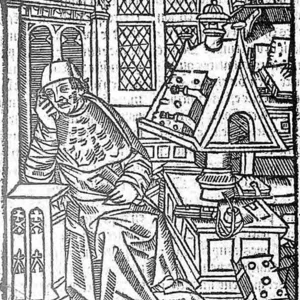

A French writer and poet of the 12th century, Chrétien de Troyes is the founder of the courtly romance. His major works such as Yvain, the Knight of the Lion and Lancelot, the Knight of the Cart established the conventions of medieval Arthurian literature.
Frequently asked questions
Key Facts
- Active as a writer between approximately 1170 and 1180
- Composition of Erec and Enide (c. 1170), the first major work of the French courtly romance
- Creation of Yvain, the Knight of the Lion (c. 1177–1181), exploring the conflict between love and chivalric duty
- Writing of Lancelot, the Knight of the Cart (c. 1177–1181), a masterpiece of the courtly romance
- Work at the court of Champagne, under the patronage of Countess Marie de Champagne
Works & Achievements
The first Arthurian romance in the French language, it tells how the knight Érec must reconcile conjugal love with chivalric prowess. This work establishes the genre of the courtly romance.
A romance blending classical and Arthurian influences, it narrates the love of Cligès and Fénice. Chrétien asserts the transfer of knowledge from Greece and Rome to France.
Commissioned by Marie de Champagne, this romance depicts Lancelot's absolute love for Queen Guinevere. It establishes the model of the courtly lover ready to sacrifice everything for his lady.
An account of Yvain's adventures in which, accompanied by a faithful lion, he must win back the love of his lady Laudine after breaking his word. It is one of the most widely studied romances in middle-school curricula.
Chrétien's last romance, left unfinished, it introduces the theme of the Grail into literature. The coming-of-age journey of young Perceval, from naïve Welshman to knight, has inspired centuries of retellings.
A hagiographic romance attributed to Chrétien, recounting the trials of a king separated from his family. Its attribution remains debated among medievalists.
Anecdotes
The very name of Chrétien de Troyes indicates his connection to the city of Troyes, in Champagne. He most likely lived and worked at the court of Marie de Champagne, daughter of Eleanor of Aquitaine, who is believed to have commissioned him to write Lancelot, or the Knight of the Cart.
Chrétien de Troyes left his last romance, Perceval, or the Story of the Grail, unfinished. This work introduces the theme of the Grail into Western literature for the first time, a motif that would fascinate generations of writers after him and give rise to numerous continuations by other authors.
In the prologue to Cligès, Chrétien claims to have translated or adapted several works by Ovid, including The Commandments of Ovid and The Art of Love. These early works, now mostly lost, demonstrate his scholarly formation and his thorough knowledge of Latin literature.
Chrétien de Troyes reportedly entrusted another poet, Godefroi de Leigni, with the task of completing Lancelot, or the Knight of the Cart. Some medievalists believe he was at odds with the subject imposed by Marie de Champagne — that of the adulterous love between Lancelot and Queen Guinevere.
Primary Sources
Chrétien de Troyes claims to draw his tale from an adventure story that he intends to put into fine arrangement, for it is right that one who has the knowledge and ability to speak well should not remain silent.
Chrétien declares that his lady of Champagne provided him with the matter and meaning of this romance, and that he himself contributes only his effort and care.
Chrétien dedicates his work to Count Philip of Flanders, whom he compares favourably to Alexander the Great, asserting that the count's charity surpasses that of all the great men of this world.
Chrétien lists his earlier works, mentioning Érec et Énide as well as adaptations of Ovid, and proclaims that chivalry and learning, once found in Greece and then in Rome, have now come to France.
Key Places
Chrétien's presumed birthplace and seat of the court of Marie de Champagne, where he composed most of his works. It was at the time a major cultural and commercial center, renowned for its famous trade fairs.
Chrétien dedicated his last romance, Perceval, to Count Philip of Flanders, suggesting that he spent time at or maintained close ties with this northern court.
The legendary forest of Brittany that appears in Yvain, the Knight of the Lion, most notably with the enchanted fountain of Barenton. It lies at the heart of the Arthurian imagination staged by Chrétien.
The Cathedral of Saints Peter and Paul, under construction during Chrétien's lifetime, bears witness to the religious and artistic vitality of Troyes in the 12th century.
A Champagne fair town near Troyes, where merchants and scholars crossed paths. This cultural crossroads contributed to the circulation of stories and legends that fed Chrétien's work.
Typical Objects

Writing material made from treated animal skin on which Chrétien composed his octosyllabic verse romances. Parchment was expensive and reserved for works intended to endure.

Writing instruments used by learned clerks of the 12th century. The brown ink was made from oak galls, iron sulfate, and gum arabic.

A bowed string instrument that accompanied the recitation of verse romances in seigneurial courts. Jongleurs used it to punctuate the dramatic passages of the narratives.

Portable wooden supports coated with wax on which one could write and erase easily. They served as drafts for sketching out verses before their fair copy was made on parchment.

An indispensable object for literary evening gatherings at the court of Champagne. Candlelight enabled readings aloud during the long winter evenings.

A shield bearing a knight's coat of arms, omnipresent in Chrétien's romances. The description of arms and combat constitutes a central element of his narratives.
School Curriculum
Vocabulary & Tags
Key Vocabulary
Daily Life
Morning
Chrétien, as a learned clerk attached to the court of Champagne, likely began his day with the prime office in the chapel of the comital palace. He could then devote himself to reading Latin manuscripts, particularly the works of Ovid or Arthurian chronicles, which fed his inspiration. The morning was also the ideal time for composition, with a fresh mind and natural light conducive to writing.
Afternoon
The afternoon might be spent exchanging ideas with other scholars and clerks at court, discussing the Matter of Britain or questions of fin'amor. Chrétien may have attended the audiences of Marie de Champagne, where political matters and courtly debates were settled. He could also supervise the copying of his works by scribes.
Evening
Evenings at court were the prime time for literary recitation. Chrétien or a jongleur would read aloud passages from his romances before an assembly of nobles. These candlelit gatherings were accompanied by music and conversations about the merits of the knights and ladies evoked in the tales.
Food
At the table of a 12th-century seigneurial court, Chrétien enjoyed a relatively rich diet: wheaten bread, roasted meats (poultry, game, pork), fish on lean days, and vegetables such as broad beans and cabbages. Champagne wine, still non-sparkling at the time, accompanied meals. Spices imported from the East, such as pepper and cinnamon, seasoned the dishes of aristocratic tables.
Clothing
As a learned clerk, Chrétien most likely wore a long fine wool robe, belted at the waist, with a surcoat over it. A fur-lined cloak protected him from the Champagne cold. His attire was distinguished from that of knights by the absence of military elements, yet reflected his privileged status at court.
Housing
Chrétien probably resided within the comital palace of Troyes or in an adjacent dwelling reserved for clerks and members of the court household. The rooms were heated by large fireplaces, the walls hung with tapestries to retain warmth. The furnishings consisted of chests, benches, and writing desks.
Historical Timeline
Period Vocabulary
Visual Style
Style inspiré des enluminures romanes du XIIe siècle, avec des tons de pierres précieuses sur parchemin, des lettrines ornées de motifs végétaux et des figures stylisées aux proportions allongées typiques de l'art médiéval.
Sound Ambience
Ambiance d'une grande salle seigneuriale à la cour de Champagne au XIIe siècle, où un récitant déclame des vers de roman courtois accompagné d'une vielle, devant un auditoire aristocratique attentif.
Liens externes & ressources
Références
Œuvres
Érec et Énide
vers 1170
Lancelot ou le Chevalier de la Charrette
vers 1177-1181
Yvain ou le Chevalier au Lion
vers 1177-1181
Perceval ou le Conte du Graal
vers 1181
Guillaume d'Angleterre
vers 1170 (attribution discutée)