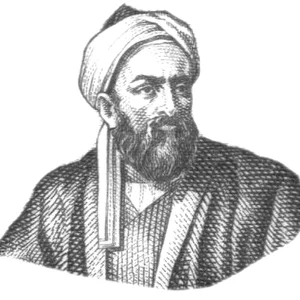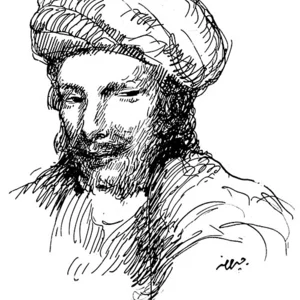

Arab-Persian poet born around 756, considered one of the greatest Arabic-language poets of the Abbasid era. He lived at the Baghdad court under caliphs Harun al-Rashid and Al-Amin, celebrating wine, love, and nature with provocative freedom.
Frequently asked questions
Famous Quotes
« Accumulate sins, then ask for forgiveness — you will find a Lord who forgives and is merciful.»
Key Facts
- Born around 756 in Persia (present-day Iran or Iraq), to an Arab father and a Persian mother
- Developed his literary education in Basra and Kufa, intellectual centers of the Islamic world
- Became court poet to Caliph Harun al-Rashid in Baghdad
- Famous for his khamriyyat (wine poems) and romantic ghazals
- Died around 814 in Baghdad; featured in One Thousand and One Nights
Works & Achievements
A collection of more than 400 poems celebrating wine, considered the absolute masterpiece of Abû Nuwâs. These poems revolutionized Arabic poetry by making the tavern and intoxication a major literary theme.
A set of lyrical love poems of great formal and thematic freedom, celebrating human beauty with a boldness that scandalized the moral guardians of the time.
Poems of praise composed for the caliphs Harun al-Rashid and al-Amin, as well as for high-ranking dignitaries. These pieces demonstrate Abû Nuwâs's talent for wielding flattery while sometimes slipping in subtle irony.
Abû Nuwâs renewed the genre of hunting poems by introducing a keen sense of observation of nature and animals, breaking away from traditional Bedouin conventions.
Poems of repentance and piety composed toward the end of his life, representing a striking counterpoint to his bacchic works and fueling debate about the sincerity of his late-life conversion.
Anecdotes
Abû Nuwâs was so famous for his wine poems that he was imprisoned several times by order of the caliphs, including Harun al-Rashid himself. Yet that same caliph would regularly have him released, for he valued his poetic genius too much to do without his company at the court of Baghdad.
The poet is said to have once composed a poem in honor of a Christian wine merchant who offered him his finest amphoras. This gesture captures the spirit of Baghdad in the Abbasid era: a cosmopolitan city where Muslims, Christians, and Jews lived side by side and sometimes shared the same taverns.
Abû Nuwâs is one of the rare classical Arabic poets to have found his way into One Thousand and One Nights. He appears there as the mischievous court jester of Caliph Harun al-Rashid, playing tricks and always talking his way out of trouble through his quick wit and improvised verses.
Born to an Arab father and a Persian mother, Abû Nuwâs was equally at home in both cultures. He drew on the Persian poetic tradition of wine and love to profoundly reshape classical Arabic poetry, introducing themes and imagery that scandalized the purists of his day.
Toward the end of his life, it is said that Abû Nuwâs repented of his excesses and composed poems of sincere religious devotion. This late conversion — whether real or legendary — long fueled debate among scholars about the true nature of the man.
Primary Sources
Pour me wine and tell me plainly it is wine; do not veil it in allegory. The wine of the beloved's cheeks and the wine of the cup are two wines, but the wine of the cup is the nobler of the two.
It is reported that Abû Nuwâs recited before Caliph Harun al-Rashid a poem so daring that the caliph ordered his imprisonment, only to have him released the next day, unable to resist the poet's extraordinary talent.
Abû Nuwâs appeared before the Commander of the Faithful and improvised verses that set the entire court laughing, whereupon the caliph presented him with a purse of gold and forgave him all his past misdeeds.
Abû Nuwâs al-Hasan ibn Hânî al-Hakamî was a native of Ahvaz. He was the most gifted poet of his age in the composition of wine poetry and erotic verse, and none could rival him in that art.
Key Places
Capital of the Abbasid Caliphate and heart of the medieval Islamic world, Baghdad is the city where Abu Nuwas spent most of his life and composed the majority of his poems at the caliphs' court.
A city in the Khuzestan province of Persia, the likely birthplace of Abu Nuwas around 756. The Arab-Persian dual culture he absorbed from childhood is at the root of his innovative poetic style.
A major city in southern Iraq where Abu Nuwas pursued his studies and received his literary training under great masters of classical Arabic poetry, before joining the court in Baghdad.
Another important Iraqi intellectual center frequented by Abu Nuwas during his education. Kufa was renowned for its philological and grammatical school, which profoundly influenced the young poet's formation.
Abu Nuwas visited Egypt on several occasions and composed celebrated poems there. These journeys inspired descriptions of the Nile Valley and enriched his work with new imagery.
Liens externes & ressources
Références
Œuvres
Dîwân — Khamriyyât (Poèmes bachiques)
fin VIIIe – début IXe siècle
Dîwân — Ghazaliyyât (Poèmes d'amour)
fin VIIIe – début IXe siècle
Dîwân — Madîh (Poèmes panégyriques)
fin VIIIe – début IXe siècle
Dîwân — Tardiyyât (Poèmes de chasse)
fin VIIIe – début IXe siècle
Dîwân — Zuhdiyyât (Poèmes de dévotion)
début IXe siècle