Imaginary interview with Ci'an
by Charactorium · Ci'an (1837 — 1881) · Politics · 6 min read
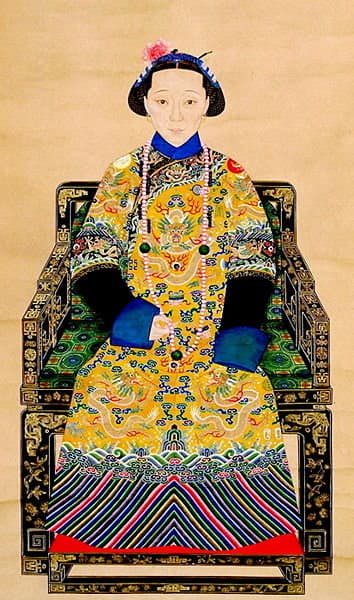
Late 1880, in the Zhongcui Palace of the Forbidden City. Behind a yellow silk curtain, a forty-three-year-old woman receives her visitor — a rare occurrence, for the Empress Dowager of the East never shows her face to outsiders. An amber rosary slips through her fingers as the first snow of Beijing falls outside; she has agreed, for once, to speak with her voice uncovered.
—Do you remember the night the eight regents were overthrown?
In the autumn of 1861, the air still carried the smoke of the Summer Palace, which the Barbarians had burned a year earlier. My husband had just passed away at Chengde, and eight ministers already thought themselves masters of the empire in the name of a child. We waited for the funeral procession to act: on the road bringing the coffin back to the capital, together with Prince Gong and my co-regent, we had those men arrested who had betrayed the will of the deceased sovereign. I had no taste for cunning, but to abandon the throne to usurpers would have been a graver fault than cunning itself. They called it the revolt of the year Xinyou. I lived it as a duty owed to my husband's memory.
To abandon the throne to usurpers would have been a graver fault than cunning itself.
—How was power divided among you, Ci Xi, and Prince Gong in the days that followed?
A decree was promulgated in the name of the young Tongzhi: the eight regents had betrayed imperial trust, they would be judged, and the regency would revert to the two empresses dowager. Prince Gong received charge of foreign legations and the Grand Council, for a man was needed to deal with the Western powers. Ci Xi had a quick mind and a ready tongue; I held the rank and the memory of the laws handed down by the ancestors. They called us rivals: we were first accomplices. This division was written nowhere; it rested on a fragile balance of seals and precedence. Each of us held a seal without which no edict could be stamped — it was there, far more than in speeches, that the real government of the empire resided.
—What really happened in 1869 with the eunuch An Dehai?
An Dehai was the favorite of my co-regent, a taijian swollen with his own importance. A law of our ancestors forbade eunuchs from leaving the capital without imperial authorization — a law two centuries old, made precisely so that none of them could become too powerful. He broke it openly, parading outside Beijing like a prince. I seized the opportunity. I ordered his arrest, then his execution, before Ci Xi could even intercede. It was not cruelty: a eunuch who believes himself above dynastic rules is a breach in the wall that protects the throne. They called me gentle in 1869; I wanted them to know that gentleness is not weakness.
They called me gentle; I wanted them to know that gentleness is not weakness.
—Why were you so insistent on distinguishing gentleness from weakness?
Because a woman who governs behind a curtain is always suspected of being a shadow, a silk ornament. The Confucian officials esteemed me for my piety and for the alms I had distributed to the poor of Beijing during the great festivals; they saw in me imperial virtue made female. But a virtue that does not know how to punish is only a facade. Before the tablets of my husband Xianfeng, each morning, I reminded myself that I reigned not in my own name, but in the name of the dead, and the dead had left laws. To enforce them, even against my own co-regent's favorite, was not harshness: it was fidelity. Gentleness chooses its moments; it never abdicates duty.
—How did one actually govern from behind a silk curtain?
The system had a name: chuilian tingzheng, governing behind the curtain. A yellow silk screen separated us from the ministers, for propriety forbade them from seeing an empress's face. They knelt, presented their memorials aloud, and from the other side of the veil we rendered our decisions according to the laws of the ancestors. It seemed a constraint; it was a freedom. No one could read hesitation or anger on my features. My word alone counted, and the jade seal that sealed it — without its imprint, no edict existed, and a piece of stone decided the fate of provinces. I spent fourteen years in that golden twilight of the Forbidden City, listening to the empire speak to me through a cloth.
I spent fourteen years in that golden twilight, listening to the empire speak to me through a cloth.
—What did you do with the memorials that arrived every day?
The zouzhe arrived folded like an accordion, written on special paper, carrying the voice of governors stationed at the empire's borders. In the afternoon, behind the curtain, they were read to us: a flood in the South, an appointment to confirm, a foreign legation demanding its due. We had to annotate, approve, or refer the matter to the Grand Council and Prince Gong. The annals — the Qing Shilu — record that we decided according to the rules handed down by the ancestors; that is true, but they omit the weight of a single signature when millions of lives depend on it. In 1876, when famine ravaged the North, I understood that our annotations, traced in the calm of a palace, sometimes meant bread or death for entire villages.
—You rose well before dawn. What did those hours of prayer mean to you?
I rose before dawn, when the Forbidden City still slept in the cold. In a small meditation hall of my Zhongcui Palace, I told my rosary — one hundred and eight beads of jade and amber — reciting the Buddha's prayers before the first eunuch brought tea. Those hours were not an escape from government: they were its foundation. How can one decide the fate of men without first silencing anger and pride within oneself? My co-regent loved opera, finery, splendor; I found in the silence of those beads a clarity that no memorial offered me. They may have mocked my devotion. It was my way of staying upright in a palace where everything invites cunning.
How can one decide the fate of men without first silencing anger and pride within oneself?
—You are constantly contrasted with Ci Xi. How did you experience this difference?
They painted us as day and night: she ambitious and worldly, I retiring and pious. It is too convenient a portrait. It is true that during the great religious festivals I had alms distributed to the poor of Beijing, and on fast days I abstained from all meat — my imperial household then served the vegetarian dishes my faith commanded, while ordinary tables groaned under lacquered duck and bird's nests. But I was no saint, and Ci Xi was no demon. We were two women thrown together into a power that no one had taught us to bear. My piety was not a reproach to hers: it was the framework that kept me standing, where she drew her strength from elsewhere.
—It is whispered that Emperor Xianfeng entrusted you with a secret decree. What is the truth of it?
It is said, yes — I will neither confirm nor deny. Tradition has it that my husband Xianfeng, shortly before his death at Chengde, gave me a decree authorizing me to punish my co-regent if she ever disobeyed the imperial laws. Suppose that paper existed. It would not have been a weapon, but a dyke: a silent guarantee, kept folded, never brandished. Power that is shown is already half lost; power kept in reserve weighs more. And if one day I consigned that decree to the flames, as some whisper, it was out of preference for harmony over confrontation. Between two women condemned to reign together, trust offered was better than a threat kept. That, at least, is what a wise empress would do.
Power that is shown is already half lost; power kept in reserve weighs more.
—Do you feel you are the only one who can still stand up to Ci Xi?
Perhaps. The courtiers whisper it: as long as I sit behind this curtain, the empire has two voices, and one can temper the other. That makes me an obstacle for anyone who dreams of ruling alone. I do not complain; I know the fragility of the powerful. They are already preparing my mausoleum in the Eastern Tombs, at Zunhua, as they prepare every empress's — a reminder that even the regency has a term. If tomorrow I were to die without warning, I who am healthy, tongues would wag, and poisons would be sought where there is perhaps only mortal fate. I prefer not to think of it. I prefer my amber beads and the duty of the day. An empire is not governed in fear of its own end.

This imaginary interview was generated by artificial intelligence from sources documented in Ci'an's profile. It dramatises what the figure might have said based on what we know about them, but does not constitute attested historical testimony. For primary sources and factual documentation, refer to the full profile.