Kids interview Ci'an
by Charactorium · Ci'an (1837 — 1881) · Politics · 5 min read
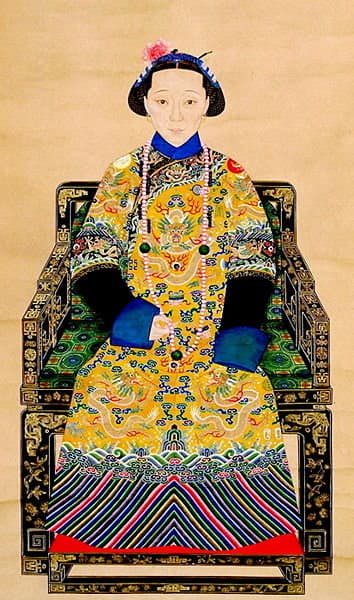
That morning, two twelve-year-old visitors stepped through a red gate of the Forbidden City. Before them, seated near a yellow silk curtain, an empress with a gentle smile awaited them. Her name was Ci'an, and she had agreed to tell them everything.
—How did you become the one ruling China? Were you a queen?
You see, my child, everything changed one autumn night in November 1861. My husband, the Xianfeng Emperor, had just died in the summer palace at Chengde, far from Beijing. Before leaving, he had chosen eight ministers to govern in his place. But these men were dangerous, greedy for power. So, with the other empress, Ci Xi, and a brave prince, we had them arrested. Imagine two women who, in one night, overthrew eight powerful men! It was called the Xinyou Coup. That day, I wasn't seeking a throne. I just wanted to protect the empire of children.
In one night, two women overthrew eight powerful men.
—What was your daily routine like? What time did you get up?
I rose before the sun, my child. Always. The court lived by very strict rules, minute by minute. In the morning, I prayed, then paid homage to the ancestors. In the afternoon, the serious work began. Imagine a great silent hall: the ministers enter, but they cannot see me. A yellow silk curtain separates us. It was called "ruling behind the curtain." A woman was not to show herself to the court men, you understand. So I listened to their reports, hidden, and I decided. In the evening, I rested a little while watching Peking opera.
The ministers obeyed me without ever seeing my face.
—But if no one saw you, how did they know it was really you making the decisions?
Ah, very good question! That's where a magical object comes in. I possessed a great imperial seal made of jade. You see, in my time, no law, no order mattered without a red mark from it. Officials sent me reports folded like accordions, on fine paper: they were called memorials. Every morning, I read them one by one. Then I wrote my replies. And without my seal placed on the document, nothing happened, absolutely nothing. Imagine a unique key that opens the doors of an entire empire. That key was my seal. It fit in my hand.
Without my jade seal, no order truly existed.
—They say you were very kind and very devout. Was that true?
It's true, my child. Every morning, even before state affairs, I prayed. I had a Buddhist rosary, a fó zhū, made of one hundred and eight jade beads. I would slide it between my fingers, bead by bead, in the quiet. It calmed me. On great feast days, I had food distributed to the poor of Beijing. You know, the other empress, Ci Xi, loved festivities and beautiful things. I preferred silence and prayer. The old wise men of the court respected me for that. They saw in me an upright woman, who did not cheat.
One hundred and eight jade beads, one by one, to find calm.
—What did you eat at court? Was it lots of dishes?
Oh, you can't imagine! Dozens of dishes were served to me at every meal. Bird's nest soups, crispy Peking duck... A true feast, prepared by a whole kitchen of imperial officers. But because of my Buddhist faith, I greatly enjoyed vegetable dishes, without meat. And on certain holy days, I ate no flesh, not a bite. That was my fast. Imagine: around me, tables covered with sumptuous dishes, and I choosing a simple bowl of vegetables. For me, true wealth was not on the plate. It was in the heart.
Before dozens of dishes, I chose a bowl of vegetables.
—Did you ever punish someone powerful? That must have been scary, right?
Yes, once, and it marked the whole court. In 1869, there was a very powerful eunuch, An Dehai. Eunuchs are men who served only within the palace. An ancient rule forbade them from leaving Beijing without permission. Now, An Dehai was Ci Xi's favorite, and he disobeyed: he went on a journey, full of pride. I applied the law. I ordered his execution. Ci Xi could do nothing. You understand, my child: even the protégé of the most powerful cannot place himself above the rules.
Even an empress's favorite is not above the law.
—But everyone thought you were gentle! How did you dare do that?
That's just it, my child. They thought I was too kind to be strong. Many believed I was just a figurehead, a pretty portrait hung on the wall. But gentleness is not weakness. When An Dehai violated the sacred rules of the dynasty, I did not tremble. I acted quickly and firmly. Imagine calm water: it looks peaceful, but underneath, the current is powerful. I was like that. Gentle face, steady hand. That day, everyone understood that behind my smile, there was real authority.
Gentleness is not weakness.
—And with the other empress, Ci Xi, were you friends or rivals?
It's complicated, my child. We were the two widows of the same emperor, both empresses dowager. To overthrow the eight regents in 1861, we were united like sisters, with the help of Prince Gong. That was one of our rare moments of true harmony. Then, for years, we ruled side by side, behind the same curtain. But our hearts were different. She loved power and splendor. I preferred harmony and prayer. Imagine two travelers in the same boat, rowing together, but dreaming of different shores. That was us.
Two travelers in the same boat, dreaming of different shores.
—They say you had a secret paper to punish Ci Xi. Is that true?
Ah, that story... Some at court said that my husband, before dying, had entrusted me with a secret order. A document that authorized me to punish Ci Xi if she disobeyed the laws. Like a silent guarantee, you see, a hidden protection up my sleeve. They say I kept it for a long time, never using it. Then, one day, I supposedly burned it. Imagine: I watch the paper turn to ashes, and I choose peace over threat. I always preferred harmony to war. A heart at peace is worth more than a hidden weapon.
A heart at peace is worth more than a hidden weapon.
—And in the end, what happened to you? Were you sick?
No, my child, and that is precisely what troubled everyone. On April 8, 1881, I died suddenly. I was forty-four years old, and just days before, I seemed in perfect health. The court was stunned. Even the great customs inspector, a foreigner named Robert Hart, wrote that my death had surprised all of Beijing. So, inevitably, rumors arose: poison? Ci Xi? Nothing was ever proven. What you should remember is not my mysterious end. It is that a woman reputed to be gentle knew, for twenty years, how to hold an entire empire steady.
A woman reputed to be gentle held an entire empire steady.



This imaginary interview was generated by artificial intelligence from sources documented in Ci'an's profile. It dramatises what the figure might have said based on what we know about them, but does not constitute attested historical testimony. For primary sources and factual documentation, refer to the full profile.