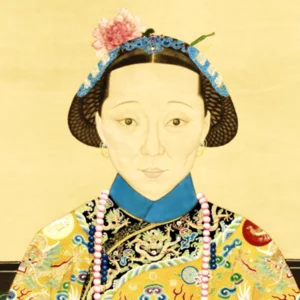

Empress dowager of China under the Qing dynasty, Ci'an exercised a joint regency with Ci Xi following the death of Emperor Xianfeng in 1861. Known for her piety and gentleness, she was long overshadowed by the more ambitious Ci Xi in historical accounts.
Frequently asked questions
Key Facts
- Born in 1837, she became consort empress of Emperor Xianfeng
- In 1861, after the death of Xianfeng, she became co-regent alongside Ci Xi for the young Emperor Tongzhi
- She took part in the Xinyou Coup (1861), which removed the conservative regents from power
- Unlike Ci Xi, she remained largely non-interventionist in day-to-day political affairs
- She died in 1881 under circumstances that remain unclear, leaving Ci Xi as the sole ruler
Works & Achievements
Together with Cixi and Prince Gong, Ci'an overthrew the eight regents appointed by Emperor Xianfeng, establishing the dual regency that would govern China for two decades. This political act was one of the most decisive in the late history of the Qing dynasty.
For fourteen years, Ci'an took an active role in governing the empire — presiding over audiences, approving the appointments of senior officials, and contributing to foreign policy decisions as pressure from Western powers continued to grow.
By ordering the execution of the powerful eunuch before Cixi could intervene, Ci'an made clear that dynastic rules took precedence over personal favoritism. The act preserved the integrity of court institutions and proved she was far more than a figurehead.
After the premature death of Tongzhi, Ci'an helped designate the young Guangxu as his successor and resumed the regency alongside Cixi. This period saw China face fresh diplomatic crises and the first stirrings of internal pressure for reform.
Anecdotes
In 1869, the eunuch An Dehai, a favorite of Empress Dowager Cixi, illegally left Beijing on a personal errand, violating the centuries-old prohibition against court eunuchs leaving the capital without imperial authorization. Ci'an seized the opportunity to assert her authority: she had An Dehai arrested and ordered his immediate execution before Cixi could intervene. This act reveals that Ci'an, despite her reputation for gentleness, knew how to wield power with firmness when dynastic rules were at stake.
According to a tradition recorded by court sources, Emperor Xianfeng reportedly gave Ci'an, shortly before his death in 1861, a secret decree authorizing her to execute Cixi should the latter disobey imperial law. Ci'an is said to have kept this document for years as a silent safeguard, before eventually burning it in a symbolic gesture — one that illustrates her preference for harmony over direct confrontation.
On April 8, 1881, the court was stunned to learn of Ci'an's sudden death. Just days earlier she had appeared to be in perfect health. Her abrupt passing at the age of forty-four immediately fueled rumors of poisoning, with some courtiers suspecting Cixi of having moved to eliminate the only woman capable of challenging her. No formal proof, however, was ever established.
During the coup of 1861, known as the “Xinyou Coup,” Ci'an and Cixi acted in concert with Prince Gong to overthrow the eight regents appointed by Emperor Xianfeng on his deathbed. This was one of the rare moments when the two empress dowagers were fully united: they had the regents arrested and jointly assumed the regency in the name of the young Emperor Tongzhi.
Unlike Cixi, who was reputed to be ambitious and worldly, Ci'an was deeply devout. She devoted a significant part of each day to Buddhist prayer and had alms distributed to the poor of Beijing during major religious festivals. This piety earned her the lasting respect of Confucian officials, who saw in her the embodiment of imperial virtue.
Primary Sources
The two Empress Dowagers, seated behind the curtain, received memorials from ministers and issued decisions in accordance with the rules established by the imperial ancestors.
The eight regent ministers have betrayed imperial trust and acted contrary to the wishes of the late sovereign. Let them be arrested and judged. The regency is henceforth entrusted to the two Empress Dowagers.
The death of the Eastern Empress Dowager surprised everyone in Peking. She had shown no signs of serious illness in the preceding days. Her passing leaves the Western Empress Dowager as the sole mistress of the regency.
The two Empress Dowagers, after deliberation with the princes of the blood, designated Zaitian, son of Prince Chun, to ascend the throne under the reign name Guangxu, in accordance with dynastic laws.
Key Places
Ci'an's official residence throughout her life at court, where she occupied the Zhongcui Palace (钟粹宫). It was from the Forbidden City that she exercised her co-regency, receiving ministers behind a silk screen as they presented their memorials.
It was at this imperial summer residence that Emperor Xianfeng died in 1861, triggering the succession crisis. The coup d'état that would transform the governance of China was plotted and partly carried out from this palace.
Ci'an was interred in this great funerary complex in Hebei, in the Pu Xiang Yu mausoleum (普祥峪定东陵). Her tomb, richly decorated, was unfortunately looted by soldiers in the early twentieth century.
A leisure retreat of the imperial court that Ci'an frequented alongside Cixi, particularly after its partial reconstruction in the 1870s. The two empresses occasionally held audiences there in a less formal setting than the Forbidden City.
Typical Objects

Made up of 108 jade or amber beads, the rosary was Ci'an's daily devotional object. She used it during her morning prayers and religious ceremonies within the Forbidden City, a testament to her sincere Buddhist piety.

As co-regent empress dowager, Ci'an held one of the jade imperial seals used to authenticate official decrees. No government edict could be issued without this seal's impression, a tangible symbol of her participation in supreme power.

Yellow being reserved for the imperial family, Ci'an traveled within the Forbidden City's enclosure in a yellow silk palanquin carried by eunuchs. This ritualized conveyance embodied her exceptional standing within the court hierarchy.

Ci'an's court robe, embroidered with five-clawed dragons and phoenixes in gold thread on yellow silk, was worn during major official audiences. Her headdress, adorned with pearls and jade, signified her supreme rank in the imperial hierarchy.

These accordion-folded reports, written on special paper by senior officials, were Ci'an's primary tool of government. Each morning she received them, read them, and had to add her annotations or forward them to the Grand Council.

Ci'an regularly venerated the tablets of deceased Qing emperors, notably that of her husband Xianfeng, as part of the Confucian rites of filial piety that structured the religious and political life of the imperial court.
School Curriculum
Vocabulary & Tags
Key Vocabulary
Daily Life
Morning
Ci'an rose before dawn, in keeping with the imperial protocol that imposed a life governed by strict rituals. She began her day with Buddhist prayers, running her fingers along her rosary beads in a private meditation room, before attending ceremonies paying homage to the ancestors. She then took her first meal, served by dozens of eunuchs and ladies-in-waiting according to an unchanging ceremonial.
Afternoon
The afternoon was devoted to official audiences: Ci'an and Cixi received memorials from ministers and rendered their decisions seated behind a yellow silk curtain, the system known as the “regency behind the curtain.” Ci'an also supervised the education of the court’s young women and devoted herself to embroidery and calligraphy, arts in which imperial ladies excelled.
Evening
In the evening, the court retired according to a meticulously codified ritual. Ci'an could attend Peking opera performances, the favorite entertainment of the high Manchu aristocracy. She also received visits from ladies of rank in a tightly regulated setting of female sociability, before withdrawing for further Buddhist devotions and meditations.
Food
Ci'an’s imperial meal comprised several dozen different dishes, prepared by the cooks of the imperial kitchen according to Manchu and Chinese culinary traditions. She enjoyed bird’s nest soup, Peking duck, and, in keeping with her Buddhist practice, many vegetarian dishes. On religious fasting days, she strictly abstained from meat.
Clothing
Ci'an wore embroidered silk robes in colors defined by her rank: imperial yellow for grand ceremonies, blue for mourning rites. Her official headdress, adorned with pearls, kingfisher feathers, and jade, required the assistance of several ladies-in-waiting. For everyday wear, she preferred lighter silk garments adorned with phoenix motifs, the feminine imperial symbol.
Housing
Ci'an resided in the Zhongcui Palace (钟粹宫) in the northeastern part of the Forbidden City, a complex of inner courtyards, gardens, and private audience halls. Her apartments were decorated with Buddhist paintings, bronze incense burners, and jade art objects. In winter, the rooms were heated by an ingenious system of hot-air channels running beneath the stone flagstones.
Historical Timeline
Period Vocabulary
Liens externes & ressources
Références
Œuvres
Co-organisation du coup d'État de Xinyou
Novembre 1861
Co-régence de l'ère Tongzhi
1861–1875
Exécution d'An Dehai — affirmation de l'autorité impériale
1869
Co-régence de l'ère Guangxu
1875–1881