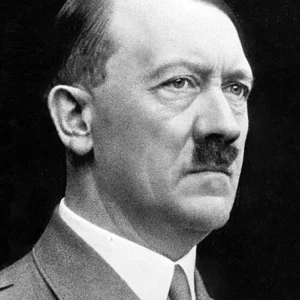

Adolf Hitler (1889-1945) was an Austrian politician and military leader who founded the National Socialist German Workers' Party (Nazi Party) and became dictator of Germany from 1933 to 1945. His totalitarian regime, built on Nazi ideology, was responsible for World War II and the Holocaust, a genocide that killed six million Jews.
Adolf Hitler(1889 — 1945)
Adolf Hitler
Autriche, Troisième Reich, Cisleithanie, Reich allemand
8 min read
Frequently asked questions
Key Facts
- 1933: Appointed Reich Chancellor by President Hindenburg, establishes the Nazi dictatorship
- 1935: Adoption of the Nuremberg Laws discriminating against Jews and other minorities
- 1939: Invasion of Poland, triggering the start of World War II
- 1941-1945: Implementation of the Final Solution, the genocide of European Jews
- 1945: Suicide on April 30, end of the Third Reich on May 8
Works & Achievements
Hitler's autobiography and political manifesto outlining his antisemitic, racist, and expansionist ideas. The book became the ideological foundation of the Nazi regime and was widely distributed throughout Germany.
A failed coup attempt to overthrow the Bavarian government and seize power in Germany. The event allowed Hitler to gain political notoriety despite his subsequent imprisonment.
Hitler became Reich Chancellor in 1933 and rapidly established a totalitarian dictatorship by suppressing civil liberties, dissolving political parties, and creating a political police force (the Gestapo). He concentrated all power in his own hands.
A set of racial laws discriminating against Jews and other minorities, stripping them of civil and political rights. These laws formed the legal framework for the systematic persecution of Jews in Germany.
The military and political incorporation of Austria into the German Reich, in violation of the provisions of the Treaty of Versailles. This action marked the beginning of Hitler's aggressive expansionism in Europe.
The invasion of Poland on September 1, 1939, which triggered World War II. This conquest initiated a series of military campaigns aimed at establishing German hegemony over Europe.
The systematic genocide of European Jews orchestrated by the Nazi regime, resulting in the deaths of approximately six million people in concentration and extermination camps. This atrocity represents the pinnacle of crimes against humanity.
The invasion of the Soviet Union launched on June 22, 1941, considered the largest military campaign of World War II. This massive confrontation changed the course of the war and marked the beginning of the Nazi regime's decline.
Anecdotes
As a young man, Hitler dreamed of becoming a painter. He attempted twice to gain admission to the Vienna Academy of Fine Arts, in 1907 and 1908, but was rejected each time. The jury felt his compositions lacked talent for the human figure. This double rejection left a deep mark on him, and he spent several years in poverty in Vienna, staying in homeless shelters.
During the First World War, Hitler served as a dispatch runner (message carrier) on the Western Front in the Bavarian Army. He was wounded twice and received the Iron Cross First Class in 1918, a rare decoration for a mere corporal. It was during this war that he developed his extreme nationalist convictions.
In November 1923, Hitler attempted a coup in Munich, known as the 'Beer Hall Putsch'. The coup failed miserably: police opened fire on the putschists, killing sixteen of them. Hitler was arrested, tried, and sentenced to five years in prison, but served only nine months. It was during his detention at Landsberg Prison that he dictated Mein Kampf.
On January 30, 1933, Hitler was appointed Chancellor of Germany by President Hindenburg, not through a forceful seizure of power, but through political maneuvering. Conservative politicians believed they could control him and use him for their own benefit. Within months, he dismantled German democracy, suppressed fundamental freedoms, and established a totalitarian dictatorship.
On July 20, 1944, Colonel Claus von Stauffenberg placed a bomb in a briefcase during a meeting at Hitler's headquarters in East Prussia. The explosion killed four people, but Hitler survived, shielded by the thick oak table in the conference room. This failed assassination attempt was followed by a fierce crackdown: nearly 5,000 people were executed.
Primary Sources
The National Socialist state must endeavor to eliminate the disproportion between our numerical importance and our territorial importance, that is to say, between our population and our territorial expanse.
Since five forty-five in the morning we have been returning fire, and from now on bombs will be met with bombs.
I have nothing else to wish for than to continue the struggle until my last breath.
The Führer is responsible for the leadership of the German people. All members of the people owe him absolute obedience.
Under proper guidance, the Jews should be transported to the East for the purpose of forced labor.
Key Places
Austrian city where Adolf Hitler was born on April 20, 1889. It is his hometown where he spent his childhood and adolescence before moving to Vienna.
Austrian capital where Hitler lived from 1908 to 1913, attempting unsuccessfully to become an artist. This period shaped the formation of his political and antisemitic ideas.
Bavarian city where Hitler settled in 1913 and where he participated in World War I. It is also the birthplace of the Nazi movement and the site of the failed putsch of 1923.
Capital of the German Reich where Hitler established the seat of the Nazi government after taking power in 1933. The political and administrative center of the totalitarian regime until 1945.
Hitler's private mountain residence in Bavaria, built in 1936. A place where he made major strategic decisions during World War II.
Fortified underground shelter in Berlin where Hitler took refuge during the advance of Allied troops in 1945. The place where he signed his last will and testament before committing suicide on April 30, 1945.
Typical Objects

Central symbol of the Nazi regime, adopted as the emblem of the National Socialist Party. It appeared on the German flag, uniforms, and official buildings of the Third Reich.

Command attire worn by Hitler during his public appearances, characterized by the khaki uniform bearing the Führer's insignia and the red swastika armband.

Essential tools of Hitler's major speeches before massive crowds. His radio broadcasts served as a primary instrument of Nazi regime propaganda.

Autobiography and political manifesto written by Hitler in prison in 1924, laying out his totalitarian ideology, virulent antisemitism, and expansionist ambitions.

Military medals and insignia of the Nazi regime, symbols of the Führer's authority and the totalitarian hierarchy of the Third Reich.

Cartographic representations showing the territories the Nazi regime sought to conquer in Eastern Europe, used to justify military expansion and aggression.

Rail cars used to transport prisoners to concentration and extermination camps. A material symbol of the Holocaust and the genocide perpetrated by the Nazi regime.

Fortified underground shelter where Hitler took refuge in 1945 during the collapse of the Third Reich, and the site of his death in May 1945.
School Curriculum
Vocabulary & Tags
Key Vocabulary
Tags
Concept
Daily Life
Morning
Hitler generally wakes up late, around 11 in the morning. He has a light breakfast of tea and pastries, often alone or with his close associates. He then reviews the overnight military and political reports.
Afternoon
The afternoon is devoted to meetings with his generals, ministers, and political advisors, particularly regarding military strategy and regime policies. Hitler often delivers lengthy monologues laying out his ideas, with his orders then relayed by his secretaries to the various government departments.
Evening
Evenings are spent studying military maps, watching films (of which he is very fond), or conversing in a small circle with his close associates and his companion Eva Braun. He generally dines late, around 7–8 PM, and goes to bed after midnight.
Food
Hitler follows a diet based on vegetables, fruit, and dairy products, being partially vegetarian out of personal conviction. He drinks little alcohol and does not smoke, occasionally having coffee and tea. His meals are served in a formal setting, even in wartime.
Clothing
Hitler habitually wears his grey-green Führer uniform with the insignia of his rank, particularly in public and at official meetings. In private, at his mountain residence in Berchtesgaden, he wears more relaxed but still formal clothing. He maintains an austere and neat appearance.
Housing
Hitler resides primarily at the Reich Chancellery in Berlin, in official apartments, and at the Berghof, his personal chalet in Bavaria in the Alps. These residences are fortified complexes with security staff, gardens, and integrated military facilities, reflecting his status as a wartime dictator.
Historical Timeline
Period Vocabulary
Visual Style
Un style visuel sombre inspiré de l'expressionnisme allemand des années 1930-1940, associant l'art de propagande de l'époque à une esthétique monumentale et austère. L'illustration privilégie les compositions angulaires, les contrastes dramatiques de lumière et les formes géométriques épurées, reflétant l'idéologie totalitaire du régime nazi.
Sound Ambience
Une ambiance sonore froide et oppressante des années 1930-1940, combinant bruits de propagande radiophonique, pas militaires, commandements autoritaires et sons industriels métalliques, évoquant le régime totalitaire et l'atmosphère austère du nazisme.
Liens externes & ressources
Références
Œuvres
Mein Kampf
1925-1926
Putsch de Munich
1923
Accession au pouvoir et formation du régime totalitaire
1933-1934
Lois de Nuremberg
1935
Annexion de l'Autriche (Anschluss)
1938
Conquête de la Pologne et début de la Seconde Guerre mondiale
1939
La Shoah
1941-1945