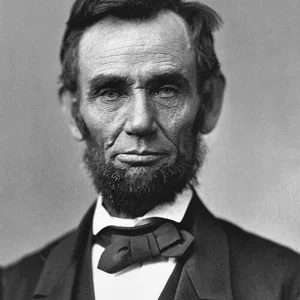

Abraham Lincoln (1809-1865) was the 16th President of the United States. He led the country through the Civil War and abolished slavery in the United States in 1863 with the Emancipation Proclamation.
Abraham Lincoln(1809 — 1865)
Abraham Lincoln
États-Unis
7 min read
Frequently asked questions
Famous Quotes
« A house divided against itself cannot stand.»
« All men are created equal.»
« Government of the people, by the people, for the people, shall not perish from the earth.»
Key Facts
- 1860: Elected President of the United States
- 1861-1865: Civil War between the Northern states (Union) and the Southern states (Confederacy)
- 1863: Emancipation Proclamation freeing enslaved people in Confederate states
- 1865: Ratification of the 13th Amendment abolishing slavery in the United States
- April 14, 1865: Assassination by John Wilkes Booth at Ford's Theatre
Works & Achievements
Presidential decree declaring free all slaves in the states in rebellion. It is the founding act of the abolition of slavery in the United States, transforming the Civil War into a struggle for freedom.
A 272-word speech delivered after the Battle of Gettysburg, reaffirming the principles of equality and democracy. This speech became one of the most important political texts in American history.
Constitutional amendment abolishing slavery throughout the entire American territory. Lincoln championed this amendment, which formally ended slavery following the Civil War.
Military and political command during the greatest American constitutional crisis. Lincoln preserved the Union in the face of Southern secession, consolidating federal authority.
Political plan to reintegrate the Southern states into the Union after the war. Lincoln's Reconstruction Plan advocated leniency toward the South, though it remained unfinished at his death.
Speech delivered after his re-election, calling for reconciliation and mutual forgiveness. It expresses a humanist vision of the country beyond the North-South divide.
Anecdotes
Abraham Lincoln was a self-taught lawyer who never attended formal school. Despite this lack of traditional education, he taught himself law by reading books and managed to become one of the most respected lawyers in Illinois before entering politics.
On November 19, 1863, Lincoln delivered the Gettysburg Address before soldiers and grieving families, a text of only 272 words that remains one of the most famous speeches in history. This speech redefined the Civil War as a struggle for freedom and equality, not merely for the preservation of the Union.
Lincoln likely suffered from chronic depression throughout his life, a condition he called 'the blues'. Despite his periods of deep melancholy, he continued to carry out his duties as president during the most severe crisis in American history.
On April 14, 1865, just 5 days after the official end of the Civil War, Abraham Lincoln was assassinated by John Wilkes Booth, a Confederate sympathizer and actor, while attending a play at Ford's Theatre. He died the following morning, depriving the nation of his leadership during Reconstruction.
Primary Sources
That all persons held as slaves within any State or designated part of a State the people whereof shall then be in rebellion against the United States, shall be then, thenceforward, and forever free.
Four score and seven years ago our fathers brought forth on this continent, a new nation, conceived in Liberty, and dedicated to the proposition that all men are created equal.
With malice toward none, with charity for all, with firmness in the right as God gives us to see the right, let us strive on to finish the work we are in.
My paramount object in this struggle is to save the Union. If I could save the Union without freeing any slave, I would do it; if I could save it by freeing all the slaves, I would do that.
Neither slavery nor involuntary servitude, except as a punishment for crime whereof the party shall have been duly convicted, shall exist within the United States, or any place subject to their jurisdiction.
Key Places
Abraham Lincoln's birthplace on February 12, 1809. It is in this small Kentucky town that Lincoln was born in a log cabin, a symbol of his humble origins.
The city where Lincoln settled in 1837 and practiced law before becoming a politician. It is also from here that he launched his 1860 presidential campaign.
The federal capital where Lincoln served as the 16th President from 1861 to 1865 during the Civil War and where he delivered the Gettysburg Address.
Site of the major battle of the Civil War in 1863. Lincoln delivered the Gettysburg Address here, one of the most important speeches in American history.
The theater where Abraham Lincoln was assassinated by John Wilkes Booth on April 14, 1865, ending his life and his presidency.
A commemorative monument built in honor of Abraham Lincoln after his death. It symbolizes his legacy and remains one of the most important monuments of the American nation.
Typical Objects

The black top hat was Abraham Lincoln's signature accessory, which he used to appear taller and more imposing. It was also a symbol of respectability and political authority in the 19th century.

An official document signed by Lincoln on January 1, 1863, declaring the abolition of slavery in the rebel states. It is the major symbol of his commitment to freedom and equality.

The primary means of communication in the 19th century, the telegraph allowed Lincoln to stay in contact with his generals during the Civil War and manage the war effort.

A typical weapon of the Civil War (1861–1865), the Minié rifle was used by soldiers on both sides of the conflict that Lincoln led.

A symbol of the nation's union that Lincoln fought to preserve during the Civil War, keeping the secessionist states within the federal union.

An iconic piece of furniture at the White House where Lincoln signed historic decrees and made the country's major decisions during the greatest crisis in its history.

A symbol of the chains of slavery that Lincoln broke through his emancipation policies, representing the oppression he strove to abolish.
School Curriculum
Vocabulary & Tags
Key Vocabulary
Tags
Daily Life
Morning
Abraham Lincoln rose early, generally before dawn. As president during the Civil War, he began his day by reviewing telegraph dispatches and reading military reports. He had a light breakfast before heading to his office at the White House.
Afternoon
Lincoln devoted his afternoons to meetings with his cabinet, his generals, and political delegations. He also received citizens in audience — a practice he maintained even during the war. These appointments could be exhausting, but Lincoln considered this access essential to democracy.
Evening
Lincoln's evenings were often occupied with administrative work, reading correspondence, and reflecting on military and political decisions. He retired late, tormented by the weight of the war. He found comfort in reading Shakespeare and spent time with his family, though his wife Mary Todd suffered from depression.
Food
Lincoln followed a simple and frugal diet, a legacy of his humble origins. He ate mainly bread, milk, eggs, and occasionally meat. His diet was plain and he paid little attention to his meals, often forgetting to eat during his busy days.
Clothing
Lincoln wore formal black suits — the three-piece style of the Victorian era — along with a tie and a top hat. His appearance was neat but austere, reflecting the gravity of his office. He was known for his lean frame and his characteristic black beard, which he had grown after his election.
Housing
Lincoln resided at the White House with his family during his presidency. The 19th-century presidential apartments were less luxurious than today, with inadequate heating and modest living conditions for an official residence. Lincoln used various offices: the Oval Office (then called the 'President's Office'), the waiting room, and his private apartments for work and family life.
Historical Timeline
Period Vocabulary
Visual Style
Un style réaliste du XIXe siècle mêlant techniques photographiques (inspirées de Mathew Brady) et peinture à l'huile, avec un éclairage dramatique en clair-obscur. L'atmosphère est solennelle et historique, évoquant la Guerre de Sécession et l'héritage politique américain.
Sound Ambience
Une ambiance sonore immersive de l'époque de la Guerre de Sécession, mêlant les bruits de guerre lointains, les sons d'un bureau présidentiel du XIXe siècle et l'atmosphère tendue d'une nation en crise.
Liens externes & ressources
Références
Œuvres
Proclamation d'émancipation
1863
Discours de Gettysburg
1863
Treizième Amendement de la Constitution
1865
Direction de la Guerre de Sécession
1861-1865
Réunification et Reconstruction
1863-1865
Discours d'investiture (Second)
1865