Imaginary interview with Ellen Gates Starr
by Charactorium · Ellen Gates Starr (1859 — 1940) · Society · Visual Arts · 6 min read
Chicago, a winter evening in the 1900s. In a Spartan room at Hull House, amid hand-bound books and student sketches pinned to the wall, a woman in gray dresses receives us. Outside, the chimneys of the Nineteenth Ward belch smoke; inside, we speak of art, justice, and the hands of workers.
—How was the idea of Hull House born, in 1889?
We had returned from Europe, Jane Addams and I, our heads full of the settlement houses springing up in London. Jane had just inherited a dilapidated old mansion in the heart of Chicago's Nineteenth Ward, surrounded by factories and tenements. Many imagined a charitable refuge, one of those asylums where you hand out soup while looking down on the poor. That was not it. We wanted a settlement house: to live there, sleep there, eat at the same table as the Italians and Poles of the neighborhood, not to pity them, but to share their struggle and build together. One evening I wrote in my journal that it was not charity, but solidarity. The word still holds me.
Not to pity them, but to share their struggle and build together.
—What difference does it make to actually live among the people you serve?
Everything, absolutely everything. My room here has only a simple bed, a desk, a few shelves of hand-bound volumes. I wake before dawn, like the workers in the nearby factory, and I eat the same bread, the same cheese as they do. A reformer who goes home to her nice neighborhood each evening will never understand why a mother of six cannot send her daughter to school. I hear the thin walls, I smell the street, I see the cold seeping under the doors. Hull House is not an office from which you observe misery through opera glasses: it is a house where you put your key under the same roof as those you claim to help. Proximity alone teaches humility.
—Why teach bookbinding to young people who could earn their bread at the factory?
Because the factory steals from them something no wage can repay: the pride of a completed gesture. I discovered the Arts and Crafts movement through William Morris, that great Englishman who refused to let the machine chop human labor into soulless fragments. So, as early as the 1890s, I set up a bookbinding workshop at Hull House. My students—immigrants, twenty-year-old workers—learn to fold, sew, and gild a book with their own hands. When a boy holds his first bound volume, straight and beautiful, I see his back straighten. He has just made, entirely, a beautiful thing. In my 1908 report, I noted that making a beautiful object with one's hands is to reclaim one's dignity as a human being, not to remain a mere factory part.
The factory steals from them something no wage can repay: the pride of a completed gesture.
—Do you remember a moment when this conviction came to life before your eyes?
There are these tools I keep near me: the punches, the gilding irons, the fine papers, the glue. Humble objects, but I venerate them a little. One afternoon, a young Italian who spent his days screwing bolts stayed after class, stroking the cover he had just bound. He said nothing. He turned the book in the light. That day I understood that Morris was right against all of profit-driven America: the beautiful is not an ornament you add when the belly is full. It is a need of the soul, as ancient as hunger. These hand-bound books my students take home are witnesses: each says a worker can be an artist.
—Many thought it scandalous to offer art classes to poor families. What did you tell them?
I told them they confused luxury with necessity. In 1902, I wrote to Jane that teaching drawing, practicing a craft, studying art history are not luxuries but necessities for a full human life—even for those who work with their hands. They found me extravagant. Offering Botticelli to people who lack coal! But who decides that beauty belongs to the salons of the rich? At Hull House, our lectures, our exhibitions, our concerts are open to all, free of charge. An exhausted mother who stops for ten minutes before an engraving—that is not time stolen from bread: it is bread of another kind. Culture is not a bourgeois privilege. It is a right.
Who decides that beauty belongs to the salons of the rich?
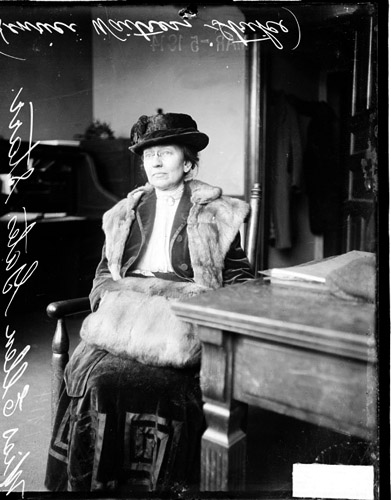
—What actually happens during these cultural evenings at Hull House?
In the evening, the house buzzes like a beehive. We push tables aside, hang reproductions on the walls, someone sits at the piano. Poles, Greeks, Russian Jews enter, shy at first, then drawn by the music and light. I can stand for hours talking with a tailor or a young man in search of meaning. These people have never set foot in a museum—many would not dare—so the museum comes to them. I organize exhibitions, talks on the great masters, readings. And I see tired faces light up. These evenings make Hull House far more than a social center: a true home of culture for the humble of Chicago.
—Why did you side with the strikers during the Pullman Strike of 1894?
Because you cannot talk about dignity in the afternoon in a workshop and look away in the evening when men are being crushed. In 1894, the Pullman Company cut wages while keeping rents high in its company housing: servitude disguised as modernity. When the workers rose up, I stood by them. The conservative press immediately called me a socialist, as if the word should make me blush. It did not frighten me. I held—and still hold—the defense of workers as a moral and religious duty. They reproached me for sullying my reputation as a woman of good family. But what good is a reputation kept clean by closing one's eyes to injustice?
What good is a reputation kept clean by closing one's eyes to injustice?
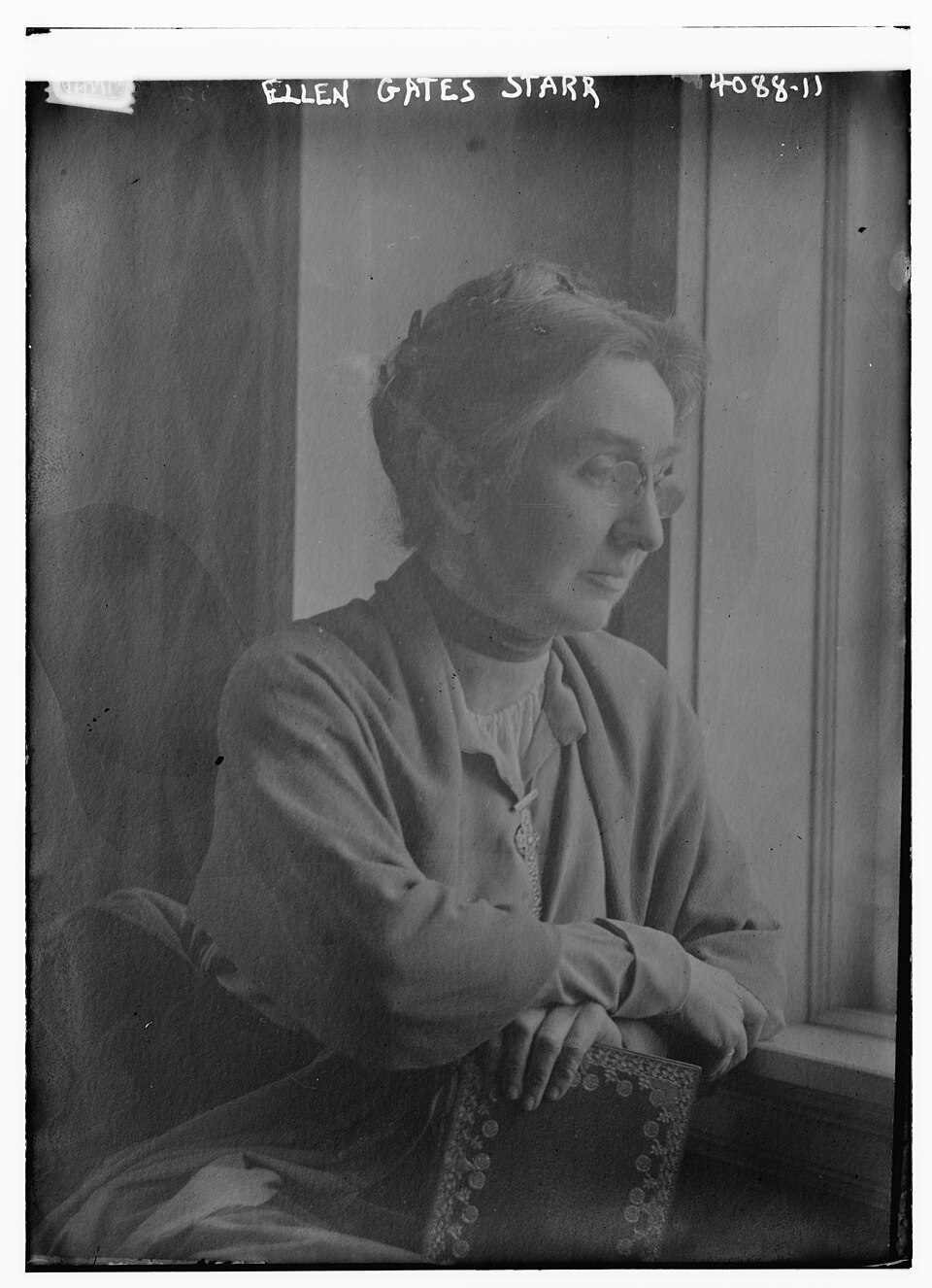
—How do you reconcile this love of art with this very concrete fight for workers' rights?
They are two sides of the same coin, not separate causes. The man who has neither bread nor rest cannot bind a book; the man who has never tasted beauty does not fully understand what has been stolen from him. I keep union pamphlets in my drawers next to my gilding irons, and that seems natural to me. Fighting for shorter workdays, supporting a strike, demanding fair wages—it is demanding, at bottom, the right to a full human life, the very one I spoke of to Jane. Economic justice and culture do not contradict each other: one prepares the ground where the other can bloom. An America founded on profit alone maims both.
—In 1920, at over sixty, you converted to Catholicism. What led you there?
I surprised many friends, I know. A reformer raised in a Protestant home in Wisconsin, embracing Rome late in life! But my faith has not changed its aim, only its form. All my life, I believed that social justice was a virtue, a commandment rather than a political opinion. In the Church, I found an ancient tradition that linked care for the poor to the sacred, without reducing it to sentimentality. This crucifix I now keep near me is not a denial of Pullman or my workshops: it is the same fire, in a different hearth. I spent thirty years saying that serving the humble is a matter of the soul. In 1920, I simply wanted to say it in a language older than myself.
My faith has not changed its aim, only its form.
—How do you feel about gradually withdrawing from Hull House?
A peace, mixed with a pang. I gave this house my finest years, and there comes a time when you must let other hands hold the gilding irons. I plan to retire someday eastward, to some small quiet town in New York State, to live more contemplatively. But make no mistake: withdrawing is not renouncing. The principles that led me to found Hull House with Jane, that threw me into the streets with the strikers—they do not retire. I carry them as one carries one's dearest books. A contemplative life is not an extinguished life—sometimes it is there that you finally understand the meaning of all you have done.
This imaginary interview was generated by artificial intelligence from sources documented in Ellen Gates Starr's profile. It dramatises what the figure might have said based on what we know about them, but does not constitute attested historical testimony. For primary sources and factual documentation, refer to the full profile.