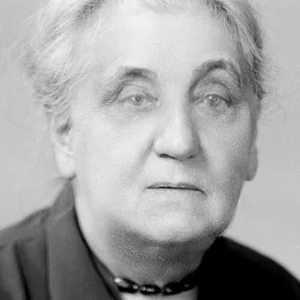

An American social reformer, Jane Addams founded Hull House in Chicago in 1889, a settlement house serving immigrants and disadvantaged communities. A sociologist and committed pacifist, she was awarded the Nobel Peace Prize in 1931.
Jane Addams(1860 — 1935)
Jane Addams
États-Unis
9 min read
Frequently asked questions
Famous Quotes
« The good we secure for ourselves is precarious and uncertain until it is secured for all of us and incorporated into our common life.»
« You do not know what life means when all the difficulties are removed.»
Key Facts
- 1889: founding of Hull House in Chicago, one of the first social settlement houses in the United States
- 1910: publication of Twenty Years at Hull-House, an autobiographical account of her social work
- 1915: co-founder of the Women's International League for Peace and Freedom
- 1919: first president of the Women's International League for Peace and Freedom
- 1931: Nobel Peace Prize laureate, the first American woman to receive the honor
Works & Achievements
Jane Addams's first and most significant achievement: the creation of this community center in Chicago revolutionized American social welfare and became a model replicated around the world.
Addams's first major work, in which she lays the philosophical foundations for social work as a democratic act. This book profoundly influenced American progressive thought at the turn of the twentieth century.
Addams develops an original vision of peace grounded in social justice and international solidarity rather than military balance, anticipating the debates that would surround the League of Nations.
A memoir and account of two decades of social work, this bestseller transformed Jane Addams into a national figure and brought the ideals of the settlement movement to a broad American audience.
Addams was one of the founding signatories of the NAACP, the first national American organization dedicated to defending the civil rights of African Americans, reflecting her early commitment to antiracism.
An account of the international women's peace conference held at The Hague during World War I, which Addams chaired. The book documents the international women's pacifist resistance movement.
The autobiographical sequel covering the years 1910–1930, in which Addams analyzes the social transformations of American society and the challenges faced by the pacifist movement in the shadow of two world wars.
Anecdotes
In 1889, Jane Addams and her friend Ellen Gates Starr visited Toynbee Hall in London, a pioneering social settlement house in impoverished neighborhoods. Inspired by this model, they purchased an old mansion in Chicago and founded Hull House, which within a few years became the most famous community center in the United States, welcoming up to 2,000 visitors per week.
During World War I, Jane Addams took courageous pacifist stances that earned her fierce criticism, notably from Theodore Roosevelt, who called her 'the most dangerous woman in America.' She was even temporarily expelled from the Daughters of the American Revolution. Her reputation was not fully restored until she was awarded the Nobel Peace Prize in 1931.
Hull House organized themed 'clubs' for immigrants: reading clubs in Yiddish, Italian, and Polish, art workshops, nurseries, and citizenship classes. Jane Addams herself learned a few words in her residents' languages to welcome them in their own tongue — a gesture considered revolutionary at the time for a woman of her social class.
In 1910, Jane Addams published 'Twenty Years at Hull-House,' which immediately became a bestseller. This autobiographical account transformed Hull House into a national symbol of social reform and catapulted its author onto the American political stage, where she campaigned for women's suffrage alongside Susan B. Anthony.
Jane Addams contributed directly to the creation of several major American institutions: she was one of the founding members of the NAACP (National Association for the Advancement of Colored People) in 1909, and co-founded the ACLU (American Civil Liberties Union) in 1920 — both organizations that continue to exist today.
Primary Sources
It is hard to tell just when the very simple plan which afterward developed into the Settlement began to form itself in my mind. It may have been even before I went to Europe for the second time, but I gradually became convinced that it would be a good thing to rent a house in a part of the city where many primitive and actual needs are found.
We are slowly learning that social advance depends as much upon the process through which it is secured as upon the result itself... The identification with the common lot which is the essential idea of democracy becomes the source and expression of social ethics.
The long struggle of women toward full citizenship, while seemingly remote from the peace movement, is in reality a basic factor in the elimination of war... Women, who have always borne the heaviest burden of war, know something of its cost.
We have learned as common knowledge that much of the insensibility and hardness of the world is due to the lack of imagination which prevents a realization of the experiences of other people... The educational problem is perhaps the most difficult one in our current situation.
Key Places
Founded in 1889 at 800 South Halsted Street, Hull House was the center of Jane Addams's entire life's work. This complex of buildings offered nurseries, cultural clubs, language classes, and medical clinics in the heart of Chicago's immigrant neighborhood.
Jane Addams's small hometown, where her father John Addams served as an influential state senator. It was here that she received a careful upbringing and developed her earliest moral and civic convictions.
The world's first settlement house, founded in 1884 in London's East End. Addams's visit there in 1887 was a turning point: she drew directly from this model when creating Hull House two years later.
It was in Oslo that Jane Addams received the Nobel Peace Prize in December 1931, crowning forty years of social work and international pacifist activism.
Jane Addams made regular trips to Washington to testify before Congress, advocate for social legislation — including child labor laws, workplace safety, and women's suffrage — and meet with successive presidents.
Typical Objects

Jane Addams worked daily at this desk, cluttered with case files, correspondence, and social reports. It was here that she wrote her articles, prepared her lectures, and organized the settlement house's activities.

A rigorous activist, Jane Addams recorded the living conditions of immigrants in detailed notebooks. These notes fed into her government reports and her works of applied sociology.

An indispensable tool in the late 19th century for producing large volumes of letters, reports, and manuscripts. Jane Addams used hers to correspond with politicians, journalists, and activists around the world.

Jane Addams typically wore dark, austere clothing, reflecting her social commitment and her rejection of bourgeois ostentation. Her simple dress allowed her to move without distinction through working-class neighborhoods.

In the early years of Hull House, electricity had not yet reached most working-class homes in the neighborhood. The oil lamp lit evening meetings, literacy classes, and community gatherings.

Each year, Addams published a report detailing the work carried out, the populations served, and the needs identified. This document became an advocacy tool with elected officials and donors to push for legislative reforms.
School Curriculum
Vocabulary & Tags
Key Vocabulary
Tags
Daily Life
Morning
Jane Addams rose early and began her day with a communal breakfast alongside the Hull House residents. She worked through a heavy volume of mail — dozens of letters from activists, politicians, and journalists — before holding her first coordination meeting with the center's staff.
Afternoon
Afternoons were devoted to visiting the neighborhood's unsanitary tenements, meeting with families in need, or navigating city hall bureaucracies. She regularly chaired working committees on social legislation or spoke at public conferences.
Evening
Evenings at Hull House were lively: public lectures, readings, choir rehearsals, and meetings of special-interest clubs. Jane Addams took an active part in all of it, and also received visiting intellectuals and reformers such as John Dewey and Florence Kelley.
Food
Practical and indifferent to luxury, Addams shared the community's simple meals: soups, breads, vegetables, and inexpensive cuts of meat. The Hull House kitchen reflected the diversity of its residents — Italian, Ashkenazi Jewish, or Polish dishes depending on who was cooking that day.
Clothing
Jane Addams wore long, plain dresses in dark wool, free of excessive ornamentation, in keeping with the ideal of simplicity she championed. She rejected the tightly laced corset then in fashion, preferring freedom of movement for her daily rounds through the neighborhood.
Housing
Jane Addams lived on the premises of Hull House itself, sharing the building with some twenty women residents. Her personal room was modest: a bed, a desk, and shelves lined with books and case files. This choice of communal living was, for her, as much a political statement as a practical one.
Historical Timeline
Period Vocabulary
Visual Style
Un réalisme social sobre et documentaire, inspiré de la photographie engagée de l'époque, avec des intérieurs de briques, des lumières tamisées et une palette de couleurs austères reflétant l'Amérique ouvrière.
Sound Ambience
L'ambiance sonore de la Hull House mêle les voix de dizaines de nationalités, le brouhaha des ateliers et les sons de la ville industrielle de Chicago à la fin du XIXe siècle.
Liens externes & ressources
Références
Œuvres
Hull House (fondation)
1889
Democracy and Social Ethics
1902
Newer Ideals of Peace
1907
Twenty Years at Hull-House
1910
Co-fondation de la NAACP
1909
Women at The Hague (co-auteure)
1915
The Second Twenty Years at Hull-House
1930