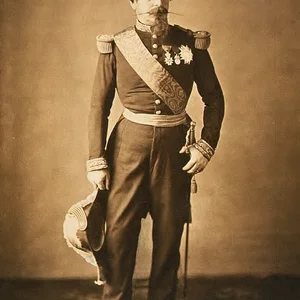

Nephew of Napoleon I, he was elected President of the Republic in 1848, then seized power through a coup d'état on December 2, 1851, before proclaiming the Second Empire. His reign profoundly transformed France: the modernization of Paris under Haussmann, industrial and railway expansion — until the defeat at Sedan in 1870.
Napoleon III(1808 — 1873)
Napoleon III
France
9 min read
Frequently asked questions
Famous Quotes
« The Empire means peace.»
« I am the only man in France who is not a Bonapartist.»
Key Facts
- 1848: elected President of the French Republic with 74% of the vote
- December 2, 1851: coup d'état against the National Assembly
- December 2, 1852: proclamation of the Second Empire
- 1853–1870: Haussmann's sweeping urban works transform Paris
- September 1, 1870: surrender at Sedan during the Franco-Prussian War, marking the end of the Second Empire
Works & Achievements
A political manifesto written in exile in London, in which Louis-Napoléon sets out his vision of a modernized Bonapartism reconciling authority with social progress. The work was a considerable success and was translated into several languages, laying the ideological foundations for the future Second Empire.
A social treatise written during his imprisonment at the Fort de Ham, proposing the use of uncultivated land to establish agricultural colonies and alleviate working-class poverty. This text earned Louis-Napoléon the image of a 'social prince,' which contributed to his presidential election victory in 1848.
A sweeping urban transformation program carried out by Prefect Haussmann under the personal direction of Napoleon III, creating the grand boulevards, the Bois de Boulogne and Vincennes parks, as well as the sewer and clean water networks that made Paris the modern capital of Europe.
An international event bringing together 52 nations and more than six million visitors, conceived as a showcase of the Second Empire's industrial progress. Napoleon III used it as an instrument of diplomatic influence and a symbol of France's renewed greatness.
Under the Second Empire, the French railway network grew from 3,000 to more than 17,000 kilometers, connecting Paris to major cities and opening up rural areas. Napoleon III actively supported the major railway companies and personally oversaw the progress of this national undertaking.
Napoleon III presided over the international Congress of Paris that ended the Crimean War, restoring France's diplomatic prestige in Europe after thirty years of post-1815 isolation. France emerged from the congress as the arbiter of European affairs.
Anecdotes
While imprisoned at the Fort of Ham after his failed coup attempt in 1840, Louis-Napoleon wrote a social treatise titled 'The Extinction of Pauperism,' which earned him unexpected popularity among the working class. In 1846, he escaped in disguise as a stonemason, carrying a plank on his shoulder to hide his face, and walked right past the guards without being recognized. His jailers mockingly nicknamed him 'Badinguet,' after the real mason whose clothes he had borrowed.
On December 2, 1851, Louis-Napoleon deliberately chose the anniversary of the Battle of Austerlitz (1805) and his uncle's coronation (1804) to launch his coup d'état. Barricades went up across Paris, and the crackdown left several hundred people dead. Exactly one year later, he proclaimed the Second Empire and took the title of Napoleon III.
To transform Paris into a modern capital, Napoleon III called upon Baron Haussmann, appointed prefect of the Seine in 1853. Over seventeen years, around 20,000 old buildings were demolished and 40,000 new ones constructed, creating the grand boulevards, parks, and sewer system still recognizable today. The Emperor himself had traced by hand, on a color-coded map of Paris, the major thoroughfares he wanted to carve through the city.
At the Battle of Sedan, so ill from kidney stones that he could barely sit on horseback, Napoleon III had himself carried onto the battlefield anyway, hoping to die from a shell like a soldier. No bullet found him. On September 2, 1870, he surrendered to Prussian King Wilhelm I and Bismarck, becoming the first French head of state to be taken prisoner by an enemy since Francis I at Pavia in 1525.
Fascinated by new technologies, Napoleon III had an aluminum dinner service made for his state banquets — the metal being rarer and more expensive than gold at the time. He reserved aluminum cutlery for his most distinguished guests, while other diners ate with ordinary silverware. During his reign, the French railway network grew from 3,000 to more than 17,000 kilometers.
Primary Sources
Napoleon did not only wage war; he organized France internally, regulating everything that pertained to administration, justice, public education, religious affairs, and finance.
The working class owns nothing — it must be given property; it is idle and destitute — it must be given work and the means of subsistence.
We have vast uncultivated territories to clear, roads to open, ports to dig, rivers to make navigable, canals to complete, our railway network to extend.
Frenchmen! The current National Assembly, instead of making laws in the interest of all, has become the breeding ground of a conspiracy against my person and against the Republic. I have dissolved it, and I return to the French people the task of establishing the Constitution of the State on new foundations.
Key Places
The main residence of Napoleon III and Empress Eugénie during the Second Empire, in the heart of Paris facing the Louvre. Burned down in 1871 during the Paris Commune, only the Tuileries Gardens survive today.
A medieval fortress where Louis-Napoléon was imprisoned from 1840 to 1846 following his failed coup attempt at Boulogne. It was here that he wrote 'The Extinction of Pauperism' and from which he escaped disguised as a mason.
The imperial court's favorite residence, where it gathered each autumn for grand hunting parties. The 'Compiègne series' brought together artists, scholars, and political figures in highly sought-after invitations.
The town where Napoleon III surrendered to the Prussian armies on September 2, 1870, bringing the Second Empire to an end. This event triggered the proclamation of the Third Republic in Paris and the Franco-Prussian War.
A Basque seaside resort where Empress Eugénie had a villa built that became the imperial couple's summer retreat. Napoleon III received foreign sovereigns there and made important diplomatic decisions.
An English manor near London where Napoleon III went into exile after the defeat of 1870. He died there on January 9, 1873, following a surgical operation, never having reclaimed his throne.
Typical Objects

Two-cornered hat worn during military ceremonies, a symbol of Bonapartist power inherited from Napoleon I. Napoleon III donned it for grand troop reviews and official parades.

Official documents signed during the night of December 1st to 2nd, ordering the dissolution of the National Assembly and calling for a plebiscite. These papers were pasted on the walls of Paris at dawn on the day of the coup.

A table service made of aluminum — then more expensive than gold — commissioned by Napoleon III for his court dinners. He reserved it for his most distinguished guests, while others ate with ordinary silver tableware.

Plans and maps of railroad lines that the Emperor personally followed as symbols of economic modernization. Under the Second Empire, the rail network grew from 3,000 to more than 17,000 kilometers.

A large map of Paris on which Napoleon III himself had drawn, in color, the future Haussmann boulevards. This document illustrates the Emperor's personal involvement in the transformation of the capital.

The highest decoration, which Napoleon III wore at all times on his uniform. He distributed it widely to reward the industrial, military, and artistic elites who supported his regime.
School Curriculum
Vocabulary & Tags
Key Vocabulary
Tags
Daily Life
Morning
Napoleon III rose early and spent his mornings reading state files brought by his secretaries. He received his ministers in Council before lunch and personally annotated urban planning, railway, and foreign policy projects. An avid reader of prefectural reports, he sought to keep a close watch over the entire administration.
Afternoon
Afternoons were often devoted to diplomatic audiences, official receptions, and visits to construction sites, particularly those involved in the renovation of Paris. Napoleon III sometimes accompanied Haussmann in the field to check on the progress of the works. He had a passion for scientific experiments and regularly received engineers and scholars at the Tuileries.
Evening
Court evenings at the Tuileries or Compiègne brought together the political, artistic, and social elite for lavish balls and dinners. Empress Eugénie held a brilliant salon frequented by composers, writers, and artists. Napoleon III was fond of the theater and the opera, institutions he generously subsidized.
Food
The imperial table offered elaborate French cuisine: game from Compiègne, fine fish, and great wines from Bordeaux and Burgundy. Napoleon III was partial to Italian dishes inherited from his childhood years in exile. Suffering from kidney stones since the 1860s, he was placed on an increasingly strict medical diet toward the end of his reign.
Clothing
Napoleon III most often wore the uniform of a major general, adorned with gold embroidery on navy blue cloth, complete with epaulettes and the Grand Cross of the Legion of Honor. For solemn ceremonies, he wore a coronation mantle of purple velvet trimmed with ermine. In private, he sometimes dressed in a simple gray civilian frock coat.
Housing
Napoleon III resided primarily at the Tuileries Palace in Paris, where his apartments had been redesigned by architect Lefuel in imperial splendor. In summer, the court moved to Saint-Cloud or the Villa Eugénie in Biarritz, and in autumn to Compiègne for the great hunts. These moves mobilized hundreds of people and were true affairs of state.
Historical Timeline
Period Vocabulary
Visual Style
Esthétique du Second Empire : pierre haussmannienne, pourpre et or impériaux, modernité industrielle et académisme pictural du milieu du XIXe siècle.
Sound Ambience
Sons du Second Empire : chantiers haussmanniens, locomotives à vapeur, fanfares impériales et effervescence des expositions universelles dans une France en pleine transformation industrielle.