Imaginary interview with Empress Jingu
by Charactorium · Empress Jingu · Politics · Military · Mythology · 6 min read
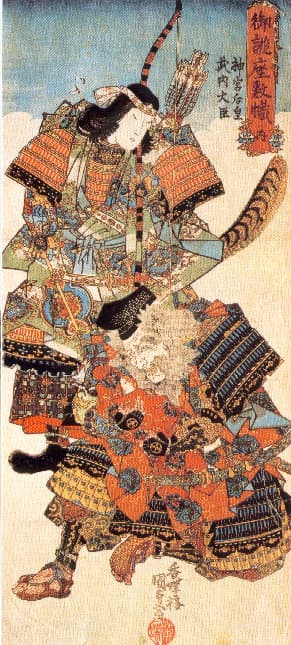
We met her at the Kashii Shrine in Fukuoka, where the sea breeze still carries the scent of salt and where, they say, the stones that held back her child are kept. Seated near the water, a jade bead around her neck, the empress-regent agrees to speak of the gods, the crossing, and the son she carried to victory.
—Do you remember the moment the gods ordered you to cross the sea?
It was still night over the camp when their voice rose within me. The Sumiyoshi deities, guardians of the waves and oars, pointed me to a land beyond the water and promised it would yield, provided I left without waiting for the next dawn. My husband Chūai was no more, and the silence he left, the kami filled with a command. I went down to the river for misogi, washed all impurity from me, then beat the taiko to summon the fleet. You don't argue with an omen that cuts through your belly like a blade. I clutched my jade bead and looked toward Silla, knowing my will was no longer entirely my own.
You don't argue with an omen that cuts through your belly like a blade.
—How would you describe that crossing to the peninsula and the welcome you received there?
Our flat-bottomed boats, those fune propelled by oars, were nothing against the swell of the strait, about one hundred and eighty li of black water wide. But the Sumiyoshi gods walked before the prow, and the sea lay down beneath us like a tamed beast. When we touched the land of Silla, there was no clashing of steel, no cry: the king came to me and bowed, and after him the other two kingdoms submitted. That is what the old accounts in the Kojiki preserve, and I know no purer victory than one where no blade was stained. The kami had kept their word; it only remained to receive the tributes and knowledge from the continent.
—It is said you were carrying a child during the campaign. How did you endure?
Yes, he was already alive in me when I embarked, and he stirred as if wanting to be born before the hour of victory. I could not allow that: a leader does not surrender arms to his own body in the midst of war. So I took a stone by the water's edge, a chinkai-seki, cold as the riverbed, and bound it against my belly to lull the child's impatience. The cold silenced what wanted to cry out. Those stones are still kept here, at Kashii, and people come to touch them as if my will from back then were still trapped in them. It was not magic: it was a body's refusal to yield before the word of the gods was fulfilled.
A leader does not surrender arms to his own body in the midst of war.
—What does the son born upon your return mean to you?
He came into the world when our boats touched the sands of Japan, as if the earth had waited for him to let him breathe. Ōjin — for that is what he would be called — was born not just of a man, but of a campaign, a sea crossed, and a promise of the kami kept to the end. I carried him through war, and it left something in him: later, men would venerate him as Hachiman, the power invoked before setting out to fight. A mother sometimes senses what her son will become; I knew it from the cold of the stone against my side. I had governed for him even before he uttered his first cry.
—You speak of the gods as a daily presence. How do you hear their voice?
I am miko as much as queen; between the kami and humans, my body is the threshold the divine voice uses. Every morning, before the affairs of the realm, I go down to the water for misogi, then sit before the bronze mirror, that dōkyō polished where the invisible world reveals itself. Signs come: a shiver, a word not my own, the beating of the taiko opening a passage. In the Japan of my time, one does not separate the ruler from the one who prays — the power of the clans and the power of the gods are held in the same hand. My magatama bead, shaped like a comma, signifies this status: it is the sign that through me passes something greater than myself.
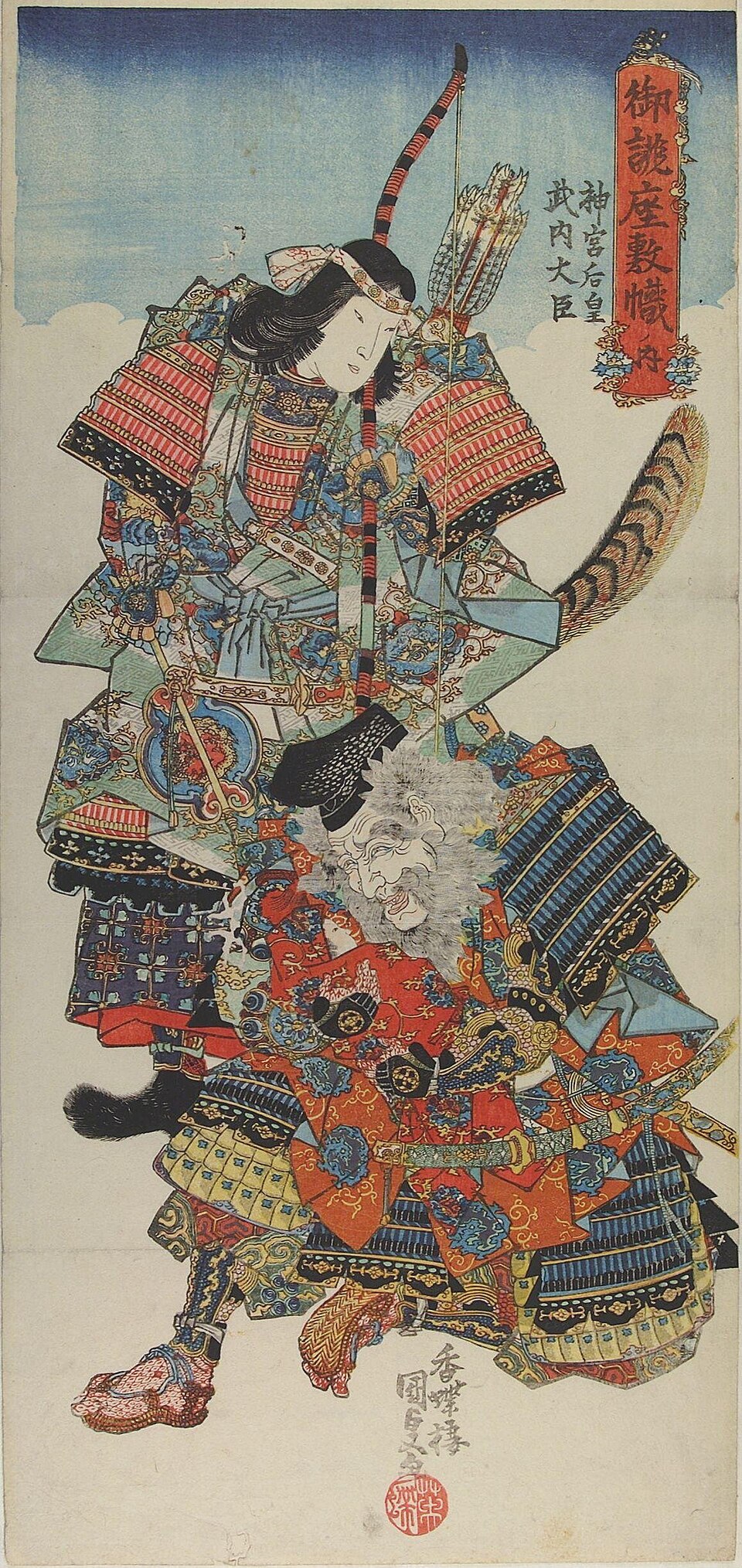
—How did this priestly function guide your decisions as sovereign?
Never did I decide a matter of war or alliance without first consulting the kami. A clan chief, an uji no kami, would bring me a dispute in the afternoon; but the true deliberation I conducted at dawn, through divination. The Sumiyoshi gods dictated the crossing; other omens told me when to wait and when to strike. People may think a sovereign decides alone, from the height of her cypress miya on stilts. I only listened and transmitted. My strength was never in my arm — even if I am sometimes depicted with the naginata in hand — but in that ear attuned to the invisible. To govern, for me, is first to obey something higher than oneself.
People think a sovereign decides alone; I only listened and transmitted.
—After your husband's death, you ruled alone for a very long time. How did you bear that burden?
When Chūai departed, the child who was to succeed him was not even born. Someone had to keep the realm standing, and that someone was I — not as kōgō, mere consort of the sovereign, but as sesshō, regent governing in the name of a son yet to come. The accounts say I held on like that for nearly seventy years, until Ōjin came of age. It is no glory I claim: it is a duty that the gods and a man's death placed on my shoulders. Sovereignty has no sex when the kami designate a hand. I ruled because there was no one else, and because the voice that had sent me to Silla had not yet returned my freedom.
—How do you govern such powerful clans without an emperor at your side?
Power in the Yamato plain is not given: it is composed. Every afternoon, I received the uji no kami, those clan chiefs who each ruled over their kin, their rice granaries, and their gods. They had to be harmonized like drums that do not beat together: through alliances, marriages, and the sharing of tributes from the continent. In the evening, the court gathered for the banquet, and the kataribe, our storytellers, recited the deeds of the divine ancestors to remind everyone where authority came from. A regent without a husband must be more skillful than a king: I had only my word, my bead, and the backing of the Sumiyoshi. That sufficed to hold the archipelago in one hand.
—Do you care how distant generations will remember you?
We do not yet write, we others; it is the kataribe who carry our names from mouth to mouth, and a name wears away like a stone at the bottom of a torrent. I would like to think I will still be sung in a thousand seasons — not for the fear I might have inspired, but for the crossing and for the child held back by the cold. If I could imagine that one day my face would be engraved on something precious, passed from hand to hand across the whole country, I would see it less as an honor than as a miracle: that the kami allowed a woman to endure so long in the memory of the living. But that, only the gods know. I can only offer my deeds and hope they are worth retelling.
—What would you like to be remembered for, beyond the tales of conquest?
Let them remember first the gods, and then me. Men love battles and blood, but my truth lies elsewhere: at Silla, no blade was stained, and it was the protection of the Sumiyoshi that bent the kings, not my wrath. If a place of mine must be kept, let it be the great Sumiyoshi Shrine, at the mouth of the waters, where those sea deities who guided me are still prayed to. Let them remember that a woman can carry at once the child, the prayer, and the kingdom, without any one causing the others to fall. The rest — the tributes, the subdued kingdoms — is only the foam of a crossing. The essential is the voice that told me to leave, and the fact that I had the faith to obey it.
A woman can carry at once the child, the prayer, and the kingdom, without any one causing the others to fall.
This imaginary interview was generated by artificial intelligence from sources documented in Empress Jingu's profile. It dramatises what the figure might have said based on what we know about them, but does not constitute attested historical testimony. For primary sources and factual documentation, refer to the full profile.