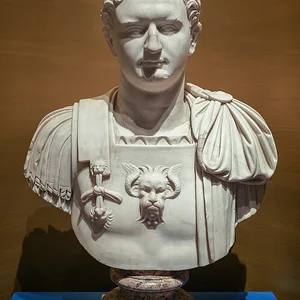

Roman consul in 69 AD, Titus Vinius was one of Emperor Galba's most influential advisors. A central figure of the 'Year of the Four Emperors', he was assassinated during Otho's coup in January 69.
Titus Vinius(12 — 69)
Titus Vinius
Rome antique
8 min read
Frequently asked questions
Key Facts
- Consul in 69 AD, during the dynastic crisis known as the 'Year of the Four Emperors'
- A trusted advisor to Emperor Galba, noted by Tacitus for his influence and greed
- Assassinated on January 15, 69 AD during Otho's coup, alongside Galba
- His career is recounted in Tacitus's Histories and Plutarch's Life of Galba
Works & Achievements
Titus Vinius served as ordinary consul alongside Emperor Galba during the most turbulent year of the century. This supreme magistracy represents the pinnacle of a brilliant senatorial career, tragically cut short only fifteen days after he took office.
Vinius accompanied Galba in administering the Hispanic province, playing a leading role in preparing the revolt against Nero and consolidating Galba's authority over the legions of Spain.
As Galba's chief adviser, Vinius wielded decisive influence over appointments, military decisions, and succession policy — an unofficial yet very real power that made him one of the most powerful men in the Empire for a few months.
Anecdotes
Titus Vinius had a reputation as the most greedy man in Rome. During the reign of Caligula, he was accused of stealing a golden cup from the imperial table at a banquet — the story spread throughout Rome and became a byword for cupidity that his contemporaries considered boundless. This episode, recorded by Suetonius, nonetheless did not prevent him from climbing every rung of a senatorial career.
When Galba came to power in 68 AD, Vinius became his most influential advisor. Together with Laco, the praetorian prefect, and Icelus, the emperor's freedman, he formed a trio of favorites that the Roman people mockingly nicknamed the 'three tutors of Galba.' Their internal rivalry and greed often paralyzed the government, making Galba unpopular from the very first months of his reign.
The question of succession proved fatal to Vinius. He wanted Galba to adopt Otho as heir, hoping to marry him to his own daughter and thereby consolidate his influence. Galba ultimately chose Piso Licinianus, an aristocrat with no political ties to Vinius — this frustrated choice drove Otho to hasten his coup, sealing the fate of the very man who had supported him.
On January 15, 69 AD, during Otho's uprising, Vinius was killed in the chaos that followed Galba's assassination in the Roman Forum. According to Tacitus, some soldiers hesitated to strike him, hoping for a reward for sparing his life, but he was ultimately cut down. His head was brought to Otho, who is said to have been unsettled by it — Vinius had been, in spite of everything, the man who had championed his cause.
Vinius had led a scandalous youth: he was dismissed from his first military command for seducing the wife of his superior, a legionary legate. This disastrous start to his career did not stop him from becoming consul — the highest magistracy in Rome. His trajectory is a perfect illustration of how, under the Empire, the favor of the prince could erase past misdeeds and open every door.
Primary Sources
Vinius was headlong in all his appetites, Laco was ignorant of military affairs, Icelus was swollen with the hopes and licence of a freedman: these men corrupted everyone and deliberated on nothing for the common good.
Vinius was the most influential man at Galba's side and the most feared: greedy and cunning, he turned every imperial decision to his own advantage, amassing wealth and political credit.
Galba surrendered the government to three men whose shared power was universally detested: Vinius, Laco, and Icelus, who were regarded as the true masters of Rome.
Vinius perished on the same day as Galba, struck down by Otho's soldiers in the Forum after attempting to escape by hiding himself among the crowd.
Key Places
The political and symbolic heart of Rome, where Galba was assassinated on January 15, 69 AD and where Vinius also met his death during Otho's coup. This site embodies the violence of imperial dynastic crises and the brutality of power transitions.
The residential hill of the emperors and their court. As Galba's closest adviser, Vinius moved at the very center of this hub of power, where conspiracies were hatched and alliances forged — and where the fate of the Empire was decided.
The permanent barracks of the Praetorian Guard in the northeast of Rome. It was here that Otho was hailed as emperor by the praetorians on January 15, 69 AD, triggering the coup that swept away Vinius, Galba, and Piso within hours.
The provincial capital from which Galba launched his revolt against Nero in 68 AD. Vinius was already at his side as a trusted adviser during this campaign, which brought them both to the pinnacle of Roman power.
The meeting place of the Roman Senate. As consul, Vinius presided over its sessions and asserted Galba's authority there during the critical weeks that preceded his downfall.
Typical Objects

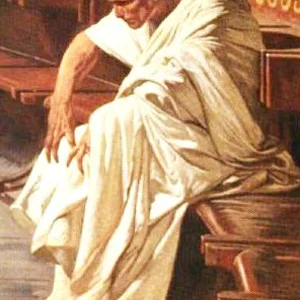
A white wool toga bordered with a purple stripe, reserved for consuls and senior Roman magistrates. As consul in 69 AD, Vinius wore it during official ceremonies — a visible symbol of the supreme authority he exercised alongside Galba.

A folding seat of ivory and metal, the attribute of curule magistrates such as consuls. Vinius occupied it during official sessions, embodying the continuity of republican institutions within an imperial regime already long established.

Common writing tools of the Roman administration, consisting of two wooden boards coated with wax. As Galba's chief advisor, Vinius made constant use of them for political correspondence, council notes, and decrees drafted in the emperor's name.

According to Suetonius, Vinius was accused of stealing a golden cup during an imperial banquet under Caligula. This object became in collective memory the symbol of his proverbial greed, cited as an example of corruption by ancient historians.

A gold ring worn by members of the senatorial order, marking membership in Rome's ruling elite. For Vinius, this ring represented the crowning achievement of a turbulent career, marked by scandals overcome through imperial favor.

The short sword of Roman officers and legionaries. Vinius had served as a military tribune before his political career — a classic trajectory for Roman elites, who passed through the army before entering the Senate.
School Curriculum
Vocabulary & Tags
Key Vocabulary
Tags
Daily Life
Morning
Vinius rose before dawn to receive his clients and supporters during the salutatio, an essential morning ritual for any senator of rank. He would then dictate his correspondence to his secretaries, handling affairs of state and his own financial interests. As consul, his early hours were also devoted to the auspices and mandatory religious rites that preceded any official session.
Afternoon
In the afternoon, Vinius took part in meetings of the consilium principis alongside Galba, where major political and military decisions were discussed. He received provincial delegations, officers seeking favors, and senators looking to secure his support. His critics accused him of selling access to these audiences, turning the antechamber of power into a source of personal income.
Evening
Vinius's evenings often unfolded at banquets (convivia) on the Palatine Hill, where Roman politics was conducted as much at the dinner table as in the Senate. He was known for his love of wine and lavish feasting, in stark contrast to the austerity Galba publicly displayed. It was at one such imperial banquet that the legend of the stolen cup was born.
Food
Like any wealthy senator, Vinius enjoyed refined dishes at banquets: Mediterranean fish, game, and elaborate sauces made with garum. White bread, olives, vegetables, and wine diluted with water formed the everyday staple, but the excess of political feasts — condemned by moralists such as Tacitus — was the true marker of his rank.
Clothing
In public and at official ceremonies, Vinius wore the toga praetexta with its purple stripe, the emblem of his consular dignity. In private life, he wore a fine wool tunic and a lighter white toga. His calcei — hard-soled leather shoes — visually set him apart from ordinary citizens in sandals.
Housing
Vinius lived in a patrician domus on or near the Palatine Hill, complete with an atrium, marble columns, wall frescoes, and an inner garden. His reputation for greed suggests a richly furnished home, with Greek bronzes and a library. Dozens of slaves and freedmen maintained the household and managed his considerable fortune.
Historical Timeline
Period Vocabulary
Visual Style
Style peinture académique inspiré d'Alma-Tadema transposé à Rome impériale : marbre ivoire, pourpre sénatorial et or vieilli dans une atmosphère de complot, de pouvoir et de chute imminente.
Sound Ambience
Ambiance sonore de Rome en crise au cœur de l'Année des quatre empereurs : tumulte du Forum, trompettes militaires des prétoriens, chuchotements du Sénat et fracas soudain du coup d'État de janvier 69.
Liens externes & ressources
Références
Œuvres
Consulat ordinaire de l'an 69 ap. J.-C.
1er janvier 69
Gouvernorat de l'Hispanie Tarraconaise (rôle de légat)
vers 67-69 ap. J.-C.
Rôle d'amicus principis (conseiller impérial)
68-69 ap. J.-C.