Imaginary interview with Eshu
by Charactorium · Eshu · Mythology · Spirituality · Culture · 7 min read

At the crossroads of two red laterite paths, somewhere between a Yoruba village and the great market, a small iron figurine stands on a mound of earth, glistening with palm oil. The wind stirs the dust, a bell tinkles in the distance — and a laughing voice, coming from nowhere and everywhere at once, answers the questions of the careless traveler who dared to stop there.
—How would you describe your role between humans and gods?
I stand at the threshold, where the world of the living — what we call ayé — touches the world of spirits, the ọrun. No human word crosses that border without passing through me; I am the mouth, the ear, and the road all at once. When the babalawo crouches in the afternoon before his board dusted with white powder and rolls his sixteen palm nuts, it is my invisible fingers that move the lot. He thinks he reads the Odu, those two hundred and fifty-six chapters of the great corpus; in truth, he reads what I consent to transmit to him. Without my agreement, the most fervent prayer remains suspended in the air like smoke without sky. That is why Olodumare, the supreme master, entrusted me with the keys to all paths: I carry the àṣẹ, that vital force, from one world to the other.
Without my agreement, the most fervent prayer remains suspended in the air like smoke without sky.
—Why must you be honored before all other orishas?
Because I hold the door, and a closed door lets through neither Shango the thunder nor Obatala the sculptor of humans. Every morning, even before greeting his own family, the faithful places on my iron figurine, the Ile Eshu planted near the threshold, a handful of palm nuts, a little alcohol, sometimes a cigar. He does this without thinking, as one breathes, because he knows that forgetting my share is to close the paths of his entire day. The agogo bell sounds, and that tinkling says: 'Eshu is invited, let him open the ways.' Even the oldest priest, who has memorized a thousand tales, would tremble to begin without me. This is not pride on my part — it is the very order of things.
A closed door lets through neither thunder nor the sculptor of humans.
—What do those altars erected at the crossroads mean?
The crossroads are my home, for I have no other: I am a perpetual traveler and sleep under no fixed roof. Where two roads meet, they raise the Ojubo Eshu for me, a simple mound of earth where they plant my iron figurine, and leave me palm nuts, tobacco, before a long journey or a frightening decision. Why this place? Because the crossroads are the very image of choice: four directions, and the hesitant man, only one life to decide. I am the god of that suspended instant when fate tips. He who honors me there obtains that I open the right path for him; he who passes without a glance, let him not be surprised if the paths become confused and obstacles repeat along his road.
The crossroads are the very image of choice: four directions, one life to decide.
—Do you remember the famous story of the hat worn between two fields?
Ah, my two peasants! I still laugh about it. That day I donned my pointed hat, red on one side, black on the other — my two colors, vital force and connection to spirits — and walked calmly along the path separating their two fields. One saw me pass on his right, the other on his left. That evening they quarreled: 'The stranger wore a red hat!' — 'Liar, it was black!' They insulted each other, fought, hated each other their whole lives over a color. Each was right, and each saw only half. I stole nothing, destroyed nothing; I only showed that truth changes face depending on where you look from. Humans believe they hold the whole world in their single point of view — and that is my sweetest lesson.
Each was right, and each saw only half.
—Many take you for a sower of disorder. Does that reputation suit you?
I am called trickster, cunning, jester — and I am, yes. In the tales of the great corpus I sow confusion, steal an offering, set a trap on the path. But look closely: my trickery is never gratuitous. It is a mirror. He whom I provoke and who keeps his calm, his uprightness, his humility — that one I reward and open the ways for. He who succumbs to anger, pride, greed — that one trips over his own faults that I merely brought to the surface. The scholar Wande Abimbola saw it well: my nature is dual, benevolent and malicious, like life itself, which can never be taken for granted. I am not a demon who undoes humans. I am the one who shows them who they truly are.
I am not a demon who undoes humans. I am the one who shows them who they truly are.
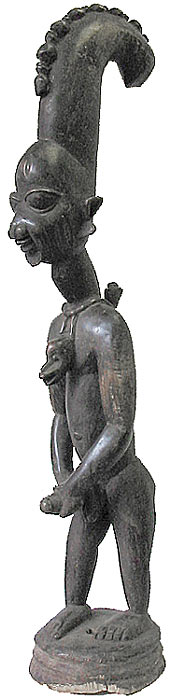
—What happens when a man comes to consult you through divination?
He sits before the babalawo, the 'father of secrets,' who has spent years engraving in his memory the thousands of tales of the Odu. The man brings his question: his health, a marriage, a journey, a gnawing fear. The priest rolls the sixteen palm nuts, the ikin, or swings the divination chain, and traces signs in the clear powder. Each figure that appears is a door I open onto destiny. But I never give the answer naked: I veil it with an ancient myth, a story where another, long ago, faced the same crossroads. It is for the man to understand. I faithfully transmit the word of the orishas, but I always leave the one who listens his share of the work — for a destiny one has not deciphered oneself is worth nothing.
A destiny one has not deciphered oneself is worth nothing.
—It is said that you crossed the ocean. How did that happen?
When they packed my Yoruba children into the holds of ships, from the great port of Ouidah to the other shore of the world, they could take neither their iron figurines nor their earthen altars. But you do not load a crossroads god into a cargo hold: I was already traveling in their memory, in the songs murmured in low voices, in the secret gesture of pouring a drop for me before drinking. They carried me across the Atlantic as one carries a fire under ash. That is how I crossed, not despite the chain, but in the very breath of those who were chained. Where they thought to extinguish our gods, we thrived. Perhaps that is my finest trick: to survive where everything was done to erase us.
They carried me across the Atlantic as one carries a fire under ash.
—On the other side of the ocean, you are no longer called Eshu. Do you still recognize those faces?
They gave me other names, and I answer to all. In Salvador de Bahia, in the terreiros of candomblé, they call me Exu and dance for me for over three centuries. In Havana, in santería, I am Elegguá, and to hide me from the masters they slipped me under the cloak of Saint Anthony of Padua — trick for trick, I appreciated the turn! In Haiti I become Legba, the old guardian of barriers invoked before all else. A name is just another hat, sometimes red, sometimes black. Under each, it is still I who hold the door, I who am honored first, I who open the paths between the living and the spirits. Languages change, shores change; the threshold guardian remains.
A name is just another hat, sometimes red, sometimes black.
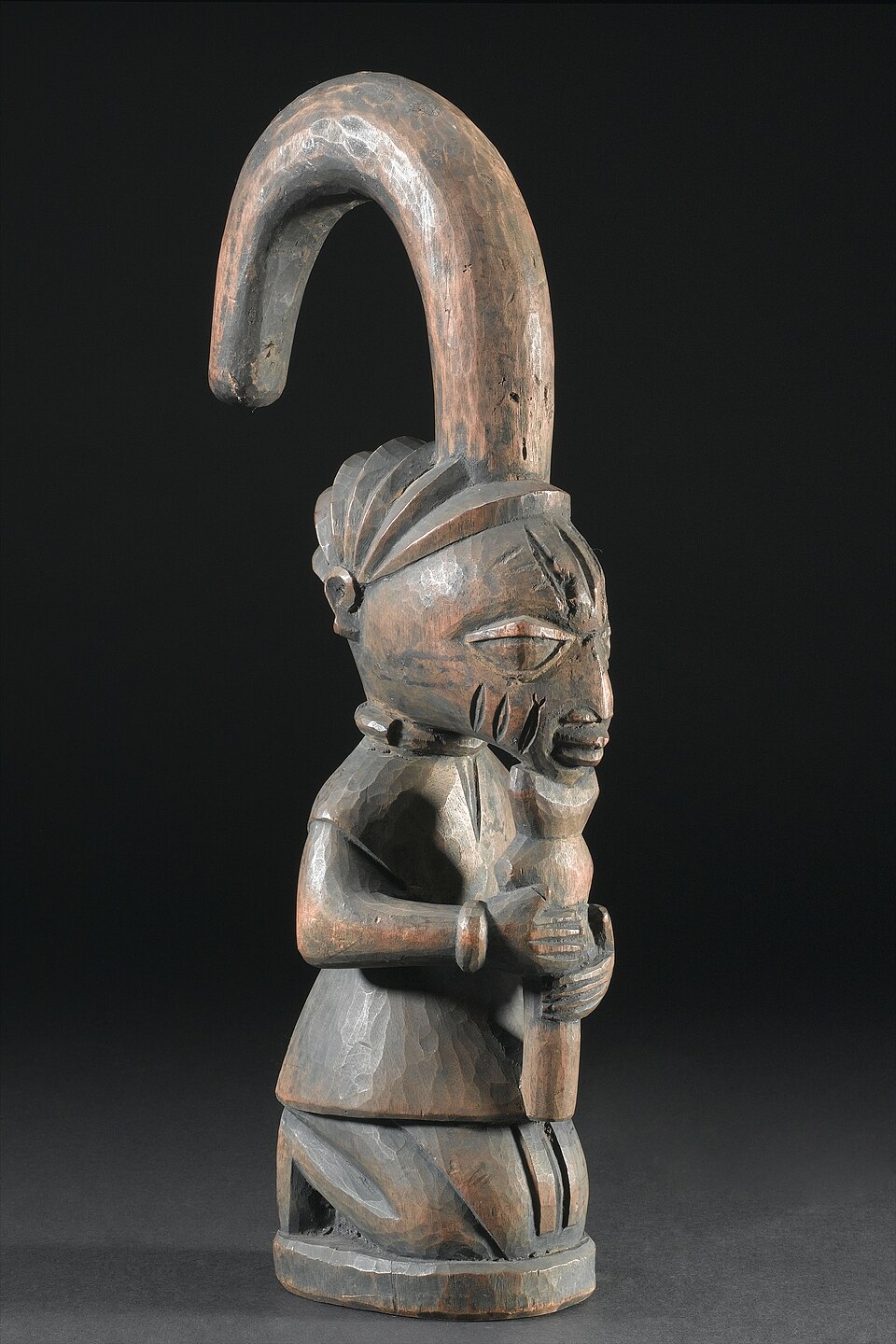
—What offerings do you demand, and why those?
I love what has fire and heat. Pour me some oti, that rum, that palm brandy the priest spills on my altar or at a crossroads — alcohol is living energy, it wakes me and grants me. I like honey, candies, tobacco smoked or chewed, thick palm oil and palm nuts, and according to traditions a black rooster or a goat. These foods, once set down, belong entirely to me: no faithful touches them, for that would be stealing my share and recalling the thief of offerings that I am in the tales — better not to invite me to that lesson! I am served with joy, never with a solemn face. I reward communities that celebrate in laughter, not those who pray with long faces.
I am served with joy, never with a solemn face.
—Many peoples have a trickster god like you. What sets you apart from all those cunning ones?
It is true that cousins of my ilk are found everywhere — those who study religions classify me among the tricksters, alongside many other mischievous spirits who overturn the established order. But none of them holds both the door of destiny and the key to all sacred speech. My mischief is not mere play: it is at the very heart of worship, for without my propitiation no ceremony begins, no message rises. I am the first invoked and, as Wande Abimbola says, the last to leave the feast. Other tricksters trouble the world for the pleasure of troubling it; I trouble it so that it reveals its truth, then I open the way to those who have understood it. Trickery and the sacred are one in my hand.
I am the first invoked and the last to leave the feast.
—What would you like those who gaze upon your two-colored hat to remember?
That they should mistrust their own certainty. The red and the black of my hat are not there to decide who is right — they are there to remind that the world always has two sides, and that man never sees more than one at a time. Red is the force that drives, energy, the blood of the living; black is the shadow of spirits, the unpredictable, what escapes. Together, they are life entire. My two peasants hated each other over a color because they believed they possessed the whole truth when they held only half. I still walk many paths, wearing the same hat, and I smile each time a man swears by his gods on what he has seen from only one side. Look from the other edge before you shout: that is all I ask.
The world always has two sides, and man never sees more than one at a time.

This imaginary interview was generated by artificial intelligence from sources documented in Eshu's profile. It dramatises what the figure might have said based on what we know about them, but does not constitute attested historical testimony. For primary sources and factual documentation, refer to the full profile.