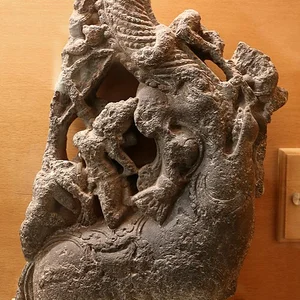

The Bunyip is a creature from the mythology of the Aboriginal peoples of Australia, said to haunt swamps, billabongs, creeks, and waterholes. Described as a threatening water spirit that devours those who approach the water at night, it embodies the real dangers of Australian wetlands.
Bunyip
Bunyip
6 min read
Frequently asked questions
Key Facts
- Figure in Australian Aboriginal mythology, transmitted orally for millennia before the Common Era
- Reputed to inhabit swamps, billabongs, creeks, and stagnant waterholes across the Australian continent
- Described very variably by region: dark fur, tusks, horse tail or fins, terrifying cry
- In the 19th century, European settlers adopted the term, and fossil bones (diprotodon) were sometimes attributed to the Bunyip around 1840–1850
- The word “bunyip” has entered Australian English to mean an impostor or illusory thing
Works & Achievements
Corpus of Aboriginal stories depicting the bunyip as both guardian and danger of waterholes, passed down orally.
Memoir that spread Buckley's account of the bunyip of Lake Modewarre to the colonial public.
Aboriginal geoglyph depicting a bunyip, one of the few material traces of the belief.
Ethnographic work that records beliefs about the bunyip in Victoria.
Political phrase that entered Australian English, sign of the bunyip's cultural entrenchment.
Classic children's picture book that reinvents the bunyip in search of its own identity.
Anecdotes
The word "bunyip" entered the English language around 1845; it comes from the Aboriginal languages of southeastern Australia, likely Wemba-Wemba or Wergaia, where it referred to a spirit or evil water being. It is one of the few Aboriginal words adopted very early by British settlers.
In 1846, a strange skull found on the banks of the Murrumbidgee was displayed at the Australian Museum in Sydney as a "bunyip skull." Crowds flocked to see it, but naturalists concluded it was the deformed skull of a calf or foal.
William Buckley, an escaped convict who lived about thirty years among the Wathaurong, claimed in his memoirs to have seen a bunyip several times in Lake Modewarre, without ever distinguishing its full body. The Aborigines, he said, deeply feared it and refused to eat it.
In 1853, orator Daniel Deniehy mocked the proposal to create a hereditary colonial nobility in New South Wales by speaking of a "bunyip aristocracy." The phrase has remained famous in Australia to describe a pretentious and ridiculous elite.
Near Fiery Creek in Victoria, the Aborigines had traced a large bunyip silhouette on the ground, called the "Challicum bunyip," which they maintained and was recorded by settlers around 1851. The drawing marked the spot where, according to tradition, a bunyip had been killed.
Primary Sources
The bones found are attributed by the natives to an animal they call Bunyip, a fearsome creature that inhabits deep waters and swamps.
In Lake Modewarre lived, they said, a strange and terrible being they called Bunyip; I saw it several times but never saw any part other than its back, covered with feathers or fur.
The Bunyip is described by the natives as a malevolent water spirit, haunting rivers and billabongs, and the disappearance of those who venture near water is attributed to its presence.
A skull presented as that of the Bunyip attracted a considerable crowd, until scientific examination identified it as a deformed young domestic animal.
Key Places
Body of water where William Buckley and the Wathaurong located a bunyip; one of the most cited places in the legend.
Site of the "Challicum bunyip," a ground figure marking the spot where a bunyip was allegedly killed.
Network of rivers, swamps, and billabongs in southeastern Australia, the geographical heart of bunyip stories.
Location of the 1847 exhibition of the "bunyip skull" that turned the creature into a colonial sensation.
Waterway where the enigmatic skull presented as belonging to a bunyip was found in 1846.
Typical Objects

An oxbow lake formed from a dead river branch; a favored spot where tradition places the bunyip's ambush.

A weapon of Aboriginal hunters that, according to stories, remained powerless against the bunyip lurking in the water.

An Aboriginal spear-thrower; a symbol of mastery over the land that the bunyip came to challenge near waterholes.

Dense wetland vegetation where the bunyip is said to hide, blurring the line between real danger and supernatural creature.

Bones of extinct megafauna (Diprotodon) often linked by settlers and Aboriginal people to the supposed remains of the bunyip.

The nocturnal noise of marshes, attributed to the bunyip's cry, was used to keep children and travelers away from the water at night.
School Curriculum
Vocabulary & Tags
Key Vocabulary
Tags
Daily Life
Morning
As a nocturnal water spirit, the bunyip knows no human morning: at dawn, it lurks at the bottom of billabongs and swamps. Aboriginal communities, for their part, used the day to fish and hunt, approaching the banks without fear.
Afternoon
In the afternoon, waterholes were places of life: gathering reeds, turtles, and bird eggs. The legend of the bunyip remained in the background, told to children to keep them from playing too far on the muddy banks.
Evening
It was at nightfall that the bunyip came to life in stories: its roar, attributed to the sounds of the swamp, signaled that it was time to leave the water. Around the fire, the elders recounted its appearances to pass on caution and knowledge.
Food
In tradition, the bunyip devours those who approach the water at night, especially careless women and children. This carnivorous and voracious trait symbolically embodies drowning and the real dangers of wetlands.
Clothing
A creature and not a person, the bunyip has no clothing: it is described as covered in dark, wet fur, sometimes feathers, with fins, a horse's tail, or walrus tusks depending on the region.
Housing
Its 'dwelling' is the water itself: billabongs, creeks, swamps, and deep waterholes of southeastern Australia. It is said to haunt especially places where the water is stagnant, dark, and dangerous.
Historical Timeline
Period Vocabulary
Visual Style
Direction artistique sombre et brumeuse mêlant l'art rupestre aborigène et la gravure coloniale, où le bunyip n'est qu'entr'aperçu dans l'eau au clair de lune.
Sound Ambience
Ambiance nocturne et inquiétante d'un marais australien, où le clapotis de l'eau noire se mêle à un mugissement caché et au cri lugubre des oiseaux.
Liens externes & ressources
Références
Œuvres
Récits du Temps du Rêve sur les esprits des eaux
tradition orale millénaire
The Life and Adventures of William Buckley (John Morgan)
1852
Challicum bunyip (figure au sol)
≈ 1851 (relevé)
The Aborigines of Victoria (Robert Brough Smyth)
1878
« Bunyip aristocracy » (Daniel Deniehy)
1853
The Bunyip of Berkeley's Creek (Jenny Wagner)
1973