Imaginary interview with Eugenie Clark
by Charactorium · Eugenie Clark (1922 — 2015) · Sciences · Exploration · 6 min read
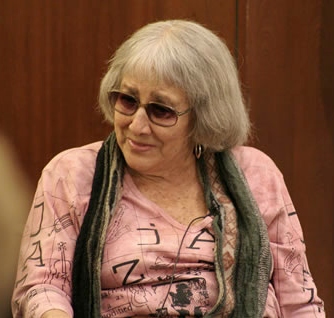
Sarasota, Florida, late afternoon. The Gulf water shimmers behind the windows of the laboratory she founded half a century ago. Eugenie Clark, her skin tanned by sixty years of salt and sun, lays her still-damp wetsuit on a chair and agrees to trace the thread of her underwater life.
—Where must we go back to find the origin of this life spent underwater?
To a Saturday morning of my childhood, in New York. My mother worked, and she dropped me off at the Battery Park Aquarium for the day, for lack of a better option. There I found much more than a daycare. I stayed for hours, my forehead pressed against the cold glass, following the slow back-and-forth of the fish. I imagined myself on the other side of the glass, walking on the bottom, among them, in that green silence. I was nine years old and didn't know it yet, but my whole life was already contained in that absurd and stubborn desire: to cross to the other side of the glass. My mother was Japanese; she had taught me that you can look at something for a long time before understanding it. Perhaps that is where, deep down, the ichthyologist was born.
My whole life was contained in that stubborn desire: to cross to the other side of the glass.
—How does one go from that dreamy little girl to a field scientist, harpoon in hand?
Through degrees, first—a bachelor's in zoology from Hunter College in 1942, then a doctorate from New York University in 1950. But a title doesn't put you in the water. What changed everything was the scuba gear that Cousteau had just developed: suddenly, you could breathe down there, for a long time, without a cable to the surface. At last I could enter the aquarium of my childhood, which had the size of an ocean. I learned to handle a simple hand harpoon—a Hawaiian sling—to collect my specimens; it gave its title to my first book, Lady with a Spear. I was no longer the little girl with her forehead pressed to the glass: the glass had disappeared.
—Why devote so many years to training sharks in your laboratory?
Because everyone thought they were stupid, mere jaws driven by hunger. In my tanks in Florida, between 1958 and 1959, I wanted to check. I taught lemon sharks to push a submerged target with their snout: if they pushed, a food reward fell. They understood. Better: they remembered from one session to the next, and resumed the exercise after weeks of interruption. I published these results in the journal Science. A predator that learns and remembers is no longer a killing machine; it is an animal. That small round target did more, I believe, for the reputation of sharks than any speech: it proved that there was someone behind those eyes that were said to be empty.
A predator that learns and remembers is no longer a killing machine; it is an animal.
—What did these experiments change in your own view of these animals?
They taught me patience and humility. At the Cape Haze Marine Laboratory, which I had founded in 1955, I spent my afternoons bent over the tanks, slate and notebook in hand, noting every deviation in behavior. One imagines the scientist dominating their beast; in reality, it is the animal that imposes its rhythm on you. A shark does not hurry to please you. I understood that conditioning was not a training trick, but a slow conversation between two very different intelligences. And I stopped being afraid, not out of bravado, but because fear is born from ignorance. The more I knew them, the less monstrous they seemed—and the more the true mystery deepened.
—Do you remember the discovery of the Moses sole repellent in the Red Sea?
Very well. In the Red Sea, near Ras Muhammad, I observed a small flatfish, the Moses sole, which secretes a milky liquid at the slightest danger. What amazed me was what it did to sharks: when one tried to grab it, its jaw seemed to freeze, open despite itself, and it fled as if burned. I had before my eyes a tiny fish that routed the great predator. The responsible toxin, pardaxin, opened an unexpected avenue: a natural repellent to protect divers. Nothing replaces fieldwork. No armchair theory would have shown me that shark's jaw refusing to bite.
A tiny fish that routed the great predator.
—What attracted you so much to those distant campaigns, especially in Egypt?
The warm, clear water of the Red Sea, first, where I conducted my first major campaign as early as 1951. A coral reef there teems with such dense life that you don't know where to look: every crevice hides a species, sometimes unknown. The days began early, checking the air tanks before the great heat, then I would submerge, underwater slate in hand, to draw and note before memory betrayed me. In the evening, under the lamp, I wrote. My life was thus divided between my Florida base and those coastal camps, those research boats. People asked if this nomadic life weighed on me; but how could the happiness of opening a door every morning onto a world yet to be described ever weigh?
—How did you hear about those famous “sleeping” sharks of Mexico?
From a fisherman, around 1973. He told me about motionless sharks, lying in underwater caves near Isla Mujeres, off Cancún—sharks that did not swim. I was urged to see it as just a sailor's legend: everyone knew then that a shark must constantly move to pass water over its gills, hence to breathe. To stop was to die. Many thought me quite naive for lending an ear to this tale. But I never knew how to believe or deny something without going to see. So I dove into those caves. And there they were, resting on the bottom, perfectly alive, breathing in a current that flowed through them. The fisherman was right; the scientists, myself included, had presumed.
I never knew how to believe or deny something without going to see.
—What would you say to those who still see you diving at an advanced age?
That the ocean does not ask for an age at its threshold. I made one of my last dives at ninety-two, shortly before the end, and over the course of my life I completed more than seventy deep submersible dives, into those zones where sunlight no longer reaches. People took me for stubborn; I think above all I never stopped being that child in front of the glass. Curiosity, if you feed it, does not age—it is the body that lags behind. To descend once more, feel the pressure, see a form emerge in the beam that had never been described: that is what I did not want to leave. You do not retire from wonder.
You do not retire from wonder.
—You were nicknamed the “Shark Lady”: did that title suit you?
It amused me and also committed me. Science popularization is not a side activity for me: what good is knowledge if you keep it to yourself? In 1981, I signed an article in National Geographic that I wanted to title “Sharks: Magnificent and Misunderstood.” Everything is in that last word. The shark had been made into a bogeyman, whereas it is rarely a danger to humans and plays an irreplaceable role in the ocean. A dozen articles, several books: I spent as much time writing for the public as working in my tanks. Changing an image rooted in fear requires even more persistence than training a lemon shark.
Magnificent and misunderstood: everything is in that last word.
—What would you like the general public to remember from your work?
That fear always recedes before patient observation. When I published Lady with a Spear in 1953, I had no idea that this account of dives and fishing campaigns would touch so many readers who would never enter the water. That is where I understood my second vocation: storytelling. A child who reads that a shark can learn, that a small sole can drive it away, that child will never look at the ocean the same way again. I did not only want to add species to the catalog of ichthyology; I wanted to make the sea less frightening and vaster in people's minds. If some, in reading me, have in turn felt the urge to press their forehead to the glass, then I have done my job.

This imaginary interview was generated by artificial intelligence from sources documented in Eugenie Clark's profile. It dramatises what the figure might have said based on what we know about them, but does not constitute attested historical testimony. For primary sources and factual documentation, refer to the full profile.