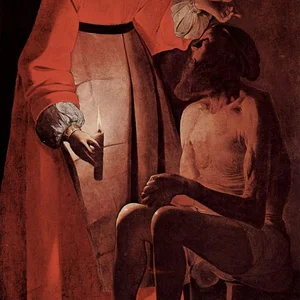

A biblical figure from the Old Testament, the archetypal Righteous Man whose faith is tested through suffering. Job embodies the question of evil and divine providence in the face of undeserved trials. His story raises the timeless questions of human suffering and trust in God despite adversity.
Frequently asked questions
Famous Quotes
« The Lord gave, and the Lord has taken away; blessed be the name of the Lord. (Job 1:21)»
« For I know that my Redeemer lives, and that in the end he will stand upon the earth. (Job 19:25)»
Key Facts
- A righteous and prosperous man struck by God with successive misfortunes — loss of wealth, illness, and the death of his children — to test his faith
- He engages in dialogue with three friends (Eliphaz, Bildad, and Zophar) who attempt to explain his suffering as the result of his supposed sins
- His story calls into question divine justice and the assumed link between sin and suffering, a central issue in theodicy
- God ultimately intervenes, answering Job with questions about the order of creation, without directly justifying his suffering
- Job is finally restored: his health, fortune, and family are all renewed, vindicating his patience and faith
Works & Achievements
A biblical book of the Old Testament that tells the story of Job, a righteous man struck by terrible misfortunes. It is a profound meditation on the problem of evil, undeserved suffering, and unwavering faith in the face of adversity.
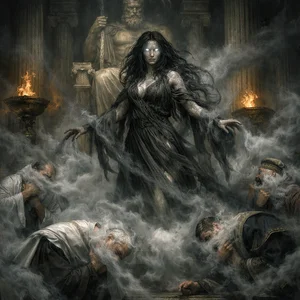
The first series of catastrophes inflicted upon Job, in which he loses his children and his wealth through a series of disasters. This trial constitutes the first test of his faith and marks the beginning of his immeasurable suffering.
Job is struck with a severe skin disease and extreme pain, sitting among the ashes and scraping himself. This trial symbolizes the pinnacle of suffering and serves as the ultimate test of his moral integrity.
A theological debate in which his friends attempt to explain his suffering through his supposed sins, while Job maintains his innocence. This exchange raises fundamental questions about divine justice and the meaning of suffering.
Job receives a divine revelation that brings him back to humility and absolute trust in providence. His material and spiritual restoration affirms that steadfast faith triumphs over adversity.
Job becomes the universal model of persecuted innocence and tested virtue, profoundly influencing Western literature, theology, and philosophy on the problem of evil.
Anecdotes
The Book of Job, one of the oldest texts in the Bible, raises a philosophical question that was revolutionary for its time: why do the righteous suffer? Unlike other biblical books, which hold that suffering is punishment for sin, Job maintains his innocence against his friends, who accuse him of hidden wrongdoing. This theological debate has shaped Western religious thought for more than 2,500 years.
The structure of the Book of Job is unique in the Bible: it weaves together a prose narrative (prologue and epilogue) with poetic debates between Job and his three friends, who try to explain his misfortunes. This hybrid form, recognized by modern biblical scholars, shows that it is a sophisticated literary composition, most likely written between the 6th and 4th centuries BCE.
The trials described in the Book of Job are extreme: the loss of his wealth, the death of his children, disease covering him from head to foot, and complete social abandonment. These ordeals are never framed as divine punishment, but as a mysterious test — which makes the story particularly unsettling and theologically groundbreaking for the ancient world.
The figure of Job has inspired countless artistic, philosophical, and literary adaptations: from the Middle Ages to the present day, thinkers such as Thomas Aquinas, Leibniz, and even Camus have reflected on the meaning of his suffering. Job has become the universal archetype of the righteous person confronting the injustice of the world.
The Book of Job reveals a major theological tension: God himself intervenes at the end not with rational explanations, but by asking Job a series of questions about the grandeur of creation. This enigmatic response suggests that human understanding of evil remains limited in the face of divine mystery.
Primary Sources
Job said: Naked I came from my mother's womb, and naked I will depart. The LORD gave and the LORD has taken away; may the name of the LORD be praised. (Job 1:21)
Then Bildad the Shuhite replied: Does God pervert justice? Does the Almighty pervert what is right? When your children sinned against him, he gave them over to the penalty of their sin. (Job 8:3-4)
Then the LORD spoke to Job out of the storm. He said: Who is this that obscures my plans with words without knowledge? Brace yourself like a man; I will question you, and you shall answer me. (Job 38:1-3)
You have heard of Job's perseverance and have seen what the Lord finally brought about. The Lord is full of compassion and mercy. (James 5:11)
Key Places
The traditional region where Job lived before his trials. It provides the geographical setting for his story, located according to biblical tradition somewhere between Mesopotamia and Syria, though its exact whereabouts remain debated by historians.
A major spiritual and religious center where the Book of Job was transmitted and interpreted within Jewish tradition. The city stands at the heart of biblical revelation and rabbinical commentary on the problem of evil.
A symbolic region associated with spiritual trials and penance in biblical tradition. It represents the setting of the suffering and isolation Job endured throughout his ordeals.
A symbolic reference to places of divine revelation in the biblical text. The Book of Job evokes transcendent realities and encounters between Job and God, often associated with sacred heights.
The likely historical context for the composition of the Book of Job in the first millennium BCE, during the Jewish exile. The textual tradition of the book is rooted in this period of reflection on suffering and divine justice.
Liens externes & ressources
Références
Œuvres
Le Livre de Job
entre le VIe et IVe siècle av. J.-C.
L'épreuve de la perte de ses enfants et de ses biens
tradition antique
L'épreuve de la maladie et des souffrances physiques
tradition antique
Le dialogue avec ses trois amis (Éliphaz, Bildad, Zophar)
tradition antique
La vision de Dieu et la rédemption finale
tradition antique
L'archétype du Juste souffrant
tradition antique