Imaginary dialogue between André Breton and Frida Kahlo
by Charactorium · Frida Kahlo (1907 — 1954) · Visual Arts · 7 min read
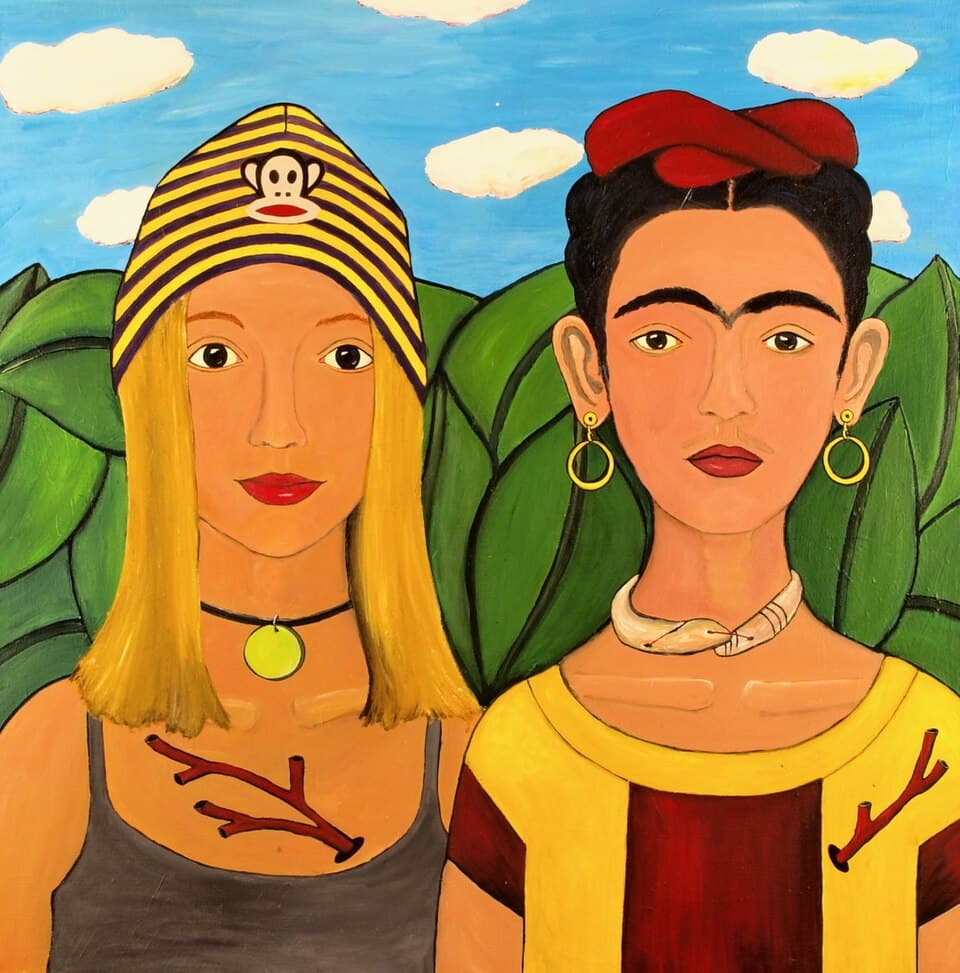
It is spring 1954 at the Casa Azul in Coyoacán, and André Breton has come one last time into the blue garden where Frida Kahlo paints and receives the world. She is seated near the fountain in an embroidered tehuana blouse, marigolds and dark ribbon wound through her hair, a half-finished canvas propped against the courtyard wall. Turpentine and tropical flowers. They have known each other since 1938, when Breton walked through these same rooms and came away convinced he had discovered the most authentic surrealist voice alive — a verdict Frida has spent the years since quietly, pointedly, refusing.
—Frida, the tramway, the months flat on your back, the mirror fixed above the bed — without all of that, would there be any paintings?
André, I sometimes ask myself exactly that, and the answer unsettles me. Before September 1925, I intended to become a doctor — the Escuela Nacional Preparatoria was preparing me for science, not canvas. The tramway changed everything in a few seconds: broken spine, broken collarbone, broken pelvis, and a steel rod that passed through me like a sentence I could not refuse. My mother had a special easel built to fix to the baldaquin of my bed so I could work lying down, and she placed a mirror in the ceiling so I could see myself. There was nothing else to look at — no sky, no street, only my own face staring back. I did not choose self-portraiture out of vanity. My body chose it, because I was the only model who could not walk away. I owe almost everything to that crash, which is an absurd and terrible debt.
I did not choose self-portraiture out of vanity. My body chose it, because I was the only model who could not walk away.
—And those months of absolute stillness — did they teach you something about how to paint that you could not have learned standing up?
They taught me precision above all. In an ordinary studio you can step back from the canvas, walk away, return with fresh eyes. I had none of that. I worked inches from the paint, which is why you will find details in my faces that are almost uncomfortable — every pore, every hair of an eyebrow, committed without the possibility of retreat. I had to trust each stroke because changing my position cost me pain. Confinement also gave me time, more time than I knew what to do with, and I filled it by looking very carefully at one subject: myself. I learned the bones of my face the way a musician learns a difficult passage — by repetition, by patience, by accepting that this is the work in front of you and nothing else will do. Paint turned out to be more reliable company than most people who came to sit with me during those months.
—When I arrived here in 1938 and stood before these paintings, I was certain I had found something new. Why have you resisted surrealism ever since?
Because the word belongs to you, André, not to me — and I mean that without any malice. Surrealism travels from Europe with its particular anxieties, its fascination with the unconscious, its desire to escape the rational and arrive somewhere strange. I have never needed to escape anywhere. My life already provided more strangeness than any theory could manufacture. What I painted in those years — and what I paint now — comes directly from what happened to my body, my country, my marriages, my beliefs. There are no dreams encoded in my canvases. There is only what I have lived, reported as accurately as I can manage. If that looks like surrealism from Paris, I understand the confusion. But from inside the Casa Azul, looking at the bougainvillea and the xoloitzcuintles and my own broken spine, I assure you it simply looks like Tuesday.
—So when you insist your reality is stranger than any dream — is surrealism, then, simply a pale imitation of ordinary life?
I would not put it that harshly — your movement has done important things, and I have genuine respect for the courage it took to break from convention. But yes, I think the surrealists went looking in the unconscious for what was already sitting in plain sight on the kitchen table. I never had to descend into dreams to find the uncanny. The uncanny came looking for me: in the form of a steel rod, in the form of thirty-five corsets, in the form of a man I divorced and then remarried and whom I will probably love until I die. What I want from painting is not obscurity but clarity — to look at the thing that happened and say: yes, this is exactly what it was. That is harder than inventing monsters. The real ones are more interesting anyway.
—Frida, the flowers, the long skirts, the old gold — is the tehuana costume simply who you are, or a decision you make each morning?
It is both, and that is exactly the point. When I was six, the polio left my right leg thinner than the left — children called me Frida pata de palo, Frida peg-leg. The long skirts cover what they mocked. But I did not stop there: I made the costume into an argument. The tehuana comes from Tehuantepec, where women hold the market, hold the family, hold the community — a world that colonial Mexico has spent centuries trying to erase. When I wear these skirts and this jewelry, I am not dressing up for Europeans who want something exotic. I am saying that this culture is serious, that it is mine, and that I refuse to trade it for a French dress and the approval of people who do not know what an ex-voto is. The costume is political. Every morning I put it on, I am making a statement that does not require a manifesto.
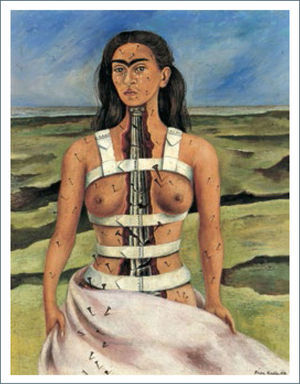
—The corsets you decorate with flowers and Aztec symbols — when I saw them, I thought: these are also your work. Do you agree?
Of course they are. What else was I supposed to do — wear a medical appliance like a defeat and say nothing? You saw at least one when you were here in 1938, André. I have lived in corsets of plaster, leather, and steel — thirty-five different ones over the years, each built because the last operation failed to hold me together long enough. Doctors hand you these objects and expect gratitude for the ugliness. I painted them with the things I loved: flowers from the garden, political symbols I believed in, Aztec motifs I inherited from a civilization I refuse to treat as dead. A decorated corset is not a metaphor. It is a practical decision. If you must wear the cage, you may as well paint the bars. And the result is more truthful than a plain white cast, because it shows you who is trapped inside.
If you must wear the cage, you may as well paint the bars.
—Your party membership, the murals, the marches — does the politics inform the painting, or do you sometimes feel they pull in opposite directions?
They have never pulled in opposite directions for me — that is a European problem, not a Mexican one. In Mexico, art and politics grew up in the same house. Diego was painting revolutions on the walls of public buildings before I held a brush. When I joined the Partido Comunista Mexicano in 1928, it was not a theoretical decision — I had watched the revolution of 1910 reshape everything I knew, and I understood that art which refuses to take a position has already taken one. My paintings are not propaganda; they are too personal for that. But they are not innocent either. When I paint my body broken against a political landscape, I am asking who benefits from keeping workers and women in pain. That question has an answer, and I have never been shy about where I stand.
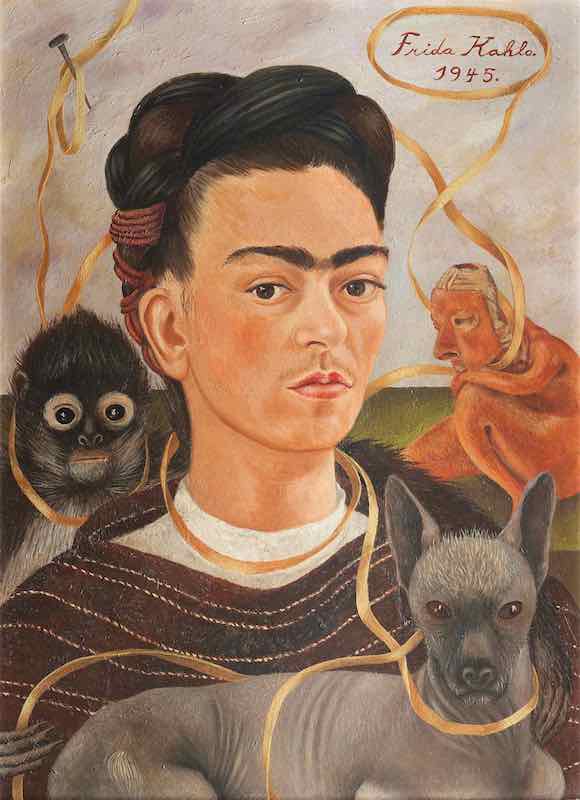
—When Trotsky was killed in 1940, just streets from here — I was in Paris, thinking of you. What did that do to your convictions?
It frightened me, yes, and the fear lasted longer than it should have. They briefly suspected me — I was detained, questioned, released. For a time I could not sleep without listening to the courtyard. Lev Davidovich was a complicated figure, as you know — I admired and disagreed with him in almost equal measure, and there are things about that time I will not rehearse here. But his murder taught me something about how seriously power takes the people who oppose it. It reminded me that conviction is not an abstract position. It can get you killed in the afternoon in your own home. I continued to believe what I believe. But after 1940 I understood that belief has consequences, and I stopped being surprised when the consequences arrive without announcement.
—At the Lola Álvarez Bravo gallery last year — your bed carried in, the doctors overruled. What made that appearance worth the risk?
Because it was the first major exhibition of my work in Mexico — in my own country, after more than twenty years of painting. I was not going to miss it because my spine refused to cooperate. They said I should rest; I said I had been resting since 1925 and it had not particularly helped. So we arranged the bed, I dressed as properly as I ever have, and I received everyone who came — artists, friends, strangers — from the pillows, with the paintings on the walls around me. Some people wept when they came through the door. I did not. I was too busy being glad to be there. A painter belongs at her own opening, whatever the doctors think. And I wanted the people of Mexico to see that I was still here, still working, still wearing flowers, still very much alive — whatever the X-rays had to say about it.
—Now, painting from a chair rather than an easel — what do you want the world to receive from what you are making now?
Joy, mostly. That probably surprises you. After so much painted pain — the broken columns, the open hearts, the surgical scars — what I want to leave behind is joy. I have been working on simpler things lately: fruits, the garden, colors I have rarely let myself use before, because I was too busy explaining suffering to celebrate anything. Now I want to paint a slice of watermelon and write underneath it that life is worth living — because it is, despite everything, and I mean everything. I have suffered more than most people will ever know, lost more than I will list for you here. And I am still sitting in this garden telling you: the world is beautiful. That is not naivety, André. That is a conclusion I earned.
The world is beautiful. That is not naivety. That is a conclusion I earned.
This imaginary interview was generated by artificial intelligence from sources documented in Frida Kahlo's profile. It dramatises what the figure might have said based on what we know about them, but does not constitute attested historical testimony. For primary sources and factual documentation, refer to the full profile.