Kids interview Frida Kahlo
by Charactorium · Frida Kahlo (1907 — 1954) · Visual Arts · 6 min read
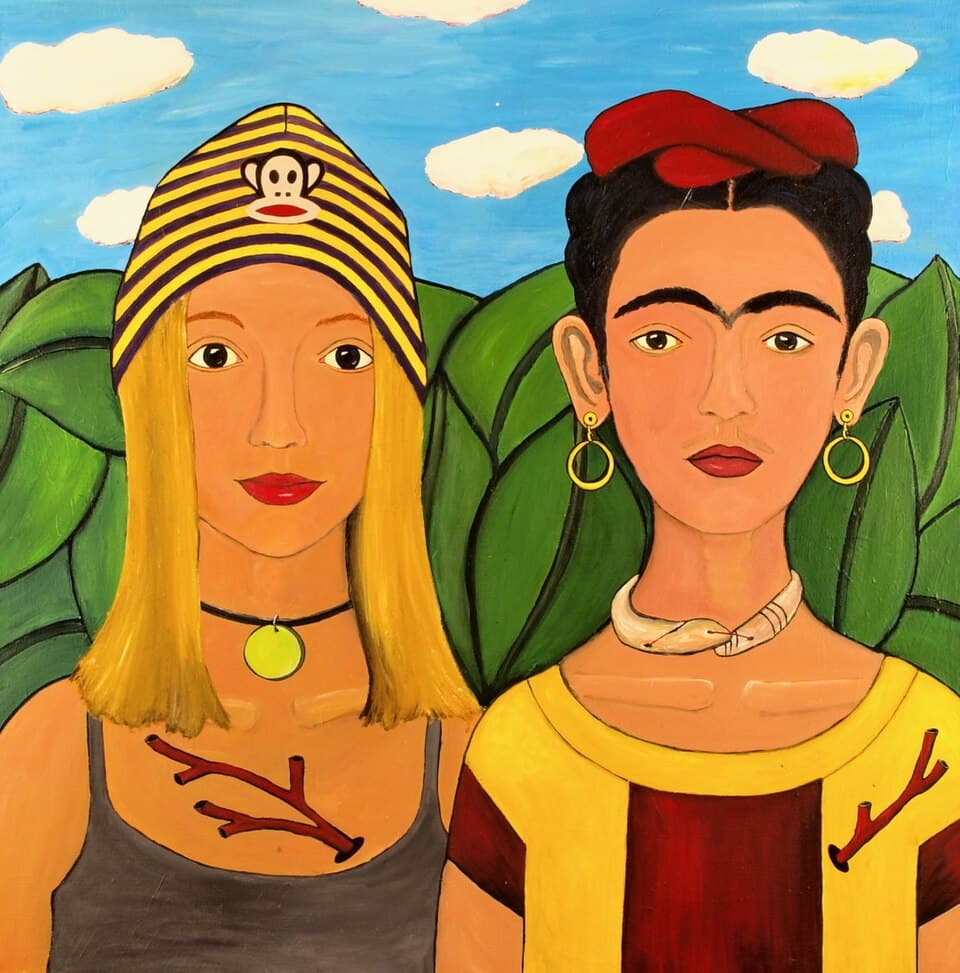
Two twelve-year-olds on a school trip have just stepped into the Casa Azul — the bright blue house in Coyoacán where Frida Kahlo was born and spent most of her life. The kitchen smells of coffee and fresh marigolds; Frida sits at the wooden table in her embroidered tehuana skirt, a crown of flowers woven into her dark hair, and she watches the two young visitors with warm, curious eyes. 'Come and sit,' she says with a smile — 'ask me anything.'
—How old were you when you had your accident? Was it very scary?
I was 18 years old. It was September 1925, on the streets of Mexico City. The bus I was riding was struck by a tramway. I don't remember the sound — only a flash of light, and then nothing. When I woke up, my spine, my pelvis, my right leg were broken, and a steel rod had gone clean through my body. The pain afterwards... imagine someone has taken every bone inside you and put them back in the wrong place. That is what I felt every single day for months. But here is the strange thing: that accident gave me something too. It put me in bed long enough to discover I could paint. Without that crash, I might never have become an artist.
That accident put me in bed long enough to discover I could paint.
—How did you manage to paint if you couldn't even get out of bed?
My mother was ingenious about it. She had a large mirror fixed to the ceiling above my canopied bed — so I could see my own face while I lay there. Then a special easel was built and attached to the bed frame, holding the canvas right above me while I worked. Picture it: brushes in my hand, canvas overhead, and my own reflection staring back at me from the ceiling. That is how my very first self-portrait was born — Autoportrait au collier de velours, in 1926, when I was 19. My bedroom became my studio. My face became my first subject. When you cannot go out into the world, you paint the world you already have — and for me, that world began with my own eyes looking back at me.
—Why did you always wear those big colourful skirts and flowers in your hair?
You noticed! Those are called tehuana costumes — traditional dress from a region of Mexico called Tehuantepec. I wore them every day of my adult life, for two reasons. First: pride. After centuries of people insisting that European fashion was superior, I wanted to say with my very clothing that our Mexican traditions were beautiful and worth keeping. Second — and this is my small secret — those long skirts hid my right leg, which had been thinner than the left since I had polio as a child. So my costume was armour and celebration at once. Add flowers in the hair, some pre-Columbian gold at the neck, and when I walked into a room, everyone stopped to look. That suited me perfectly.
—Were you interested in politics? Did it change your painting?
Enormously. I joined the Partido Comunista Mexicano — the Communist Party of Mexico — in my early twenties. I believed the world was profoundly unfair to the poor and to indigenous peoples, and that an artist who ignored that was being dishonest. Mexico had fought a long revolution beginning in 1910, promising dignity to those who had none — that mattered deeply to me. So my paintings are filled with Mexican symbols: indigenous masks, ancient objects, ordinary faces. I wore pre-Columbian jade beads and gold earrings every day to honour the cultures that colonisers had tried to erase. For me, a painting was never just decoration. Every colour I chose was a choice about what I believed in.
—A man called André Breton said you were a Surrealist. Was he right?
Ha! André Breton visited my studio in Mexico in 1938. He was dazzled and wrote that I painted 'spontaneously' like a Surrealist. I was not offended — but I disagreed, very firmly. The Surrealists painted dreams: invented worlds drawn from the unconscious mind. I painted my own life. My broken spine. My lost pregnancies. My love for Diego. None of that was invented or imagined — it was completely, terribly real. Imagine someone calling your personal diary a fantasy novel. That is how I felt. It matters, you know, to know exactly what you are making and why — and not to let anyone else stick a label on you that does not fit.
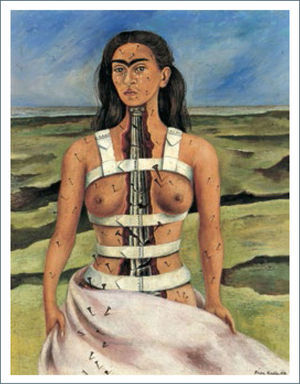
—If you didn't paint dreams, what exactly did you paint?
I painted what I actually lived through — all of it. I once wrote in a letter to my friend Nickolas Muray: 'I never painted dreams. What I painted was my most intimate reality.' That is as precise as I can be. My canvases were like a diary — except instead of words, I used paint and colour. Look at Henry Ford Hospital, from 1932: I had just lost a pregnancy in Detroit, far from home and in terrible pain. I painted that loss exactly as I felt it, without softening a single detail. That kind of grief is not a dream. It is the realest thing there is. My art was simply me, put honestly on canvas.
My canvases were a diary — except instead of words, I used paint and colour.
—Who was Diego Rivera to you? Was he your best friend?
Diego was many things — I find it hard even now to name just one. He was my husband, not once but twice: we married in 1929, divorced, then married again in 1940. He was the greatest muralist in Mexico, painting enormous frescoes across the walls of public buildings. He was also my deepest inspiration and, often, my deepest sadness — he was unfaithful, more than once, and so was I. And yet I could never fully let go of him. He once called me, in his strange roundabout way, the best proof that purposeful evolution exists — that was his peculiar sort of compliment. What I can say is this: loving Diego was never simple, and never peaceful. But the love itself was absolutely real.
—In that big painting with two of you — why are there two Fridas?
That painting is Les Deux Fridas — my largest canvas ever. I made it in 1939, right after Diego and I divorced. Picture two women seated side by side — both me, both with their chests open and their hearts exposed, connected by a single vein. One Frida wears a white European dress: the Frida Diego had stopped loving. The other wears a tehuana costume: the Frida he once adored. When someone important leaves you, you feel split in two. One part remembers who you were when you were loved. The other tries to figure out who you are alone. I painted both those Fridas so that I could look at them — and learn to survive the split.
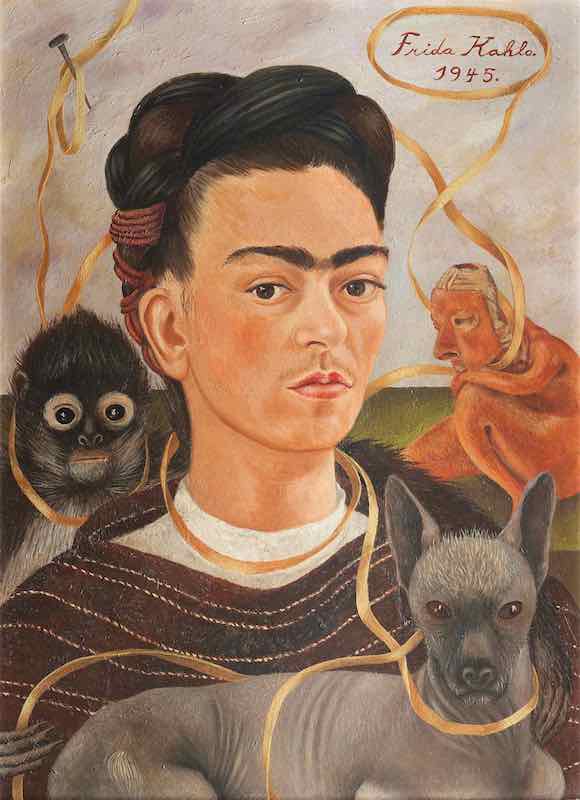
—Did you really paint and decorate the medical corsets you had to wear?
Every single one. Over my life I wore 35 different corsets — some plaster, some leather — because my spine needed constant support after so many operations. They were rigid and heavy and made me feel like a prisoner inside my own body. So I decorated them. Flowers. A red star. The face of Diego. Mexican patterns. They were never meant for a gallery — just my way of saying: even this cage belongs to me. Picture having to wear a heavy brace around your ribs all day, every day, for years. Now imagine painting it bright red and covering it with sunflowers. My body was broken. My hands still worked. And where my hands went, colour followed.
—Is it true you came to your own exhibition lying in your bed?
Absolutely true! It was April 1953, at the gallery of Lola Álvarez Bravo in Mexico City — my first solo exhibition in Mexico after years of showing abroad. My doctors had forbidden me to stand: my health was very bad by then. But I had waited too long for that night to miss it. So my canopied bed was carried into the gallery. I arrived by ambulance. I lay there in my finest tehuana costume, laughing, singing, receiving guests as if it were a grand party. Some people wept when they saw me. I thought: what better way to show paintings about pain than to be there in person — alive, dressed, and absolutely refusing to disappear?
—What do you most want us to remember about you?
Eight days before I died, I finished my last painting — Vive la vida, a still life of watermelons. On the bright red flesh of the fruit I wrote three words: Viva la vida — long live life. Not because everything had been easy. Nothing had been easy for me. But I had loved Mexico, I had loved painting, I had loved other people fiercely — even when loving hurt. So I want you to remember this: you do not need a perfect body, or a perfect life, to make something true and beautiful. You need only to look honestly at what you have — your room, your pain, your small joys — and to begin. That is all I ever did. And it was enough.
You do not need a perfect life to make something beautiful. You only need to begin.
This imaginary interview was generated by artificial intelligence from sources documented in Frida Kahlo's profile. It dramatises what the figure might have said based on what we know about them, but does not constitute attested historical testimony. For primary sources and factual documentation, refer to the full profile.