Imaginary interview with Frida Kahlo
by Charactorium · Frida Kahlo (1907 — 1954) · Visual Arts · 7 min read
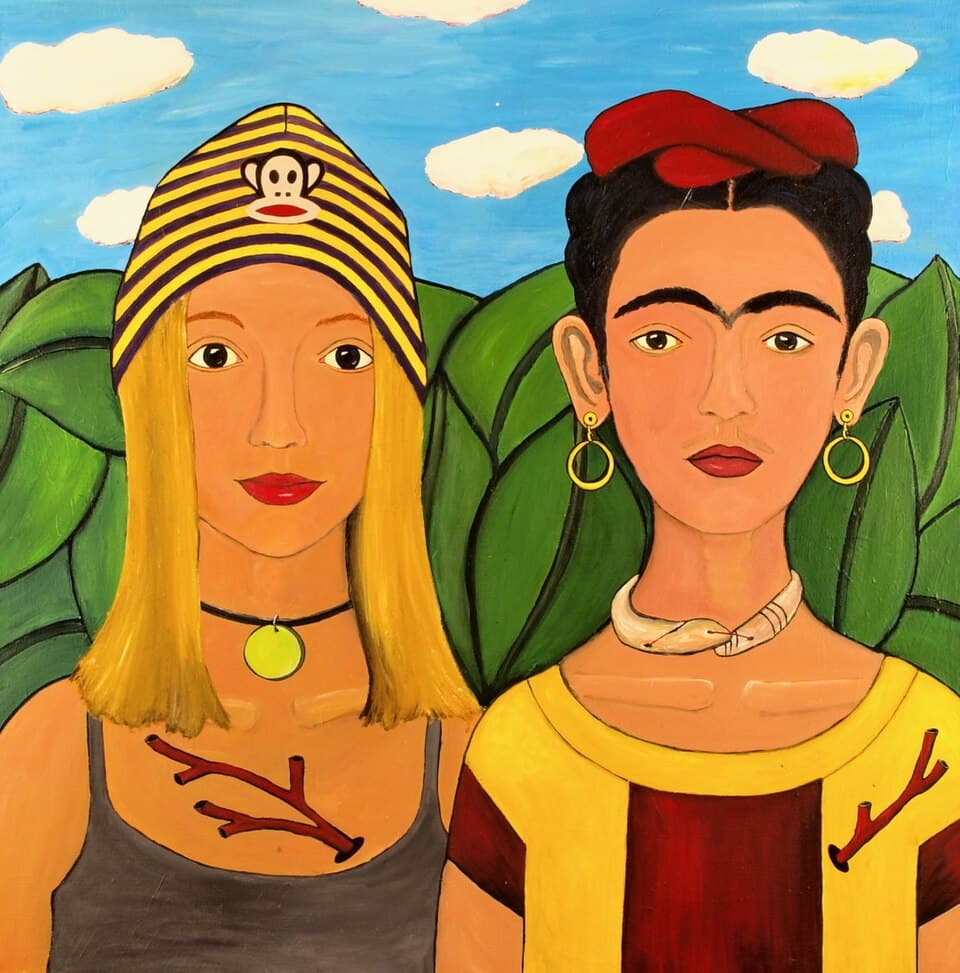
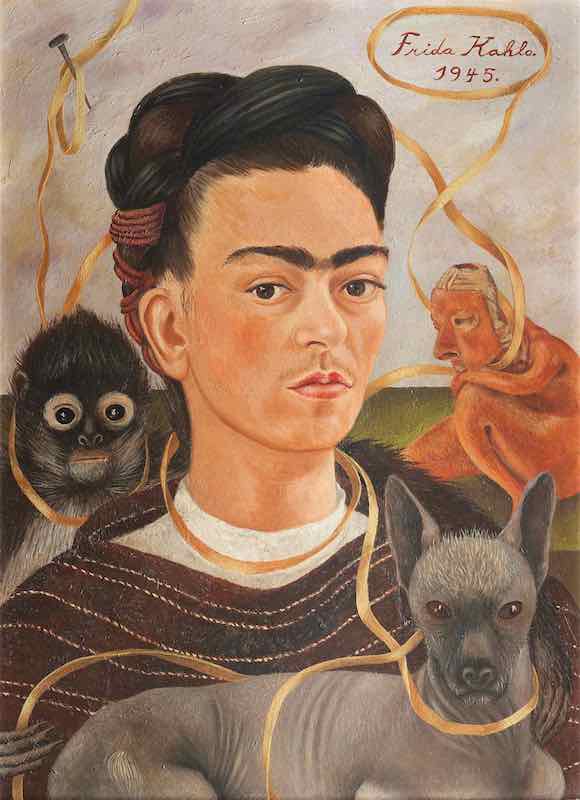
We meet Frida Kahlo in the summer of 1954, in the studio adjoining the Casa Azul — the cobalt-blue house in Coyoacán where she was born and has spent most of her life. She is propped against the pillows of her four-poster bed, a new canvas drying on the fixed easel above her, the air carrying turpentine and the sweetness of marigolds arranged in clay pots along the sill. A xoloitzcuintle dog sleeps undisturbed at her feet; around her neck, a strand of pre-Columbian jade she has worn in paintings for nearly twenty years.
—You were eighteen when the 1925 bus accident confined you to bed for months. What do you remember of those first weeks of enforced immobility at the Casa Azul?
What I remember is a particular quality of silence — not peaceful, but imposed. The bed became my country, my studio, my prison, all at the same moment. My mother had a carpenter build an easel that fixed to the baldaquin so I could work lying flat, and she hung a mirror from the frame above so I could see my own face. Day after day, that face looking back at me. I had never paid much attention to my own features before — faces are for other people to study. But confined to that room in Coyoacán, my face was the one model who never grew tired, who never asked to leave. The first serious portrait I finished during that convalescence was painted at nineteen. There is already something in those eyes that knows it will have to learn to stare back at a great deal of difficulty.
My face was the one model who never grew tired, who never asked to leave.
—Your right leg has been thinner and shorter since the polio of your childhood. How early did you understand that clothing could be a kind of answer to that?
Very early, and not by philosophy — by necessity. I was six years old when the illness came, and when I was walking again one leg had fallen behind the other. My classmates in Coyoacán had a name for it: Frida pata de palo, Frida peg-leg. Children are not subtle. So I began wearing extra stockings, shoes with thicker soles, skirts long enough to swallow the difference. But at some point the concealment became a choice — I was already wearing the long skirts of Tehuantepec for practical reasons, and then I understood that they were also beautiful, that they carried a whole history of women who had made them by hand. What began as a way to hide a limb became a way to carry a civilization on my hips. The disguise became a declaration, and by then I had forgotten which was which.
—The tehuana costume — the embroidered skirts, the flowers woven into your hair, the pre-Columbian gold — has become inseparable from how the world sees you. What does a woman put on when she dresses that way each morning?
She puts on a position, a history, and a refusal — all at once. The skirts of Tehuantepec are long, heavy, and embroidered by women whose names no one outside their village will ever know. When I walk into a room wearing mine, I carry that labour with me. And I carry an argument. Mexico in the 1920s was rediscovering itself after the Revolution — indigenismo, the intellectuals called it — and the muralists were reclaiming the pre-Hispanic past for the walls of public buildings. I was wearing that same reclamation daily. Every time I left the Casa Azul in my huipil and my gold and my flowers, I was saying: this is whose country this is, this is what beauty looks like here. Politics and adornment and the smell of a market, all bound together in the fabric.
She puts on a position, a history, and a refusal — all at once.
—In the 1931 double portrait Frieda and Diego Rivera, you stand beside him holding his hand — yet the painting also asserts you as an independent artist. How did you hold both those things at once?
Look at the painting carefully and you will see exactly how. Diego is enormous — he always was, in every sense — holding his palette and brushes in one hand, proof that he is the muralist, the one who fills walls. My hand is in his other hand, and I am standing straight, looking outward — not at him, but out, toward whoever is watching. A painter's wife and also a painter: I included both because both were true, and the tension between them was not something I wanted to resolve by choosing only one. We had married in 1929. I was twenty-two. I already knew that being near Diego meant living permanently in a large shadow. What I did not yet understand was how long that shadow falls, and what it teaches you about working in the hours when the light shifts just enough.
—The ceiling mirror your mother installed during your convalescence — you have painted yourself hundreds of times since. Do you consider it your most important artistic inheritance?
I consider it an accident that became a discipline. The mirror forced a confrontation I could not sidestep: you cannot look at your own eyes for months on end without learning what lives inside them. I began to understand that my face was a landscape as complex as any exterior view — the slight asymmetry, the brows joined above the nose, the upper lip I never thought to alter. All of it went directly onto canvas. Later, working in the proper studio when I could move again, I kept painting myself — not out of vanity, I think, but because that long confinement in the Casa Azul had trained me to look without flinching at whatever was in front of me, including my own strangeness. I know myself better than I know any other subject. That is simply the truth, and the mirror is where I learned it.
—When André Breton arrived in Mexico in 1938 and declared your work 'spontaneously surrealist,' what was your first reaction?
Amusement first, then something between irritation and pity for him. Breton arrived with his theories already completely packed, like luggage. He had decided what he would find before he opened his eyes. He watched me work and concluded I had dreamed everything — that my bleeding papayas and split torsos were products of the unconscious on its way toward revelation. I told him plainly: I have never painted dreams. What I painted was my most intimate reality. I later wrote the same thing to a friend in New York because people kept asking. My leg. Three miscarriages. The hospitals in Detroit. Diego. None of this was conjured by the unconscious; it was experienced by the body and recorded by the hand. The surrealists needed the dream to escape from reality. I already had more than enough reality. I was not in the market for additional imaginary suffering.
—Yet Paris in 1939 brought recognition hard to find elsewhere — the Louvre acquired your self-portrait Le Cadre, making you the first Mexican woman in its collection. How complicated was that victory?
Very complicated, and I will not pretend otherwise. Breton had organized everything under his surrealist banner — precisely the label I had refused — and my canvases spent weeks in customs before the opening. The gallery was not the one I had imagined. And yet: the Louvre acquired Le Cadre — my face framed by painted flowers, looking out from inside a gilded border as if I had already decided to become a museum piece. I was the first Mexican woman to enter those collections. That is not nothing, whatever the politics surrounding it. The painting is in those walls now, categorized however they choose, and it will remain there long after the argument about which movement it belongs to has been entirely forgotten. I arrived via Breton's passport. The painting stayed on its own terms.
—In your journal you wrote that you had suffered two great accidents — the tramway, and Diego. What did you mean by placing them in the same sentence?
I meant precisely what I wrote. The sentence requires no decoration. The first collision — September 1925, the bus and the tram — left me with fractures I spent years counting. The second was Diego: a collision that did not end in a hospital, that kept rearranging all my interior architecture year after year without resolution. We married in 1929, divorced in 1939, married again in 1940 — his infidelities, mine, the jealousies, the love that was never quiet or convenient. When the first divorce came I painted Les Deux Fridas — the largest canvas I had ever stretched — two versions of myself seated side by side, one heart whole and one laid open, connected by a single vein that someone is in the act of cutting. You paint a wound to understand its shape from outside. That is the only way to grasp what it has actually cost.
—You wore more than thirty different orthopaedic corsets over your lifetime, and you painted them — covered them with flowers, mirrors, political symbols. What makes a person decorate an instrument of constraint?
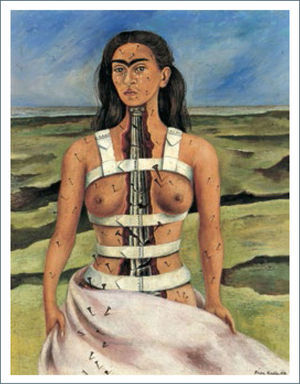
The same impulse that makes anyone decorate a prison wall — the need to claim it. After each operation the surgeons wrapped my torso in plaster and told me not to move. So I took my finest brushes and covered the white surface with mirrors, flowers, hammers and sickles, whatever lived in me at the time. The corset becomes mine the moment my hand is on it. When I painted La Colonne brisée in 1944 — after a surgery that put me in another new corset for months — I showed the spine as a ruined Ionic column cracking through my body, nails covering the whole surface the way a devotional image fills up with votive pins. Not to make pain beautiful. To make it legible. Once something is on a canvas I can look at it from the outside. I am no longer entirely inside it, which is the only way to continue.
—In 1953, at your first solo exhibition in Mexico City, the doctors forbade you to stand — so you had your four-poster bed carried into the gallery and received guests lying down. What went through your mind when you entered the room that way?
First, that it was funny — genuinely, good-humouredly funny. I called Lola Álvarez Bravo and said: if I cannot come to the gallery, the baldaquin comes to the gallery. They set the bed in the centre of the room. I was in full tehuana dress, jewellery, hair done — entirely present, entirely myself. Guests came to me the way one visits someone in residence. And then, lying there, I looked at the walls: canvas after canvas of a body in some state of breaking or enduring. And in the centre of the room, the body itself — the same body that had produced every one of those paintings. The work and its subject finally in the same space at the same moment. It was the most honest hanging I have ever been part of, and I am not sure a healthier woman could have managed it.
The work and its subject finally in the same space at the same moment.
—You have just completed Vive la vie — the words Viva la vida inscribed directly into the flesh of watermelons. What compelled you to write that?
Exactly what I said: Viva la vida. Long live life. Not as performance, not as irony for whoever might be watching. I have been ill for months, barely leaving the Casa Azul, painting when I can still hold the brush. Watermelons have something of the wound about them — that vivid red interior when you cut them open, the damp exposed flesh. But they are also sweet, and they are summer, and they are the market-stalls of Coyoacán on a Friday morning where I have been going since I was a child. I cut the words into the fruit as if carving into stone: direct, permanent, no qualification. Forty-seven years of negotiating with a body that has required almost constant attention — and still I have painted, and loved without restraint, and sung corridos until midnight, and worn flowers in my hair every morning I was well enough to dress. Long live life. I meant it completely.

This imaginary interview was generated by artificial intelligence from sources documented in Frida Kahlo's profile. It dramatises what the figure might have said based on what we know about them, but does not constitute attested historical testimony. For primary sources and factual documentation, refer to the full profile.