Imaginary interview with Funmilayo Ransome-Kuti
by Charactorium · Funmilayo Ransome-Kuti (1900 — 1978) · Politics · Society · 6 min read
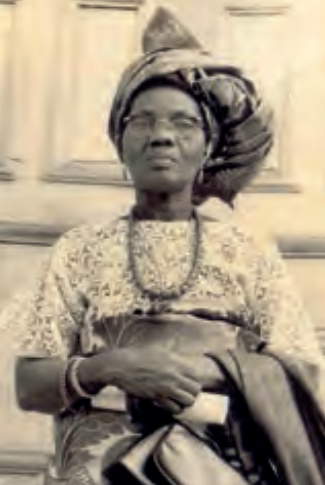
Abeokuta, a dry-season afternoon, in the large house where activists from the villages and colonial law books cross paths. Funmilayo Ransome-Kuti, her gele impeccably tied, sets down her cup and agrees to look back on sixty years of struggle. Her voice is calm, but every sentence rings like a marching order.
—Before you were a crowd leader, you were a teacher. How did that classroom make you an activist?
People always think it all began in the streets, with shouts and banners. No. It all began in front of a blackboard, chalk in hand, at the primary school in Abeokuta. I saw women from the market who could count their coins but could not decipher the tax notice handed to them. How do you defend yourself against a paper you cannot read? I realized the alphabet was a weapon before it was knowledge. So my afternoons filled with those women from nearby villages, bent over letters as if over a secret that had been stolen from them. When I founded the Abeokuta Women's Union in 1946, I simply opened that classroom wider.
The alphabet was a weapon before it was knowledge.
—You were born Frances Abigail Olufunmilayo Thomas. Why did you abandon the name 'Frances'?
A name is not a garment you wear by chance: it is a flag planted on yourself. 'Frances' was the flag of others, the one placed on our cradles to remind us who was in charge. Many around me collected these European names like titles of nobility. I, as a young woman, removed that flag. I kept only Funmilayo — 'give me joy', in the Yoruba language. The same gesture as when I refuse English-cut dresses to tie my gele and drape my bright wax iro. They called me eccentric. But how could I lead thousands of women toward their dignity if I began by renouncing my own, even in my name and even in my headscarf?
A name is not a garment you wear by chance: it is a flag planted on yourself.
—Tell us about that day in 1947 when the women of Abeokuta marched.
They came by the thousands, more than ten thousand, from the market corridors to the gates of the Alake's palace. They had imposed a direct tax on women — on us alone, who had no voice in the council that voted it. So we wrote to the governor, humbly but firmly, that this system was unjust and unbearable, that we were made to pay a tax without being granted any representation. Then we stopped writing and we marched. We camped, sang, held firm under the sun, refusing to disperse. Two years later, in 1949, Ademola II, that sovereign the English used as a screen for their Indirect Rule, had to abdicate. A king felled by the will of market women: that is what they never forgave us.
A king felled by the will of market women: that is what they never forgave us.
—How do you explain that an entire colonial administration yielded before unarmed women?
Unarmed? We carried the weapon most feared by the powerful: numbers, and the refusal to leave. They were used to negotiating with a few notables, a Warrant Chief appointed by them, a docile Alake. They did not know what to do with a crowd of mothers and traders who knew every alley, every market, and could paralyze city life without raising a fist. In the Manifesto of the Abeokuta Women's Union, we had clearly written our goal: to protect all women, regardless of their religion or tribe, to wrest full political representation. It was not a riot, it was an organization. An administration can suppress a revolt; it does not know how to dissolve patience.
An administration can suppress a revolt; it does not know how to dissolve patience.
—They say you were the first woman to drive a car in Nigeria. What did that change, concretely?
My Ford from the forties was not a fancy lady's whim — it was an organizing tool, as precious as my typewriter. When a city woman takes the wheel in a country where they wanted us immobile, between the courtyard and the market, that already causes scandal. But I used it to go further than scandal: I drove to remote villages that no speech reached, to seat peasant women around a board and teach them to read, then to demand. The Abeokuta Women's Union could not remain an affair of city women. Every kilometer traveled sewed one more rural woman into the great fabric we were weaving.
Every kilometer traveled sewed one more rural woman into the great fabric we were weaving.
—You speak a lot about rural women. Why hold so tightly to them rather than the urban elites?
Because that is where the real strength of the country lives, and where injustice strikes hardest. In Lagos, in the salons, they discussed independence in suits and in English. But independence that forgets the market woman is merely a change of masters. My afternoons were spent receiving women who came on foot from the villages, mixing alphabet lessons with strategies of resistance against new taxes. When I brought our struggle to the national level with the Nigerian Women's Union in 1949, then the Federation in 1953, it was so that these rural voices would finally weigh in negotiations. A nation is not liberated from above; it rises through those who carry water.
Independence that forgets the market woman is merely a change of masters.
—In 1953, you spoke in Budapest, far from Abeokuta. What did you go there to say?
I stepped up to the podium of the Women's International Democratic Federation, in Budapest, to say a simple thing that Europe preferred not to hear: the African woman suffers a double oppression. African under colonial domination, woman in a society that denies her the most basic rights — two irons instead of one. I said that our struggle was not separate from that of other peoples, but one and the same battle. That is pan-Africanism: understanding that a peasant woman from Abeokuta and an activist from the other side of the world pull the same rope. They listened with surprise. A Yoruba woman in gele, come to remind entire congresses that half of Africa was still waiting to exist in the eyes of the law.
Two irons instead of one: African under the colonial yoke, woman in a society that denies her.
—These travels earned you surveillance, then the loss of your passport in 1956. Do you regret those distant meetings?
Regret? One does not regret seeking allies when fighting bare-handed. They reproached me for shaking hands with the East, for meeting leaders that London and Washington saw as the enemy. In 1956, the government confiscated my passport, like cutting the legs of a walker. British and American intelligence kept files on a schoolteacher from Abeokuta — measure the absurdity, and the compliment! This Cold War they waged everywhere served mainly to discredit anyone who spoke of freedom with a colonized accent. I met those men neither out of ideology nor fashion: I sought, wherever they were, those willing to listen to the cause of the women of my country.
One does not regret seeking allies when fighting bare-handed.
—Deep down, between the chalk, the typewriter, and the petition, what was your real weapon of struggle?
All three are one single gesture. The chalk teaches reading; the typewriter turns anger into precise words; the petition places them on the desk of the powerful. Remember what we addressed to the Secretary of State for the Colonies in 1949: we demanded an end to the practice of taxing women without granting them representation, for we were not subjects to be exploited but citizens worthy of justice. It took hours bent over those keys to find the right tone, neither suppliant nor insulting. A people that knows how to read and write ceases to be governed in silence. My real instrument is that: the word given back to the voiceless.
A people that knows how to read and write ceases to be governed in silence.
—You made your Yoruba attire a banner. What did you reply to those who saw it as a rejection of progress?
Progress? They called 'progress' the act of emptying us of ourselves to fill us with their ways. My wax iro, my buba, my gele tied high: it was not nostalgia, it was a declaration. Every time I appeared like that before the administration, in Yoruba dress rather than European gown, I reminded them that one could be modern, educated, formidable in negotiation, and remain fully African. The colonized elite believed they rose by aping London. I thought a woman ashamed of her headscarf would end up ashamed of her people. You can drive an automobile and type on a machine without trading your soul for an English hat.
A woman ashamed of her headscarf will end up ashamed of her people.
—If you imagined being read in a century, what would you want people to remember from your journey?
If I could dream of being read so far in time, I would not ask that they remember my name — the one I chose, Funmilayo — but the number: ten thousand women standing before a palace, and a king forced to bend. Let them remember that the voting rights of Nigerian women did not fall from the sky of independence, but were wrested market after market, village after village. Let them not forget the price either: a regime that, unable to silence me, would strike even into my son's house at a seventy-seven-year-old woman. Let them finally remember this: wherever a woman demands to read, to drive, to vote, a little of Abeokuta will still walk with her.
The voting rights of Nigerian women did not fall from the sky: they were wrested market after market.
This imaginary interview was generated by artificial intelligence from sources documented in Funmilayo Ransome-Kuti's profile. It dramatises what the figure might have said based on what we know about them, but does not constitute attested historical testimony. For primary sources and factual documentation, refer to the full profile.