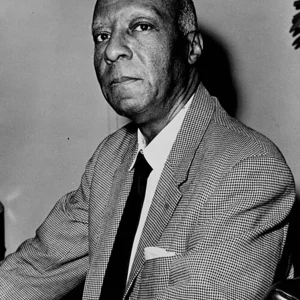

A. Philip Randolph was an African-American trade unionist and civil rights activist. Founder of the first major Black union in the United States, he was a key architect of desegregation and the 1963 March on Washington.
A. Philip Randolph(1889 — 1979)
Asa Philip Randolph
États-Unis
7 min read
Frequently asked questions
Famous Quotes
« Freedom is never granted; it is won. Justice is never given; it is exacted.»
Key Facts
- Founded the Brotherhood of Sleeping Car Porters in 1925, the first recognized African-American union
- In 1941, his threat of a march on Washington pushed Roosevelt to sign Executive Order 8802, banning discrimination in the defense industry
- In 1948, his pressure helped Truman desegregate the U.S. military via Executive Order 9981
- Principal organizer of the March on Washington for Jobs and Freedom in August 1963
- Received the Presidential Medal of Freedom in 1964
Works & Achievements
First major independent Black union in the United States, officially recognized in 1937. It is a foundational achievement demonstrating the organized power of Black workers.
Radical publication carrying Randolph's ideas on workers' rights and African American freedom, influencing Black political thought during the Harlem Renaissance.
Decree by President Roosevelt obtained through Randolph's threat of a massive march, banning racial discrimination in the defense industry during World War II.
Peaceful gathering of over 250,000 people organized by Randolph, culminating the civil rights movement with Martin Luther King Jr.'s famous speech.
Struggle led by Randolph for full integration of the armed forces, resulting in gradual and legal desegregation of military troops.
Memorable speech in which Randolph set the march's goals and legitimized the fight for economic equality and freedom for African Americans.
Anecdotes
In 1925, A. Philip Randolph founded the Brotherhood of Sleeping Car Porters, the first major union led by African Americans. For 12 years, he waged a fierce struggle against the railroad companies for better working conditions and union recognition. In 1937, his perseverance triumphed: the Pullman Company officially recognized the union, a revolutionary victory for the cause of Black workers' rights.
On January 25, 1941, Randolph wrote to President Franklin D. Roosevelt, threatening a massive "March on Washington" to protest racial discrimination in American defense factories. Fearing scandal during World War II, Roosevelt relented and signed Executive Order 8802, banning racial discrimination in the defense industry. This was a major victory achieved without violence.
At age 73, Randolph opened the March on Washington for Jobs and Freedom on August 28, 1963. Respected by all activists, including Martin Luther King Jr., he delivered an eloquent speech and introduced the speakers. His distinguished figure and powerful voice embodied the moral leadership of a generation fighting for equality.
Unlike some leaders who accepted compromises, Randolph categorically refused to compromise on the principles of full equality. He insisted that African Americans should have the same rights as all citizens, without exception or delay. This moral integrity earned him the respect of even his political opponents.
As early as the 1920s, even before Gandhi, Randolph used the strategy of strikes and peaceful marches to win rights. This method of nonviolent pressure became the model for the civil rights movement, proving that one could win without violence but with determination and organization.
Primary Sources
We have come to Washington to seek work and freedom. Freedom for all people and not just for a few. For freedom is the indispensable condition for achieving justice and peace.
Black workers cannot accept serving in an army that discriminates against them. We will organize a massive march on Washington to demand equality.
We create this union to defend the interests of the porters, obtain fair wages, a reasonable workday, and demonstrate the organized power of Black workers.
True freedom will only come when every Black man can work without fear of discrimination, vote without hindrance, and be treated with the dignity he deserves.
Key Places
Center of Randolph's labor and political activism, where he established the Brotherhood headquarters and organized major campaigns. The heart of his activism for 60 years.
Site of the 1963 March on Washington, where Randolph opened the demonstration. Symbol of the political power that civil rights movements can exert on the government.
Randolph's birthplace in 1889 in the segregated South. This small southern town shaped his awareness of racial inequality.
Epicenter of the 1955-1956 bus boycott, where Randolph supported the movement led by Martin Luther King Jr. against transportation segregation.
Symbolic starting point of many demonstrations organized by Randolph, a gathering place before civil rights marches.
Typical Objects

Pullman sleeping cars symbolize the work of Black porters, who served wealthy white passengers. Randolph made the dignity of porters the central cause of his union activism.

A symbol of membership in the Brotherhood of Sleeping Car Porters, it represents the first legally recognized Black union victory in the United States.

Randolph used his eloquence and powerful voice to address entire crowds. The microphone became the instrument of his peaceful struggle for equality.

A radical publication founded by Randolph in 1917, it spread his ideas on workers' rights and African American freedom.
During marches and picket lines, signs carried slogans of justice and equality, tools of Randolph's peaceful protest.
📷 CC BY-SA 4.0 · Wikimedia Commons ↗
Randolph was often photographed in an impeccable black suit, a symbol of dignity and professionalism that contrasted with the racist stereotypes of the era.

Randolph used the flag to remind that African Americans are full citizens and deserve the promises of liberty and equality enshrined in the Constitution.
📷 Domaine public · Wikimedia Commons ↗School Curriculum
Vocabulary & Tags
Key Vocabulary
Tags
Daily Life
Morning
Randolph rises early in New York, reading the newspapers to follow political and union news. He has a simple breakfast before heading to the Brotherhood offices. The leader's disciplined routine sets the tone for a day filled with meetings and strategy.
Afternoon
Afternoons are devoted to union meetings, negotiations with management, and meetings with other activists. Randolph receives porters who come to report problems, listens to their grievances, and plans future actions. He walks through the offices, talks with his team, and maps out the strategy of the struggle.
Evening
In the evening, Randolph prepares his speeches and writings in his office, perfecting every sentence. He meets with fellow activists, organizes protest strategies, and attends coalition meetings. Late into the night, he often continues his work of organizing and reflection.
Food
Randolph followed a sober and temperate diet, refusing excess in line with his strict moral principles. He preferred simple, nutritious meals at modest Harlem restaurants rather than luxurious establishments. Water was his usual drink; coffee and tea were his late-night work companions.
Clothing
Randolph wore immaculate black or gray suits, neat ties, and polished shoes, embodying professional dignity in the face of racist stereotypes. Every detail of his appearance was a silent statement of equality and respectability. He cultivated his image as a dignified leader and intellectual.
Housing
Randolph lived in a modest but respectable apartment in Harlem, close to the Black communities he served. His home was simple, devoid of unnecessary luxury, reflecting his egalitarian beliefs and commitment to workers. It was a space for work and reflection rather than a place of personal comfort.
Historical Timeline
Period Vocabulary
Visual Style
Style photographique et documentaire en noir et blanc, époque 1930s-1960s, incarnant la dignité des travailleurs noirs et la puissance organisée du mouvement des droits civiques. Palette de tons chauds et contrastés évoquant l'archive historique.
Sound Ambience
Sons de l'Amérique urbaine du XXe siècle, des gares ferroviaires aux salles de réunion syndicales, des rues de Harlem aux espaces du pouvoir politique. Ambiance d'engagement civique, de lutte pacifique et de foules mobilisées.
Liens externes & ressources
Références
Œuvres
Fondation du Brotherhood of Sleeping Car Porters
1925
The Messenger (magazine d'opinion)
1917-1928
L'Executive Order 8802
1941
La Marche sur Washington pour l'emploi et la liberté
1963
Campagne pour la déségrégation de l'armée américaine
1948-1950
Discours d'ouverture à la Marche sur Washington
1963-08-28