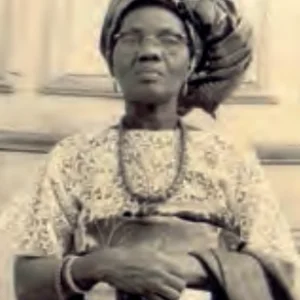

Nigerian educator and activist (1900–1978), she led the Abeokuta women's movement against British colonial taxation. A pioneer of women's suffrage in Nigeria, she was the first woman to drive a car in her country and the mother of musician Fela Kuti.
Frequently asked questions
Key Facts
- 1900: born in Abeokuta, Nigeria, then under British colonial rule
- 1932: founded the Abeokuta Ladies' Club, which would become the Abeokuta Women's Union (AWU)
- 1947–1949: led a successful campaign against the discriminatory tax imposed on women by the colonial administration, forcing the resignation of the local chief (alake)
- 1949: the AWU had nearly 100,000 members, making it one of the largest women's organizations in Africa
- 1978: died after being thrown from a window during a military raid on her son Fela Kuti's compound
Works & Achievements
A pioneering political organization she founded and led, bringing together thousands of women from all backgrounds to defend their rights against British colonial administration.
A mass protest movement she organized, resulting in the abolition of the tax and the abdication of the Alake — a historic demonstration of the power of African women's activism.
A national extension of her local organization, aimed at uniting women across Nigeria in a common struggle for voting rights and equal rights.
A national federation she created to coordinate the various Nigerian women's associations and gain greater influence in negotiations for independence.
Active participation in international conferences across Europe and Asia to champion African decolonization and forge alliances with liberation movements around the world.
Anecdotes
In 1947, Funmilayo Ransome-Kuti organized a march of more than 10,000 women from Abeokuta to protest a British colonial tax imposed exclusively on women. The procession impressed the authorities so greatly that the local ruler, Alake Ademola II, was forced to abdicate temporarily in 1949.
Born Frances Abigail Olufunmilayo Thomas, she decided as a young adult to drop her English name 'Frances' to assert her Yoruba identity. This symbolic act reflected her deep commitment to African culture at a time when many of her compatriots were adopting European names.
Funmilayo was the first woman to drive a car in Nigeria — a remarkable achievement in a society where women were confined to very limited roles. She used her travels by automobile to crisscross the country and mobilize rural women around her political causes.
She was received in audience by Queen Elizabeth II in London and met leaders such as Mao Zedong and Nikita Khrushchev, which led to her being monitored by British and American intelligence services during the Cold War. Her passport was confiscated by the Nigerian government in 1956.
Her death in 1978 is directly linked to the brutality of the military regime: soldiers threw Funmilayo, then 77 years old, from a window during a raid on the home of her son Fela Kuti. She died from her injuries several weeks later, becoming a symbol of courage in the face of tyranny.
Primary Sources
We, the women of Abeokuta, humbly beg to state that the present system of taxation is unjust and unbearable. We are not represented in the council which imposes this tax, yet we are made to pay.
African women are not free. They are doubly oppressed — as Africans under colonial rule and as women in a society that denies them basic rights. Our struggle is one.
I write to demand that the practice of taxing women without granting them representation be immediately abolished. We are not subjects to be exploited but citizens deserving of justice.
The Abeokuta Women's Union is founded to protect the rights and dignity of all women, regardless of religion or tribe, to fight all forms of oppression and to secure full political representation for women in Nigeria.
Key Places
Funmilayo's hometown and the heart of her movement: it was here that she founded the Abeokuta Women's Union and led the major marches against colonial taxation.
The economic and political capital where Funmilayo brought her demands to the national stage and supported the Nigerian independence struggle.
She traveled to London on several occasions to directly challenge British colonial authorities and advocate for Nigerian women's rights at the Colonial Office.
The city where she attended the 1953 congress of the Women's International Democratic Federation, bringing the voice of African women to the international stage.
She met Mao Zedong during a visit to China as part of her engagement with anticolonial movements and international solidarity networks.
Typical Objects

Funmilayo proudly wore traditional Yoruba attire, particularly during her political actions, to assert her African identity in the face of British colonial culture.

An essential tool of her activism, she used it to draft petitions, official letters, and manifestos to challenge colonial authorities and mobilize Nigerian women.

The first woman to drive a car in Nigeria, her vehicle allowed her to travel across the country to organize rural women and expand the influence of the Abeokuta Women's Union.

Funmilayo rigorously managed the finances and administration of her organizations, keeping precise records of members and actions taken.

A trained teacher, she used these tools in her classroom to teach women and girls to read and write, firmly believing that education was the primary instrument of emancipation.

The taxes imposed on the women of Abeokuta by the British administration were the trigger for her most iconic act of activism and the symbol of the injustice she fought against.
School Curriculum
Vocabulary & Tags
Key Vocabulary
Daily Life
Morning
Funmilayo rose at dawn to prepare her lessons at the primary school in Abeokuta where she taught. She read both Nigerian and British newspapers to stay informed on political developments, then spent an hour writing letters to colonial authorities or her activist networks.
Afternoon
Afternoons were often devoted to meetings of the Abeokuta Women's Union, where she received women who had traveled from surrounding villages. She organized literacy sessions for rural women and discussed strategies of resistance against new colonial tax measures.
Evening
In the evenings, her home became a gathering place for Nigerian activists and intellectuals. She received correspondence from international allies, drafted speeches, and planned upcoming actions with her closest collaborators — before a quieter family evening with her children, including the young Fela.
Food
Like most Yoruba families in Abeokuta, she ate jollof rice, egusi (melon seed soup), pounded yam (iyan) with spiced sauces, and smoked fish. Family meals were a time for sharing cultural traditions and engaging in political discussion.
Clothing
Funmilayo wore Yoruba traditional dress with pride: a wrapper (iro) made of brightly colored printed wax fabric, a buba (loose blouse), and a gele, a large head tie twisted into an imposing headdress. She deliberately rejected the European-style dresses adopted by the colonized elite, turning her choice of clothing into a political statement.
Housing
She lived in an Afro-colonial style house in Abeokuta, spacious enough to host meetings and visitors. The family home was lined with shelves of political and legal books, a desk for her activist work, and an informal classroom where she taught literacy to women from the neighborhood.
Historical Timeline
Period Vocabulary
Visual Style
Portrait militant et coloré dans une palette chaude afro-coloniale, mêlant photographie documentaire des années 1940 et motifs graphiques des textiles yoruba.
Sound Ambience
L'ambiance sonore d'Abeokuta dans les années 1940 : l'effervescence du marché, les tambours yoruba annonçant un rassemblement politique et les voix de milliers de femmes en marche.
Liens externes & ressources
Références
Œuvres
Fondation de l'Abeokuta Women's Union
1946
Campagne contre la taxation coloniale des femmes
1947-1949
Fondation du Nigerian Women's Union
1949
Fondation du Federation of Nigerian Women's Societies
1953
Militantisme international pour le panafricanisme
1950-1960