Imaginary interview with Gisèle Halimi
by Charactorium · Gisèle Halimi (1927 — 2020) · Society · Politics · labels.domains.droit-justice · 6 min read
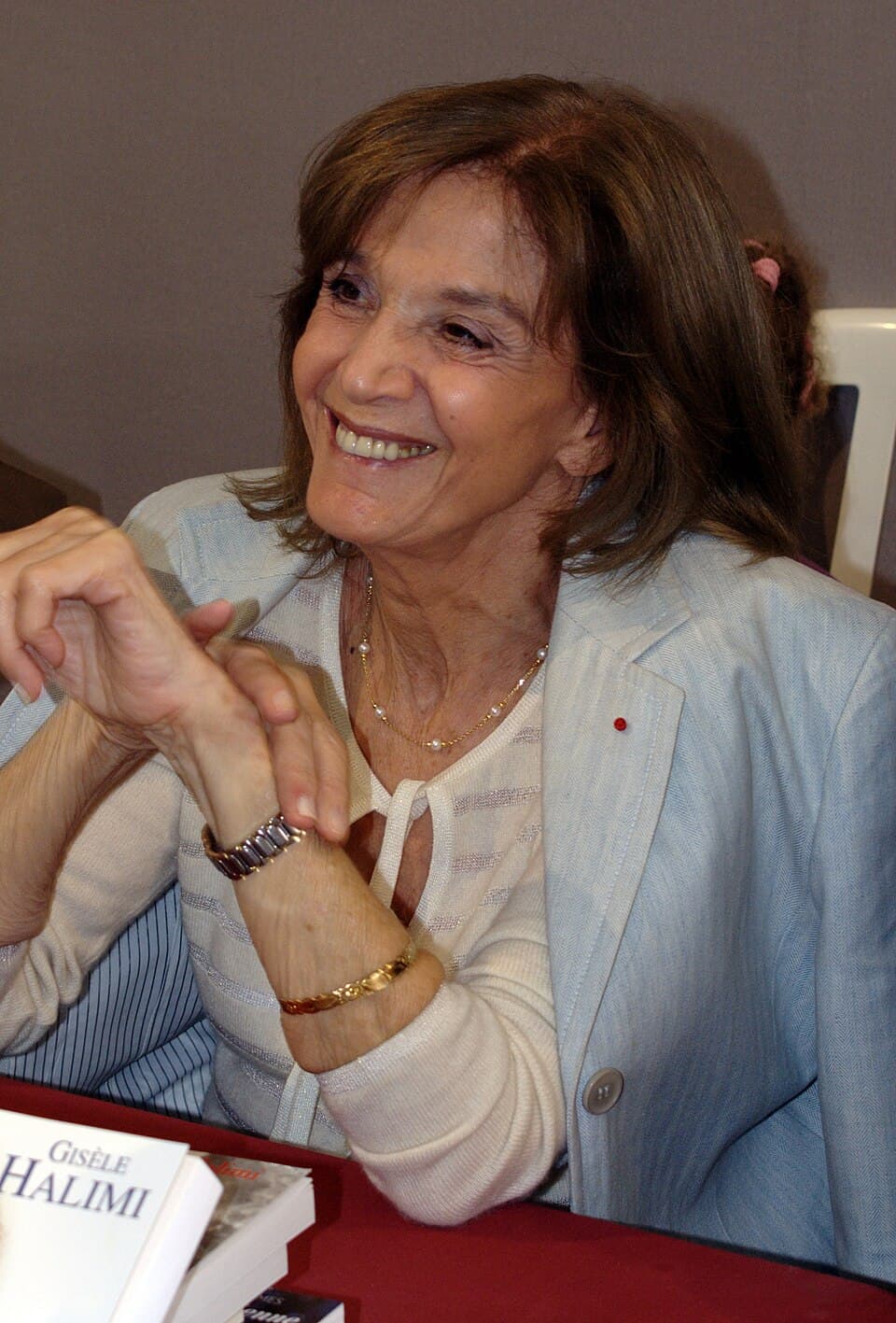
We met her one gray morning in her office in the 6th arrondissement of Paris, a stone's throw from the Palais de Justice where she pleaded for more than half a century. On her desk, thick files, a worn-out annotated Penal Code, and an old issue of Le Nouvel Observateur she never put away. She greets us upright, her voice clear, that voice that made entire courtrooms tremble.
—Where do you place the very first spark of your revolt?
In La Goulette, Tunisia, around a table. I was ten. My brothers were eating, they were being served, and I had to serve — because I was a girl, and girls, in my Sephardic family, learned obedience before the alphabet. One day, I simply refused. I stopped eating. A child's hunger strike, if you will, but carried out with terrible seriousness. As I wrote much later in Le Lait de l'oranger: “I was ten when I understood that revolt was not only permitted, but necessary. My mother served my brothers before me. That day, I decided it would be the last time.” Everything else — the courtrooms, the trials, the laws — was born from that table.
A child's hunger strike, carried out with terrible seriousness.
—How did that child from Tunisia become a lawyer in Paris?
Against everyone. My family saw marriage as a girl's natural horizon; I saw law. In 1945, I left La Goulette for Paris, alone, with the fixed idea of entering studies reserved for boys. In 1949, I was admitted to the Paris Bar. But I was never allowed to forget where I came from or what I was. As I wrote in La Cause des femmes: “To be a woman and a lawyer in this country is to be doubly suspect in a world built by and for men.” The black robe, I wore it not as a uniform of respectability, but as a weapon. Each hearing would become, for me, something other than a plea: a platform.
—Do you remember the day the Djamila Boupacha case entered your life?
In 1960. I was asked to defend a young FLN activist, barely more than a teenager, arrested and accused of planting a bomb in a café in Algiers. But that was not the real case. The real case was what was done to her in police custody: torture, rape, by French soldiers, in the name of France. I went to Algiers to gather testimonies. I understood that pleading in a courtroom would not be enough — the army judged on its own turf. So we brought the case before world opinion. With Simone de Beauvoir, we turned it into a book, Djamila Boupacha, in 1962. It earned me admiration, and death threats. I considered them an acknowledgment of receipt.
Death threats, I considered them an acknowledgment of receipt.
—Why was it so important to take this case out of the courtroom alone?
Because a military tribunal in the middle of the Algerian War was not a place of justice, but a closed session. Djamila claimed she had been tortured and raped in custody, and her only crime, we argued, was wanting her country to be free. If we left that in the shadows, she would be condemned twice. With Simone de Beauvoir, we wrote, published, alerted Gallimard, forced the government to order a change of jurisdiction. I have always thought that the decolonization of peoples and the emancipation of women were one and the same struggle against domination. Djamila, in her own way, carried both. Defending her tortured body was defending the idea that no reason of state redeems torture.
—How was the idea born of having women publicly sign a confession of having had an abortion?
From a wartime observation. Every year, a million women had clandestine abortions in France, in danger, under the threat of the law of 1920. They were condemned to silence and sometimes to death. In 1971, I co-founded with Simone de Beauvoir the association “Choisir la cause des femmes.” And we had this audacity: ask well-known women to publicly admit the illegal. The manifesto appeared in Le Nouvel Observateur of April 5 — I still keep the copy. Each wrote: “I declare that I am one of them.” Three hundred and forty-three women thus exposed themselves to prosecution. People laughed, insulted, but they could no longer pretend to ignore. The confession, this time, changed sides: they were no longer the guilty ones; it was the law.
The confession changed sides: they were no longer the guilty ones; it was the law.
—What did this shift from the intimate to public debate mean to you?
Everything. As long as an abortion remained a shameful secret hidden in kitchens, it was an individual fault. The day hundreds of women declared it together, openly, it became a political issue. That is the very logic of what I called combat feminism: never beg for clemency for what is a right. We brought together, in Djamila Boupacha yesterday as in the Manifesto, women who refused to be silent victims. A woman's body belongs neither to the natalist state, nor to the doctor, nor to the judge. Saying it out loud, in the columns of a newspaper read throughout France, was a bomb — but a bomb that killed no one, except a century-old hypocrisy.
—How did you decide to turn the Bobigny trial into a platform rather than a simple defense?
November 1972. I am entrusted with Marie-Claire Chevalier, sixteen, prosecuted before the Bobigny court for having an abortion after a rape. I could have pleaded tears, youth, circumstances. I refused. Pleading clemency was admitting there was fault. So I turned the courtroom inside out. I called to the stand doctors, Nobel laureates, feminists, so that it was no longer a child being judged, but a text. In my plea, later published by Gallimard, I said it bluntly: “It is not Marie-Claire you are judging today. It is a law. An unjust law that condemns hundreds of thousands of women each year to secrecy, danger, sometimes death.” The court had become an improvised national assembly.
I turned the courtroom inside out.

—What connection do you make between that Bobigny hearing and the law that followed?
A direct connection, though never mechanical. A plea does not vote a law; it prepares the ground where it can grow. At Bobigny, the emotion was such, the press so present, that the question of abortion ceased to be shameful and became political. Three years later, in 1975, the Veil law decriminalized abortion. I do not claim paternity — other women, before and around me, carried this struggle. But I know that that day, in that gray suburb, we made decriminalization thinkable. My plea is studied, it seems, still in law schools. I see it less as a title of glory than as proof: the courtroom can be the place where a society finally looks at itself in the face.
—You were elected deputy in 1981: what did you expect from institutional politics?
A lot, and I was wrong. After Mitterrand's victory, I entered the National Assembly in 1981, convinced that we could do inside what I had done in courtrooms: wrest real rights. I was quickly disillusioned. Campaign promises on equality dissolved into party caution; the Socialist Party found me cumbersome as soon as I spoke of women other than through symbols. I refused to run again in 1986. They would not make me believe again that voting motions amounted to changing lives. I recounted this disenchantment in Une embellie perdue: the title says it all. The lull had been real; it was lost for lack of courage.
They would not make me believe again that voting motions amounted to changing lives.
—After this disappointment, where did you take your struggle?
Where I had always carried it deep down: in writing and on the ground. I continued to plead, to fight, to write, especially in the evenings, at my table, as I had always written my pleas. I also wanted to go back to my roots — Le Lait de l'oranger, then Fritna in 1999, that book about my mother, that woman torn between submission and a secret strength I understood only late. For my feminism was never an abstraction: it comes from a little girl in La Goulette who refused to serve her brothers. Laws are won, lost, rewritten. But the demand for equality, it, never rests. I passed it on as one passes a flame — ensuring it does not go out.
The demand for equality, it, never rests.
This imaginary interview was generated by artificial intelligence from sources documented in Gisèle Halimi's profile. It dramatises what the figure might have said based on what we know about them, but does not constitute attested historical testimony. For primary sources and factual documentation, refer to the full profile.