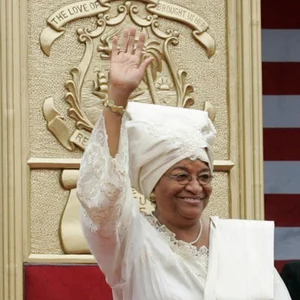

Ellen Johnson Sirleaf became in 2006 the first woman elected president of an African state, leading Liberia after a long civil war. A trained economist, she worked to rebuild the country and foster national reconciliation, receiving the Nobel Peace Prize in 2011.
Ellen Johnson Sirleaf(1938 — ?)
Ellen Johnson Sirleaf
Liberia
7 min read
Frequently asked questions
Famous Quotes
« In Africa, women are the pillars of society. They do the work, they feed the children, they hold families together.»
« If your dreams don't scare you, they aren't big enough.»
Key Facts
- Born in 1938 in Monrovia, Liberia, she studied economics in the United States, including at Harvard.
- Imprisoned twice under Liberian authoritarian regimes before being forced into exile.
- Elected President of Liberia in January 2006 — the first woman ever elected head of state in Africa.
- Awarded the Nobel Peace Prize in 2011 alongside Leymah Gbowee and Tawakkol Karman for their nonviolent struggle for the safety of women.
- Re-elected in 2011, she governed until 2018, completing two consecutive terms.
Works & Achievements
Ellen Johnson Sirleaf rebuilt Liberian institutions after fourteen years of civil war: restoring the rule of law, fighting corruption, reviving the economy, and attracting foreign investors.
She secured the cancellation of more than 4 billion dollars in debt under the HIPC initiative, freeing up considerable resources for the country's reconstruction.
She continued democratic consolidation and managed the 2014–2016 Ebola crisis, strengthening the Liberian health system with the support of the international community.
A memoir published in English, tracing her journey as a female politician in Africa, her imprisonments, her exiles, and her rise to power; translated into several languages.
Following the Ebola epidemic, she co-chaired this international commission to strengthen fragile health systems and prevent future pandemics in low-income countries.
The first peaceful transfer of power between two elected presidents in Liberia since 1944, hailed as a major democratic milestone for West Africa.
Anecdotes
In 2006, Ellen Johnson Sirleaf became the first woman elected head of an African state, winning the presidential election in Liberia. Her victory was celebrated worldwide as a historic turning point for democracy and women's rights on the African continent.
Imprisoned twice under the military regimes of Samuel Doe and Charles Taylor, Ellen Johnson Sirleaf never yielded to intimidation. During one of her detentions, she was sentenced to ten years in prison before ultimately being released under international pressure, which strengthened her resolve to fight for democracy.
In 2011, Ellen Johnson Sirleaf received the Nobel Peace Prize, which she shared with Leymah Gbowee and Tawakkol Karman. The Nobel Committee honored their non-violent struggle for the safety of women and their right to participate fully in peacebuilding.
Nicknamed the "Iron Lady" by her supporters, Ellen Johnson Sirleaf had to contend with a devastating Ebola epidemic between 2014 and 2016. She coordinated the national and international response, mobilizing resources to contain a health crisis that threatened to destabilize the entire region.
An economist by training, she studied at Harvard before returning to Liberia to serve her country. Her command of financial matters allowed her, once in power, to renegotiate a massive national debt inherited from the civil wars, securing the cancellation of more than 4 billion dollars in debt.
Primary Sources
I have always believed that Africa's salvation lies in the hands of its women. We are the ones who bear the burden of conflict, who rebuild after war, who hold families and communities together when everything else falls apart.
We know what we want. We want peace. We want freedom. We want prosperity. And we are determined to work hard to achieve these goals, because Liberia is worth fighting for.
This prize belongs to all the women of Liberia — the market women, the church women, the women who risked their lives to stop the war. I share this honour with each and every one of them.
Liberia is at a crossroads. With your continued support, we will transform our nation into a beacon of democracy and development for all of Africa.
Key Places
Capital of Liberia and the site of her inauguration in January 2006; it is here that she governed for twelve years, rebuilding the institutions of a state devastated by two civil wars.
Ellen Johnson Sirleaf earned a master's degree in public administration here in 1971; this training gave her the intellectual tools to manage public finances and negotiate with international institutions.
The city where she received the Nobel Peace Prize on December 10, 2011, recognizing her fight for democracy, peace, and women's rights on the international stage.
Site of the peace negotiations that ended the Liberian civil wars in the 1990s and 2000s; Sirleaf played a role there as a mediator and voice of Liberian civil society.
The Ghanaian capital where the Accra Peace Agreement was signed in 2003, ending the second civil war and paving the way for the 2005 elections won by Sirleaf.
Typical Objects

Ellen Johnson Sirleaf often wears outfits in the red, white, and blue colors of the Liberian flag during official ceremonies, asserting her national identity while projecting an image of feminine authority in a political world dominated by men.

A symbol of her training as an economist at Harvard and her years at the IMF and the World Bank, the briefcase accompanies her debt negotiation missions and her travels to world capitals to advocate for Liberia's cause.

Key documents that Sirleaf studies and uses to renegotiate Liberia's $4.9 billion external debt, ultimately securing the cancellation of a large portion through the HIPC initiative (Heavily Indebted Poor Countries).

Awarded on December 10, 2011, in Oslo, this medal honors her commitment to peace, democracy, and women's rights; she makes it a symbol of the struggle of all Liberian women.

During civil wars and crises such as Ebola, this indispensable communication tool allows her to coordinate international aid and maintain contact with global organizations from a country with devastated infrastructure.

The foundational text that Sirleaf commits to upholding and strengthening from her inauguration onward, particularly by fighting corruption and ensuring the separation of powers in a state weakened by decades of dictatorship.
School Curriculum
Vocabulary & Tags
Key Vocabulary
Tags
Daily Life
Morning
The president rises early, around 5:30 AM, and begins her day by reading dispatches and ministerial reports. She often attends a brief prayer before chairing the morning meetings of her cabinet at the Executive Mansion in Monrovia.
Afternoon
Her afternoons are devoted to diplomatic audiences, meetings with international delegations, or visits to reconstruction sites. She regularly travels across Liberian counties to stay connected with realities on the ground.
Evening
In the evenings, Sirleaf receives heads of state or participates in official ceremonies. She dedicates part of her evenings to reading economic files and corresponding with international institutions such as the IMF or the World Bank.
Food
Her diet reflects traditional Liberian cuisine: jollof rice, cassava leaves cooked in sauce, grilled fish, and fufu. At official receptions, she has local dishes served to promote national gastronomy.
Clothing
Ellen Johnson Sirleaf alternates between a plain Western suit and the traditional lappa fabric costume, often in the colors of the Liberian flag. She almost always wears a matching headscarf or hat, which has become one of her distinctive hallmarks recognized worldwide.
Housing
She resides at the Executive Mansion, the presidential palace in Monrovia rebuilt after the destruction of the civil wars. The building blends American colonial architecture with modern facilities, symbolizing the reconstruction of the Liberian state.
Historical Timeline
Period Vocabulary
Visual Style
Portrait officiel chaleureux et solennel, mêlant réalisme photographique et iconographie politique africaine contemporaine, dans les couleurs nationales libériennes.
Sound Ambience
Ambiance sonore de Monrovia post-guerre civile : marchés animés, pluies tropicales, cérémonies officielles et vie quotidienne d'une capitale en reconstruction.
Liens externes & ressources
Références
Œuvres
Présidence du Liberia (premier mandat)
2006–2011
Renégociation de la dette extérieure libérienne
2006–2010
Présidence du Liberia (second mandat)
2012–2018
This Child Will Be Great (autobiographie)
2009
Co-présidence de la Commission de haut niveau sur la santé dans les pays en développement (OMS)
2015–2016
Passation démocratique du pouvoir à George Weah
2018