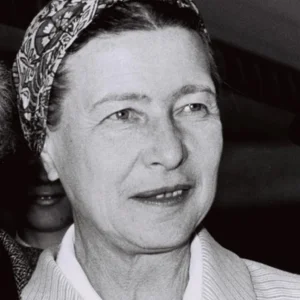

French philosopher and novelist (1908–1986), Simone de Beauvoir is a towering figure of existentialism and modern feminism. Author of The Second Sex, a foundational essay on the condition of women, she profoundly shaped philosophical thought and emancipatory movements throughout the 20th century.
Simone de Beauvoir(1908 — 1986)
Simone de Beauvoir
France
8 min read
Frequently asked questions
Famous Quotes
« One is not born, but rather becomes, a woman.»
« Freedom is, first of all, choosing for oneself.»
« There is no destiny, there are only choices.»
Key Facts
- 1949: publication of The Second Sex, a landmark essay analyzing the condition of women and a founding text of modern feminist thought
- 1945: engagement with Jean-Paul Sartre and involvement in the existentialist movement
- 1954: awarded the Prix Goncourt for her novel The Mandarins
- 1947–1972: active political commitment to progressive and anti-colonialist causes
- 1986: death in Paris, leaving behind a vast body of work comprising more than 40 books
Works & Achievements
A landmark essay analyzing the condition of women throughout history, biology, psychology, and culture. This major work laid the foundations of modern feminism and remains an essential reference.
Beauvoir's first novel, exploring human relationships and questions of identity against the backdrop of the French Resistance. The book introduces the existentialist themes that would define her work.
A Prix Goncourt-winning novel dealing with Parisian intellectual life after World War II and the political commitments of writers.
The first volume of her memoirs, an autobiographical account of her childhood and youth in France up to 1929, revealing the formation of her philosophical and feminist thinking.
The second volume of her memoirs, covering the years 1929–1944, documenting her intellectual development, political engagement, and her relationship with Jean-Paul Sartre.
The third volume of her memoirs, covering 1944–1952, a period of literary recognition and feminist commitment marked by her role as a key figure of existentialism.
A philosophical essay on freedom and commitment, examining the responsibilities of the individual in a changing world, and a founding text of her existentialist thought.
An essay presented as a lecture, offering an early analysis of the challenges facing women in modern society and foreshadowing the major themes of The Second Sex.
Anecdotes
Simone de Beauvoir met Jean-Paul Sartre at the philosophy agrégation exam in 1929: she came in second, he came in first. The jury members noted that she was the true philosopher of the two. This meeting marked the beginning of an intellectual and romantic relationship that lasted until Sartre's death in 1980.
While writing 'The Second Sex' (1949), Beauvoir was struck to realize that she had always been defined in relation to men. She wrote the book to understand her own condition, before she even considered herself a feminist. The work was immediately placed on the Vatican's Index of Forbidden Books and sold thousands of copies.
In 1971, Simone de Beauvoir signed the 'Manifesto of the 343', a petition signed by famous women publicly declaring they had undergone illegal abortions, demanding freedom of abortion in France. This courageous act brought her threats but directly contributed to the Veil Law of 1975.
Simone de Beauvoir declined the Nobel Prize in Literature offered by the Swedish Academy, following Sartre's example in 1964. She felt that accepting such an institutional honor would have betrayed her intellectual commitment against official recognition and the bourgeois appropriation of culture.
She spent much of her life in Parisian hotels and cafés, particularly the Café de Flore and Les Deux Magots in Saint-Germain-des-Prés, where she wrote every morning. She long refused to have an apartment of her own, viewing this material freedom as essential to her philosophical independence.
Primary Sources
One is not born, but rather becomes, a woman. No biological, psychological, or economic fate determines the figure that the human female presents in society.
Freedom exists only within a situation, and it cannot brutally deny that situation without denying itself. But it can seek itself by working to transform the situation.
I decided never to marry and to be a writer. That was exactly the opposite of what fate seemed to have planned for me.
Existentialism places us all before our responsibilities: we cannot invoke any essence that would make us act one way or another.
I am no longer anyone. It took me time to discover it: I have become an absence, a hole, a silence.
Key Places
Simone de Beauvoir lived and worked mainly in Paris, notably on Rue de la Grande Chaumière. It was in the capital that she frequented existentialist cafés such as the Café de Flore and developed her philosophical thinking.
Simone de Beauvoir taught philosophy here during her career as a teacher. This place represents her commitment to education and the passing on of knowledge to younger generations.
The address where Simone de Beauvoir was born in 1908, representing her Parisian roots and her upbringing in the bourgeois Paris of her youth.
The place where Simone de Beauvoir pursued her higher studies in philosophy and passed the agrégation examination. The Sorbonne shaped her intellectual development and academic commitment.
A region where Simone de Beauvoir stayed regularly and found inspiration for her writing. Provence represents her escapes from Paris and her connection with the Mediterranean landscape.
An iconic neighbourhood associated with Simone de Beauvoir's intellectual and artistic life, where she moved in circles of writers and existentialist thinkers of the twentieth century.
Typical Objects

An essential working tool for Simone de Beauvoir, she wrote her essays, novels, and philosophical works on a typewriter — the iconic instrument of the 20th-century writer. It represents her intellectual productivity and deep commitment to writing.

Simone de Beauvoir's landmark work, published in 1949, this groundbreaking essay raises the question of women's condition and became a cornerstone of modern feminist thought. The book symbolizes her lifelong commitment to women's equality.

A signature everyday accessory for Simone de Beauvoir, who was frequently photographed cigarette in hand, reflecting the intellectual culture of 20th-century Paris and her lifestyle as a free and independent woman.
📷 Domaine public · Wikimedia Commons ↗
A constant companion to Beauvoir's intellectual work, these handwritten notebooks contain her existentialist reflections, philosophical analyses, and the development of the ideas that would make her a founding figure of French existentialism.

A hub of Parisian intellectual life where Simone de Beauvoir regularly gathered with Sartre and other existentialist thinkers. The café represents the philosophical ferment of postwar France.

Works of existentialist philosophy — especially those by Sartre, with whom she was closely associated — embody the philosophical movement of which she was a central figure, and which shaped her vision of the world and of human freedom.

A symbol of her freedom of movement and independence, Simone de Beauvoir traveled widely around the world, including to North America, reflecting her open-mindedness and cosmopolitan outlook.

A typical accessory of the 20th-century Parisian intellectual, often worn by Simone de Beauvoir, it symbolizes French identity and the image of the modern, emancipated woman of ideas.
School Curriculum
Vocabulary & Tags
Key Vocabulary
Tags
Mouvement
Concept
Daily Life
Morning
Simone de Beauvoir typically rose early to devote herself to writing, her absolute priority. After a coffee and a cigarette, she would settle at her desk to work for several hours at a stretch, often at a Parisian café such as the Café de Flore, where she would meet Sartre and other intellectuals from her circle.
Afternoon
Afternoons were given over to philosophical discussions, intellectual debates within the existentialist group, or working sessions in the cafés of the Latin Quarter. She made time for her romantic and personal relationships — above all with Sartre — while continuing her reading and theoretical thinking.
Evening
Evenings often brought Simone together with the Parisian intelligentsia in restaurants or apartments, where conversation turned to politics, philosophy, and social issues. She might also carry on writing or editing manuscripts late into the night, fuelled by intellectual debate and cigarettes.
Food
Simone de Beauvoir ate simply and often quickly, favouring practicality over gastronomy. She was a regular at cafés for light meals or aperitifs, and consumed wine and coffee on a daily basis — both central elements of her Parisian social life.
Clothing
Dressing plainly and with no concern for vanity, Simone wore functional clothing such as shirts, jumpers, and skirts, rejecting the feminine conventions of her era. Her hair was usually tied back simply, and she smoked regularly, asserting her independence and her indifference to the norms of bourgeois femininity.
Housing
Simone de Beauvoir lived modestly in Paris — on the rue Schoelcher and the rue de la Grande Chaumière, among other addresses — in spartanly furnished apartments typical of the Parisian intellectual milieu. Her home was above all a place to pass through and to work: less a comfortable household than a refuge for writing and thought.
Historical Timeline
Period Vocabulary
Visual Style
Un style graphique moderniste et introspectif, mêlant les codes esthétiques de Paris intellectuel des années 1950, avec des influences expressionnistes et cubistes. L'atmosphère privilégie le contraste dramatique, la profondeur philosophique et l'élégance austère de l'existentialisme.
Sound Ambience
Une ambiance sonore intime mêlant les bruits d'un café parisien des années 1950 avec les sons de l'écriture intellectuelle et philosophique, créant une atmosphère de création littéraire et de débat d'idées existentialistes.
Liens externes & ressources
Références
Œuvres
Le Deuxième Sexe
1949
L'Invitée
1943
Les Mandarins
1954
Mémoires d'une jeune fille rangée
1958
La Force de l'âge
1960
La Force des choses
1963
Pyrrhus et Cinéas
1944