Kids interview Gutenberg
by Charactorium · Gutenberg (1400 — 1468) · Technology · 4 min read
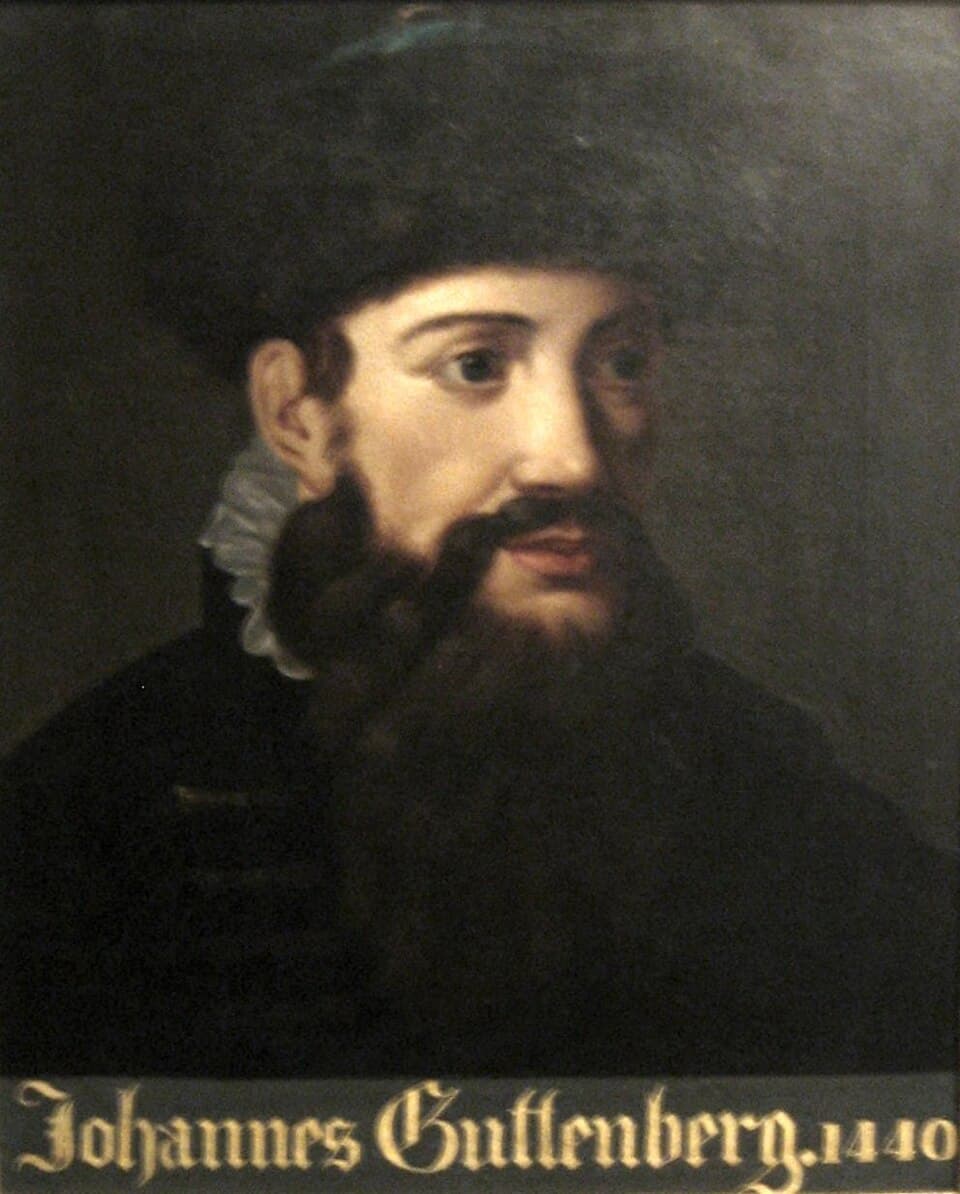
That morning, two young visitors on a school field trip push open the door of a workshop in Mainz. It smells of ink, hot metal, and paper. An old man with ink-stained hands greets them with a smile: it's Johannes Gutenberg, and he has agreed to tell them everything.
—Is it true that you sold little mirrors before making books?
You know, my child, yes! Before books, I made tiny metal mirrors. Imagine crowds of pilgrims walking to Aachen to see sacred relics. People believed these mirrors captured a bit of their holy light. So I sold many of them. But the most important thing was what my hands were learning. By casting and polishing that metal, I discovered the secrets of alloys. I didn't know it yet, but each little mirror was preparing me. One day, those same gestures would give birth to letters of lead.
Each little mirror prepared my hands to make letters.
—How did you come up with the idea for your printing machine?
Imagine the hillsides of the Rhine, my child, covered with vines. In autumn, they crush grapes under large wooden presses that descend slowly. I watched that for a long time. And I said to myself: if a press can crush grapes, it can press a sheet of paper onto inked letters. But the scribes' ink, too liquid, slipped off the metal. So I invented a thick greasy ink, made with linseed oil. It stuck perfectly and gave a deep black. Everything came from observing, tinkering, and starting over.
If a press can crush grapes, it can press a sheet onto letters.
—What exactly was your invention? We don't quite understand.
Come closer, I'll show you. My idea is movable type: very small blocks of metal, each with a single raised letter. You assemble them to write a word, an entire page. Then you take them apart and start again with another text! Before me, a monk would copy a book by hand for months. I would compose a page and could print it hundreds of times. That box of reusable little letters is my whole secret. Organizing the alphabet so it can serve endlessly.
A single metal letter that serves a thousand times without wearing out.
—But how did you make so many identical letters?
Ah, that's the real goldsmith work, my child! Listen carefully to the chain. First, I engraved the letter, reversed, on a hard steel rod: the punch. I struck this punch into a small copper block, and it carved the imprint of the letter: the matrix. This matrix became a mold. I poured molten lead into it, and pop, a perfect letter came out. I repeated this gesture hundreds of times. Imagine casting the same letter over and over, all identical. Without my goldsmith trade, I would never have achieved such precision.
Punch, matrix, molten lead: my letter was born three times before printing.
—Why did you work in secret in Strasbourg?
Because I was afraid, my child. Very afraid that someone would steal my idea. In Strasbourg, around 1439, I had formed a small society with associates, including a certain Andreas Dritzehen. But everything had to remain secret. We met in a secluded place, speaking in hushed voices. I made them swear silence. You see, an idea is fragile. If someone understands your process, they can copy it and beat you to it. I had spent years tinkering. I wasn't going to let a chatterbox ruin everything. Secrecy was my best guardian.
An idea is fragile: one chatterbox, and someone else beats you to it.
—That must have been stressful, always being afraid someone would copy you, right?
You're right, it was a heavy burden. Imagine living for years with a hidden treasure in your head, unable to show it. When my associate Dritzehen died, his brothers wanted to know about our machines. There was even a trial! We spoke before the judges of a mysterious "process" without ever really naming it. That was my inventor's life: moving forward in the shadows, closing doors, watching glances. The hardest part wasn't working with metal. It was keeping my mouth shut when I was so proud.
The hardest part wasn't the metal, it was keeping silent when I was proud.
—What was your first real printed work?
Many people think I started with the great Bible. But no, my child! My first prints were much humbler and more practical. I printed indulgences around 1454: papers the Church sold to forgive the sins of the faithful. People wanted hundreds of them, all identical. Perfect for my machine! I also printed a calendar calling for a crusade against the Turks. You see, my invention wasn't just for beautiful books. It served the Church, commerce, and even war. Printing was already a trade.
My invention served not only fine books but also the Church and commerce.
—Was it a time of wars? Did you talk about them?
Yes, and a terrible piece of news had shaken us all. In 1453, the great city of Constantinople had fallen to the Ottoman Turks. All of Christendom trembled. So I printed a calendar, the Türkenkalender, which called on princes to defend Europe. Do you understand the power of my machine? A single message, copied quickly and in large numbers, could reach many people at once. Before, an idea traveled slowly, by word of mouth. With printing, it could run everywhere. It was a brand-new power, and a bit frightening too.
A single message, copied quickly and in large numbers: a brand-new power.
—Is it true that you lost your Bible because of a banker?
Alas, yes, and it still pains me. To make my great forty-two-line Bible, I needed a lot of money: metal, paper, vellum, workers. So I borrowed 800 florins — gold coins — from a rich banker in Mainz, Johann Fust. But the work always cost more. I couldn't repay everything. In 1455, Fust sued me. And he won. He took my workshop, my presses, and even the Bibles already printed. My masterpiece, my lifelong dream, gone to another.
I invented the printed book, and another man walked away with my Bibles.
—Were you sad after all that? How did you end your life?
I was sad, of course. Imagine giving your life to something, only to see it slip away at the end. I was old, ruined, almost forgotten. But history has a smile. In 1465, the archbishop of Mainz finally honored me: he made me a gentleman of his court, with a pension of grain, wine, and clothing. A little comfort for my last days. I died three years later. And you know what? Today, you two, children, walk through my door. That means my lead letters have never stopped living.
I lost everything, but my lead letters never stopped living.
This imaginary interview was generated by artificial intelligence from sources documented in Gutenberg's profile. It dramatises what the figure might have said based on what we know about them, but does not constitute attested historical testimony. For primary sources and factual documentation, refer to the full profile.