
German Renaissance painter, printmaker, and theorist (1471–1528), Dürer is considered the greatest Germanic artist of his time. He introduced Italian Renaissance ideals to Northern Europe and revolutionized the art of woodcut and copper engraving.
Albrecht Dürer(1471 — 1528)
Albrecht Dürer
duché de Bavière
8 min read
Frequently asked questions
Famous Quotes
« As for beauty, I know not what it is, though it clings to many things.»
« Every figure, every creature you wish to paint, you must first have seen and carefully observed.»
Key Facts
- 1471: born in Nuremberg, son of a goldsmith
- 1494–1495: first journey to Italy, discovery of the Italian Renaissance
- 1498: publication of the Apocalypse, a series of 15 woodcuts that brought him European fame
- 1514: creation of the engraving Melencolia I, a masterpiece combining art and mathematical symbolism
- 1525–1528: publication of theoretical treatises on geometry, fortifications, and human proportions
Works & Achievements
Dürer's first major illustrated publication, for which he served as both author and publisher. The series brought him instant pan-European fame through the expressive power and technical complexity of its compositions.
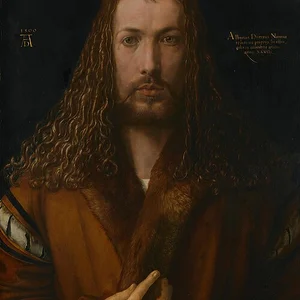
Dürer portrays himself facing forward, in a pose traditionally reserved for images of Christ, asserting his dignity as a creative artist. This oil on panel, housed in Munich, is one of the most famous self-portraits in the history of art.
A watercolor and gouache depicting a hare with extraordinary realism and precision. This work illustrates Dürer's naturalistic approach — he studied nature directly in order to capture its truth.
An engraving considered an absolute technical masterpiece. It depicts an impassive Christian knight facing the forces of Evil, interpreted as an allegory of stoic virtue inspired by Erasmus.
An enigmatic engraving depicting a winged figure surrounded by instruments of geometry and science, lost in melancholic contemplation. Dürer's most analyzed work, it symbolizes creative genius confronted with its own limitations.
A large oil painting created in Venice for the German merchants' brotherhood, now held in Prague. In it, Dürer demonstrates his complete mastery of painting in the style of the Italian Renaissance.
A monumental diptych presented to the city of Nuremberg, depicting Peter, John, Mark, and Paul. Dürer's last major painting, it is interpreted as a Protestant profession of faith and a call for wisdom against extremism.
Anecdotes
At the age of thirteen, Dürer created a silverpoint self-portrait of astonishing precision. This drawing, now held in Vienna, is one of the earliest autonomous self-portraits in the history of Western art and demonstrates an exceptional technical maturity for a child.
During his first trip to Italy (1494–1495), Dürer was so captivated by the works of Mantegna and Bellini that he copied some of their engravings to study their techniques. He wrote to his friend Willibald Pirckheimer that Italian artists were treated like lords, unlike craftsmen in the North.
Dürer was so famous in his own lifetime that he was received by Emperor Maximilian I, for whom he illustrated a prayer book. During his journey to the Netherlands in 1520–1521, he was welcomed as a celebrity in every city and gave signed prints as diplomatic gifts.
In 1515, the Bishop of Lisbon presented Emperor Maximilian with a live rhinoceros — the first seen in Europe since antiquity. As Dürer had never seen the animal himself, he created his famous engraving based solely on a written description and a rough sketch. Yet this image became the definitive depiction of the rhinoceros in Europe for more than two centuries.
Dürer was one of the first artists to defend his copyright: he had his monogram 'AD' engraved on all his works and took legal action against copyists who reproduced his prints without permission, most notably the Venetian engraver Marcantonio Raimondi.
Primary Sources
The following Sunday, the painters of Antwerp held a great feast in my honor and took me to their guild house, where many paintings by distinguished men hung. They treated me with great marks of respect.
Here I am a lord, at home I am a parasite. How I regret fleeing the sun! Here there are men so learned in music, in perspective, in art!
Geometry is the foundation of all painting. Whoever is ignorant of it cannot claim perfection in this art. I have therefore wished to lay the foundations of measurement by compass and ruler.
The true figure of man cannot be grasped by a single artist. God alone knows perfect beauty. We must therefore seek beauty among men and draw from it what is best.
Key Places
Dürer's birthplace and main home, a thriving commercial and intellectual hub of the Holy Roman Empire. It was here that he ran his workshop, trained apprentices, and published his theoretical treatises.
Dürer made two pivotal visits here (1494–1495 and 1505–1507), studying Italian masters, particularly Giovanni Bellini. These journeys profoundly transformed his style, opening him up to the light and color of the South.
The home Dürer purchased in 1509 and lived in until his death. Preserved and converted into a museum, it allows visitors to see his workshop and understand the working conditions of a great Renaissance artist.
The main stop on his journey to the Netherlands (1520–1521), where Dürer was given a triumphant reception by the painters' guild. The city was at that time the leading commercial center of Northern Europe.
The residence of Emperor Maximilian I, for whom Dürer worked on several occasions. It was here that he collaborated on the Triumphal Arch of Maximilian, a monumental woodcut print nearly 10 feet tall.
Typical Objects

A hardened steel tool Dürer used to cut into copper plates. He mastered it with unmatched virtuosity, producing extremely fine hatching to render textures and volumes.

The surface on which Dürer engraved his most refined compositions. Copper allowed for details impossible on wood, as seen in his masterpiece engravings Melencolia I and Knight, Death and the Devil.

The material used for his woodcuts, including the Apocalypse series. Dürer would draw the composition onto the wood, then specialized craftsmen would carve away the areas not meant to hold ink.

Geometry instruments ever-present in his workshop, symbols of his scientific approach. They even appear in his allegorical engraving Melencolia I, lying on the ground beside the melancholic figure.

Dürer always carried vellum notebooks on his travels to draw animals, landscapes, and figures from life. His Young Hare (1502) and Great Piece of Turf (1503), both done in watercolor, are testament to this practice.

Dürer adopted the Flemish oil painting technique early on, which allowed for transparent glazes and precise detail. He sourced rare pigments such as lapis lazuli during his travels.

Dürer's personal trademark, which he placed on all his works to assert his status as an artist-author. The monogram was so well known that it was copied and forged during his lifetime, leading him to fight for his rights.
School Curriculum
Vocabulary & Tags
Key Vocabulary
Tags
Daily Life
Morning
Dürer rose early, often at dawn, to make the most of the natural light essential to his meticulous work. He began his day with prayer, then made his way to his workshop where he prepared his tools — sharpening his engraving burins or grinding pigments with the help of apprentices.
Afternoon
The heart of the day was devoted to creation: engraving on copper or wood, oil painting, or theoretical writing with a quill. Dürer also received clients and commissions, negotiating the price of his works or overseeing the sale of his prints, which were distributed throughout Europe.
Evening
In the evenings, Dürer frequented the circle of Nuremberg humanists gathered around his friend Willibald Pirckheimer, discussing philosophy, mathematics, and theology. He read Euclid, Vitruvius, and Italian treatises, drawing inspiration from them for his own theoretical writings.
Food
Like any prosperous Nuremberg burgher, Dürer ate pork or beef, rye bread, local vegetables, and Rhenish wine. During his travels, particularly to the Netherlands, he recorded in his journal the meals and gifts he received, revealing a clear fondness for oysters and saltwater fish.
Clothing
Dürer placed great importance on his appearance, well aware of his status as a recognized artist. He wore long robes or doublets of dark velvet, trimmed with fur for formal occasions, as shown in his 1500 self-portrait. His carefully styled curly hair was a hallmark of his personal elegance.
Housing
In 1509, Dürer acquired an imposing half-timbered house on the hill below Nuremberg Castle — a prosperous craftsman's residence complete with a workshop, servants' quarters, and a small garden. The house featured a large north-facing workroom to capture diffuse light, ideal for painting and engraving.
Historical Timeline
Period Vocabulary
Visual Style
Style visuel ancré dans la Renaissance du Nord : précision graphique de la gravure, palette chaude aux ocres et bruns profonds, mélange de rigueur gothique germanique et de lumière italienne, détail naturaliste extrême.
Sound Ambience
Ambiance sonore d'un atelier de gravure et de peinture à Nuremberg au début du XVIe siècle, entre travail artisanal concentré et vie urbaine animée de la cité marchande.
Liens externes & ressources
Références
Œuvres
Apocalypse (série de 15 gravures sur bois)
1498
Autoportrait en manteau de fourrure
1500
Le Lièvre
1502
Le Chevalier, la Mort et le Diable
1513
Melencolia I
1514