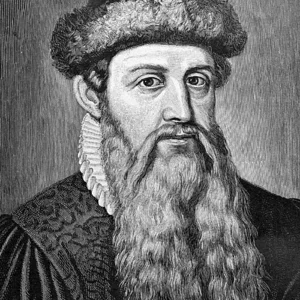

German typographer and goldsmith (c. 1400–1468), Gutenberg is the inventor of movable type printing. His innovation revolutionized the spread of knowledge across Europe and marked the beginning of the Renaissance.
Gutenberg(1400 — 1468)
Johannes Gutenberg
Saint-Empire romain germanique
7 min read
Frequently asked questions
Key Facts
- c. 1440: invention of movable type printing using metal alloy type
- 1455: printing of the Gutenberg Bible (or 42-line Bible), the first major printed book in the Western world
- 1468: death in Mainz, the center of his printing activities
- Development of a process for casting reusable type and of the printing press
- Revolution in written communication enabling the rapid, mass reproduction of texts
Works & Achievements
First major book printed in Europe with movable metal type. A typographic masterpiece of 1,282 pages, printed in approximately 180 copies, it marks the beginning of the age of printing.
A widely used Latin grammar textbook, probably one of the first texts printed by Gutenberg. Several fragments have been found with different typefaces, bearing witness to his successive experiments.
A printed calendar calling for a crusade against the Turks following the fall of Constantinople. It is one of the oldest printed works dated with certainty, attesting to Gutenberg's technical mastery.
Documents mass-printed for the Church, allowing the faithful to obtain forgiveness for their sins in exchange for a contribution. They demonstrate the immediate commercial use of the printing press.
A second Bible attributed to Gutenberg's circle, printed with larger typefaces. Its exact attribution remains debated between Gutenberg and his former associate Albrecht Pfister.
A Latin encyclopedia and dictionary printed in Mainz, whose colophon pays tribute to the invention of printing. It is often attributed to Gutenberg or his workshop.
Anecdotes
Gutenberg worked in the greatest secrecy for several years to develop his invention. He had set up his workshop in an isolated house in Strasbourg and made his associates swear to silence, fearing that someone might steal his revolutionary idea.
To finance his printing project, Gutenberg borrowed 800 florins from a wealthy Mainz banker, Johann Fust. Unable to repay his debt, Fust sued him in 1455 and recovered the workshop, the presses, and the copies of the Bible already printed. Gutenberg thus lost the fruit of his labor.
Before embarking on book printing, Gutenberg manufactured and sold small mirrors to pilgrims traveling to Aachen. These mirrors were said to capture the sacred relics displayed during pilgrimages. It was while working metal for these objects that he perfected his alloying techniques.
The Gutenberg Bible, known as the 'Forty-Two-Line Bible', is considered the first book printed in Europe with movable type. It is estimated that around 180 copies were produced around 1455. Today, 49 survive, some of which are among the most valuable books in the world.
Gutenberg, ruined after his lawsuit against Fust, was finally recognized late in life by the Archbishop of Mainz, Adolf of Nassau, who granted him in 1465 the title of gentleman of his court, along with a pension in kind comprising grain, wine, and clothing. He died three years later.
Primary Sources
This 1455 legal document records the lawsuit brought by Johann Fust against Gutenberg for the repayment of 1,600 florins lent to him. It constitutes one of the few direct pieces of evidence of Gutenberg's printing activity.
Piccolomini reports having seen at the Frankfurt fair gatherings of a Bible of remarkable clarity, printed with great elegance, which could be read without glasses. He mentions that all copies had already been sold.
This chronicle, printed in 1499, explicitly attributes the invention of printing to Gutenberg of Mainz and describes the process of manufacturing movable metal type, distinguishing this technique from the woodblock printing practiced previously.
This document records a dispute between Gutenberg and the heirs of his associate Andreas Dritzehen, revealing the existence of a secret partnership formed to develop a technical process, most likely related to printing.
Key Places
Gutenberg's hometown and the site of his main workshop. It is here that he printed the famous 42-line Bible and where he died in 1468.
Gutenberg lived there from around 1434 to 1444, a period during which he conducted his first secret experiments on movable type printing.
Building in Mainz where Gutenberg set up his printing workshop around 1448–1455. It is in this location that he produced his first major printed works.
Small town near Mainz where Gutenberg is said to have continued his printing activities after losing his workshop. He is believed to have helped the Bechtermünze brothers with printing there.
An important trading venue where the first copies of the Gutenberg Bible were presented and sold. The fair would go on to become the largest book market in Europe.
Typical Objects

Small metal blocks each bearing a raised letter, cast from an alloy of lead, tin, and antimony. They constitute Gutenberg's central invention and allow texts to be composed and broken down at will.

Inspired by Rhenish wine presses, Gutenberg's press applies uniform pressure to the inked paper. It is the main tool of his workshop in Mainz.

A precision instrument used to cast metal letters in an identical and reproducible manner. Gutenberg designed it drawing on his experience as a goldsmith.

Gutenberg developed a special ink, thicker than the water-based ink used by scribes, which adheres perfectly to metal type and produces a deep black.

A steel rod on which the letter is engraved in relief. The punch is used to strike the copper matrix into which the lead type is then cast.

A leather pad stuffed with wool used to apply ink to the composed type. Printers used two of them, one in each hand.

Gutenberg printed his Bible on two materials: vellum (calfskin) for luxury copies and rag paper, more affordable, imported from Italy.
School Curriculum
Vocabulary & Tags
Key Vocabulary
Tags
Époque
Daily Life
Morning
Gutenberg rose at dawn, like most craftsmen of his era, to the sound of the bells of Mainz Cathedral. After morning prayers, he would head to his workshop to check the state of the presses and the molten metal. He supervised the typesetting of pages by his workers and inspected the quality of freshly cast type.
Afternoon
The afternoon was devoted to intensive printing work and the most delicate technical operations. Gutenberg checked the inking, pressure, and alignment of printed sheets. He also received visitors — ecclesiastical patrons or merchants interested in his output — and negotiated orders.
Evening
As evening fell, Gutenberg would stop work at dusk, natural light being essential for judging print quality. He might head to a tavern to discuss matters with other craftsmen or burghers of Mainz. He sometimes spent his evenings sketching new typefaces or planning future projects by candlelight.
Food
The diet of Gutenberg, a Rhenish burgher of the 15th century, consisted of rye bread, thick soups, salted or smoked meats, fish from the Rhine, and seasonal vegetables such as cabbage and turnips. Wine from the Rhine region accompanied meals, and beer was equally common.
Clothing
As a prosperous craftsman and later gentleman, Gutenberg wore a long woolen or broadcloth robe (Schaube) cinched with a belt, along with a chaperon or cap covering his head. In the workshop, he donned a leather apron to protect himself from ink and molten lead.
Housing
Gutenberg lived in several houses in Mainz, including the Hof zum Gutenberg, a patrician residence inherited from his family. His printing workshop was housed in a separate building, equipped with presses, furnaces for smelting metal, and large tables for typesetting and drying sheets.
Historical Timeline
Period Vocabulary
Visual Style
Esthétique de la fin du Moyen Âge rhénan, mêlant l'atmosphère intime d'un atelier d'orfèvre-imprimeur éclairé à la bougie et la grandeur gothique des villes allemandes du XVe siècle, dans un style inspiré des maîtres de la Renaissance du Nord.
Sound Ambience
L'atelier d'imprimerie de Gutenberg à Mayence : le bruit sourd et rythmé de la presse en bois, le cliquetis des caractères en plomb manipulés par les compositeurs, le grésillement du métal fondu et, au loin, les cloches de la cathédrale et l'animation des rues médiévales.
Liens externes & ressources
Références
Œuvres
Bible à quarante-deux lignes (Bible de Gutenberg)
vers 1455
Grammaire latine de Donat (Ars minor)
vers 1451-1452
Calendrier astronomique (Türkenkalender)
1454
Lettres d'indulgence
1454-1455
Bible à trente-six lignes
vers 1458-1460
Catholicon de Jean de Gênes
1460