Imaginary dialogue between Enea Silvio Piccolomini (futur pape Pie II) and Gutenberg
by Charactorium · Gutenberg (1400 — 1468) · Technology · 6 min read
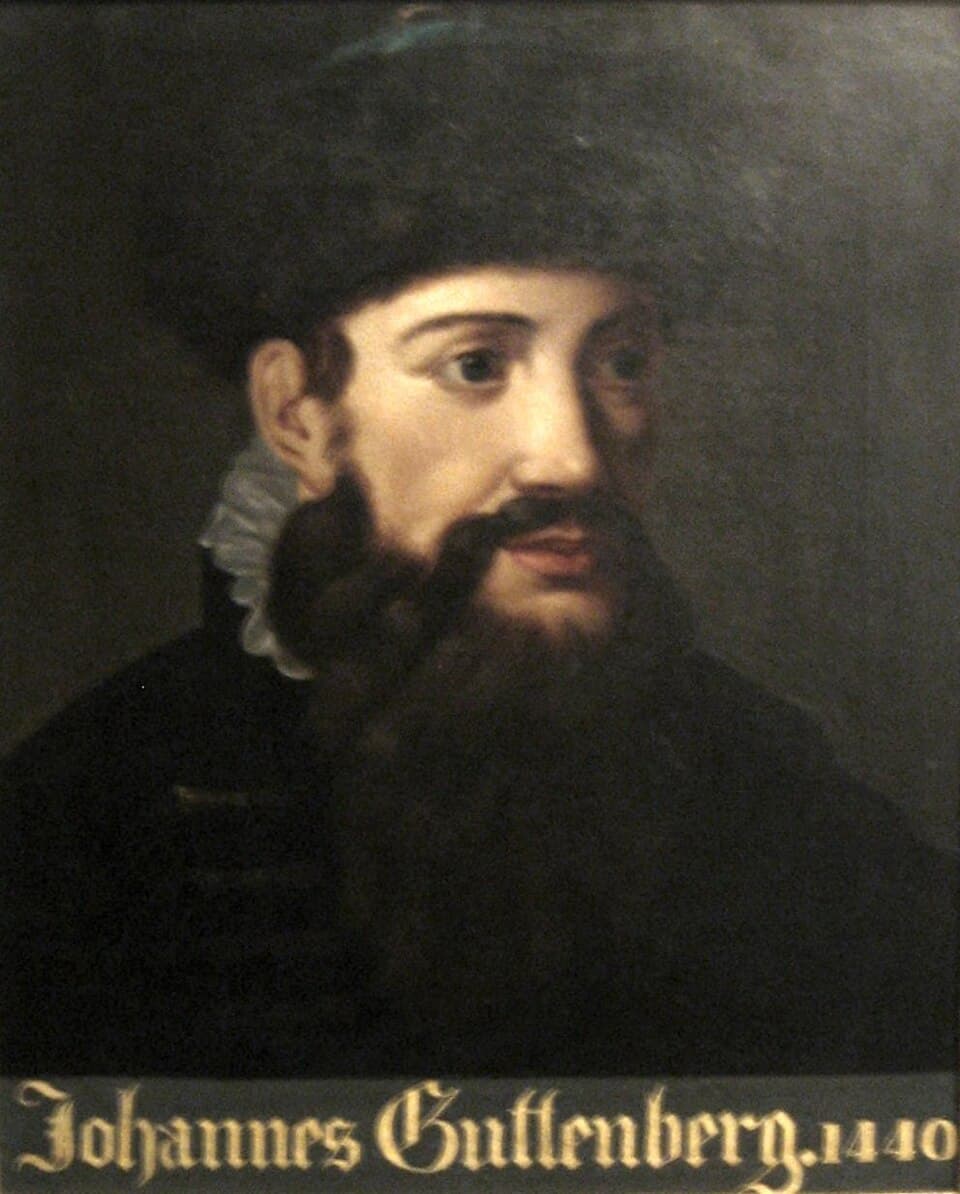
It is in a back room of a tavern in Frankfurt, in the autumn of 1455, that Enea Silvio Piccolomini meets Johannes Gutenberg, passing through the great fair. The imperial secretary, still amazed by the Bible quires he saw a few months earlier on the stalls, is eager to see the man with his own eyes. On the table, a sheet of vellum is still drying, its deep black gleaming in the candlelight. The two men know each other by reputation: one has written to Cardinal Carvajal about what he discovered; the other has just emerged from a trial that cost him his workshop.
—Master Johannes, I am told that before books you sold mirrors to pilgrims in Aachen. Is that true?
It is true, and I am not ashamed of it. When the crowds climbed to Aachen to venerate the relics, everyone wanted their little metal mirror, believed to capture and take home the grace of the holy things on display. With my associates, I cast them by the hundreds. But you see, it was not just a trade: to cast those mirrors, I needed to know alloys, to proportion tin and lead, to polish the metal until it gave a clear reflection. These same hands, used to the mold and the crucible, later knew how to forge letters. The pilgrim thought he was buying a reflection of heaven; I, without yet knowing it, was learning the craft that would serve Scripture itself.
The pilgrim thought he was buying a reflection of heaven; I was learning the craft that would serve Scripture.
—They say that in Strasbourg you worked locked away, making your companions swear to secrecy. Why so much mystery?
Because a bare idea does not defend itself, sir. In Strasbourg, in the thirties, I held in my fingers something no one had done before me, and a single glance was enough to steal it. I had taken a house apart, and my associates were bound by oath: not a word, not a gesture outside the workshop. When one of them, Andreas Dritzehen, died, his heirs wanted to enter the partnership and learn the process — there was a trial, and I still had to keep silent before the judges. Understand me: it was not greed. An invention takes years to mature, and during those years it is fragile as glass. Silence was my only wall.
A bare idea does not defend itself; silence was my only wall.
—Those letters so uniform that I saw on your quires, how are they born? I understand nothing of your art.
Everything starts from a steel rod, the punch, on which I engrave a letter in relief, backwards. With this punch I strike a small block of soft copper: that is the matrix, which holds the hollow imprint of the letter. This matrix I place in a mold of my invention, and I pour in a molten metal — lead, tin, and a little antimony so it hardens quickly and cleanly. In an instant, a type is born, identical to all its brothers. Repeat a thousand times, and you have enough to compose any text, then dismantle it to build another. That is the heart of the matter: not a page carved from a block, but movable, free letters, which you assemble and return to the case.
Not a page carved from a block, but free letters which you assemble and return to the case.
—And this ink, that deep black I admired, is not the copyist's ink, it seems to me?
You have a sharp eye, sir — the copyist's ink, clear and liquid, would slide off my metal without biting. I had to reinvent it: a greasy, thick ink, made with boiled linseed oil and loaded with lampblack, almost a varnish. It clings to the types, does not run, and leaves on the vellum that deep, almost shiny black you noticed. My workers apply it with two leather balls stuffed with wool, one in each hand, which they roll over the form before lowering the press. It is a detail, you will say? But without this ink, everything else — punches, matrices, press — would yield only a pale, dirty grey. The beauty of a book sometimes lies in what you do not see.
The beauty of a book sometimes lies in what you do not see.
—Such a workshop costs a lot. How does a single man finance presses, metal, and paper in such quantity?
Alone, you cannot, and that is all my pain. To set up the workshop in Mainz, I borrowed from Johann Fust, a financier of the city — first eight hundred florins, then as much again. Think of what is needed: vellum from hundreds of calves, rag paper brought from Italy, metal, wages for the workers, and all this for years before a single book sells. Fust's gold made the Bible possible. But borrowed money is never a gift: one day it comes to claim its due, and it claims it in full. I built an eternal thing with a mortal debt hanging around my neck.
I built an eternal thing with a mortal debt hanging around my neck.
—Let us come to this Bible. You printed it on two supports, I am told. Why this choice?
Because not all buyers are equal, sir. A few copies of the Forty-Two-Line Bible I printed on vellum, that fine white calfskin, for princes and abbeys who want a treasure to place on the altar. The others, on good rag paper from Italy, lighter on the purse. In all, nearly one hundred and eighty volumes came off my presses, which no scriptorium could have copied in a man's lifetime. And note: I leave the large initials and margins blank, so that the illuminator can later add his colors and gold by hand. The printed book did not kill the art of the brush; it prepares the place for it.
The printed book did not kill the art of the brush; it prepares the place for it.
—These quires, I held them myself at the fair, and I wrote to Cardinal Carvajal about them: they could be read without spectacles. Did you expect such a reception?
That you, a man of your learning, should have carried my quires to the eyes of a cardinal — that I did not expect, and it touches me more than I can say. I had wanted a script so clear, so regular, that no eye would have to strain over the page, be it a tired eye. When I was told that at the fair the copies were sold before even being bound, I understood that the world was hungry for what I was doing. A copyist takes a year for a single volume; I give one hundred and eighty with a single gesture, all alike, without a single error copied from one to the next. You have seen with your own eyes, sir, what no scribe can ever promise again.
The world was hungry for what I was doing.
—You do not print only Bibles. I learned that a calendar called for war against the Turk, since the fall of Constantinople.
Yes, the Türkenkalender, which came off my presses this very year when Christendom still mourns Constantinople. When the city fell last year, fear ran from town to town, and people wanted to call the princes to crusade. My press serves that too: no longer a single holy book in one hundred and eighty copies, but a brief sheet, printed quickly and in quantity, read by the fireside to rouse courage. See the power of the thing, sir: what the preacher says to one assembly, the printed letter carries to a thousand homes, the same day, in the same words. An idea no longer needs to wait for the rider or the crier. It multiplies.
What the preacher says to one assembly, the printed letter carries to a thousand homes.
—And these indulgences that the Church orders from you in series — does your art so quickly serve the trade in souls?
Do not judge it too quickly, sir. The Church has always issued these letters, where the name of the faithful and the grace obtained for their alms are written; but the scribe copied only a handful per day. My press produces hundreds, all identical, where only the name and date need to be filled in by hand. It is, I admit, the first use that truly brings in money, and helps pay my debts. Perhaps I am blamed for serving commerce as much as faith. But an invention does not choose its uses: it gives itself to those who know how to use it. The same press prints the word of God and the receipt of the almoner — it is up to man, not the machine, to answer for the rest.
An invention does not choose its uses: it gives itself to those who know how to use it.
—It is whispered here that you have just lost a trial against Fust. Is it true that he took everything from you?
Everything, or almost. In November, before a notary, Fust demanded his gold and the interest, and the judges ruled in his favor. He took the presses, the equipment, and even the Bibles you saw, finished or not. The work of my life passed into other hands at the very moment it triumphed — the man who financed the ship keeps the cargo, and the pilot is left on the dock. I am not finished, mark me well: I know the process, it lives in my head and in my fingers, and no judgment can seize it. They take my tools, not my knowledge. But tonight, sir, I would be lying if I told you my heart is not bitter.
They take my tools, not my knowledge.
This imaginary interview was generated by artificial intelligence from sources documented in Gutenberg's profile. It dramatises what the figure might have said based on what we know about them, but does not constitute attested historical testimony. For primary sources and factual documentation, refer to the full profile.