Imaginary interview with Gutenberg
by Charactorium · Gutenberg (1400 — 1468) · Technology · 6 min read
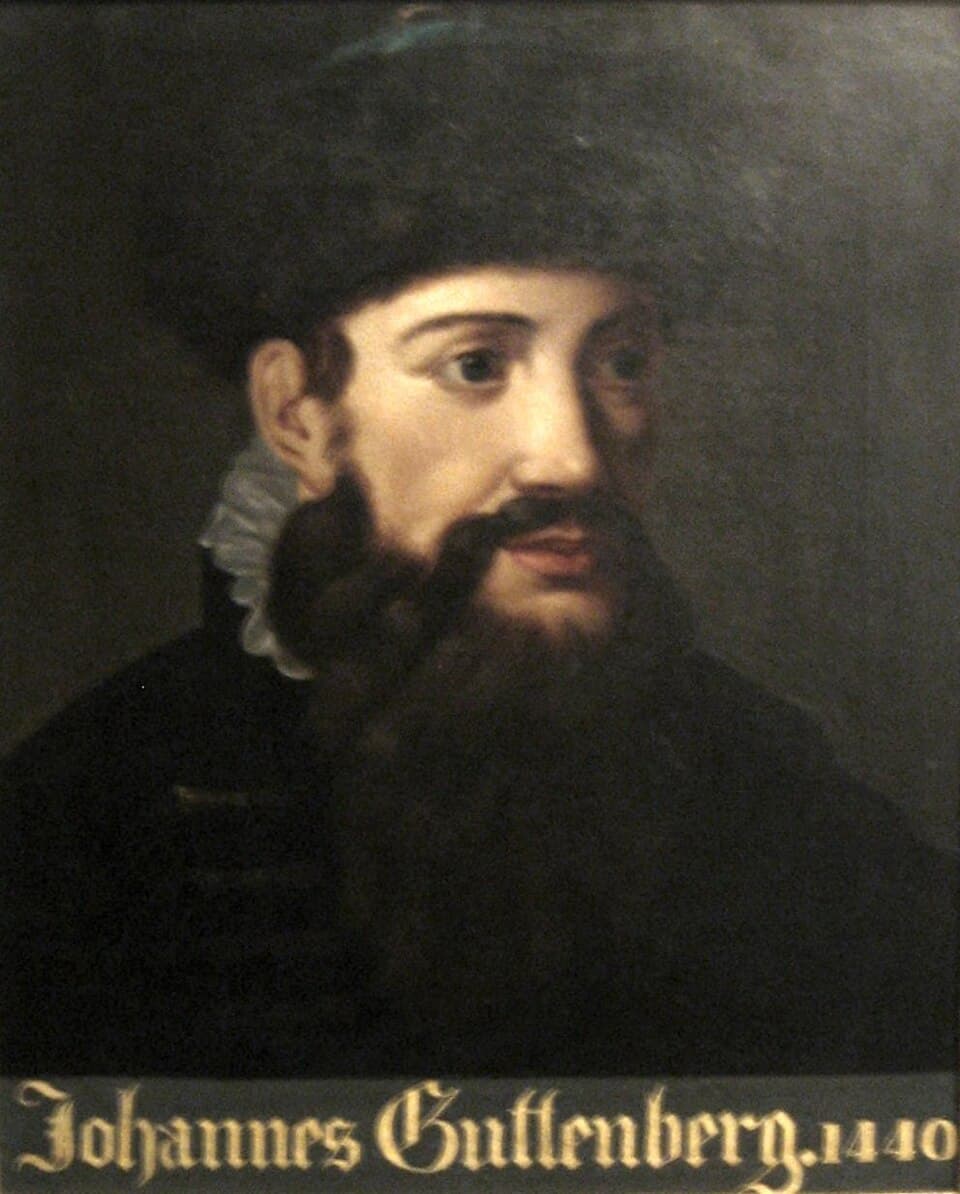
Mainz, a grey morning in the winter of 1467. In a workshop where the smell of molten lead mingles with that of linseed oil ink, an old man with stained hands receives us among his now-silent presses. Johannes Gutenberg, recently ennobled and still bitter, agrees to revisit the invention that brought him glory and ruin.
—One imagines you immediately bent over a Bible, but your first trade was quite different. How did you come to metal?
You are right to start there. Before any book, I sold small metal mirrors to pilgrims journeying to Aachen to gaze at the relics displayed there. People believed then that these mirrors captured something of the sacred light — I, above all, learned to cast metal, polish it, and melt it in quantity. My family held a rank in Mainz that put goldsmithing in my hands, and the smell of hot lead has been familiar to me since childhood. What the faithful took for devotion I experienced as an apprenticeship: pouring an alloy into a mold, releasing it identical, repeating it a thousand times. When I later wanted to cast letters, my hands already knew the gesture. No one, seeing me sell those trinkets, would have guessed that I held there the beginning of everything.
—What world did the child you were grow up in? What was a book worth, then?
I was born into a patrician family, of those who sit on the city councils and quarrel with the guilds — to the point that as a child, I had to leave Mainz more than once when the wind turned against our kind. The book, in those days, was the business of monks. In the scriptoria, they copied by hand, one page after another, months on end for a single Bible, and only the wealthy could afford one, embellished with gold and azure illuminations. Knowledge slept behind cloister walls. I always found it scandalous that a text cost as much as a vineyard. Without yet knowing how, I already carried that stubborn idea: what if one could do in a month what the scribe takes a lifetime to accomplish?
—Why did you surround your early experiments in Strasbourg with such secrecy?
Because a bare idea is worth nothing until you master it, and anyone can steal it. In Strasbourg, where I lived for about ten years, I had set up my workshop apart and made my associates swear silence. We spoke of an 'enterprise' without ever naming it. When one of them, Andreas Dritzehen, died, his heirs dragged me to court to find out what our partnership concealed — and thus an act of 1439 preserves the trace of presses, forms, and pieces that had to be, they said, cast and immediately dismantled so that no one could understand them. I was not suspicious by nature. But an invention is like molten lead: until it has taken its final form, the slightest draft is enough to spoil it.
—Explain to us, from the beginning: how is a single one of your metal letters born?
Everything starts with the punch: a steel rod at the end of which I engrave a letter in relief, backwards, like a goldsmith chisels a seal. I strike this punch into a small block of soft copper — the matrix — which retains the impression in intaglio. Then comes my real secret, the type mold, this 'hand mold' that opens and closes: I pour the alloy of lead, tin, and antimony into it, and I obtain a clean letter, exactly the same height as all the others. I release it from the mold, I start again — a hundred, a thousand times the same letter. The whole art lies in this regularity. A clumsy goldsmith makes a crooked jewel; a clumsy type caster makes an illegible book.
The whole art lies in this regularity: that each letter be the identical brother of the one before.
—Once the letters are cast, how do you move to the printed page?
First, the characters are assembled one by one in an iron frame we call the form, until an entire page is composed, reversed and tight. But the metal type repels the water-based ink of the scribes: so I needed a new ink, greasy, thick, which I long sought from linseed oil and lampblack, so that it would bite into the lead and give that deep black. It is spread with ink balls of leather, one in each hand. Then the press: I wanted it similar to the wine presses of our Rhenish hillsides, where the screw slowly lowers a board that presses down all at once, evenly, on the whole sheet placed over the inked type. The wine of our valley inspired the machine that would print the word of God.
—Let us come to your great work. What did the Forty-Two-Line Bible represent for you?
It was everything at once: my ruin and my glory in the same work. Around 1455, in my workshop at the Hof Humbrecht, we printed nearly one hundred and eighty copies — forty-two lines per column, two columns per page, more than twelve hundred pages of an even black. I printed some on vellum, that fine calfskin reserved for princely copies, and on rag paper from Italy for the others. I wanted a man, opening it, not to be able to tell whether it came from the press or from the hand of a genius scribe — but that there would be one hundred and eighty where the scribe would have made but one. Beauty alone was not enough for me: I needed it multiplied.
—How did your contemporaries discover these first volumes?
At the Frankfurt Fair, that great market where all Europe comes to sell and buy, quires of my Bible were shown even before it was bound. I learned that a very learned Italian prelate, Enea Silvio Piccolomini — the one who later became Pope Pius II — had seen the leaves and marveled at them: he reported, it seems, that the script was so clear that one read it without need of spectacles, and that already all copies had found buyers. Imagine what that did to me. A man of such quality, speaking of my work to a cardinal, perhaps ignorant of my name but struck by the thing itself. The book was already traveling farther and faster than I. It was the sign that I had been right.
—It is often forgotten that you did not print only Bibles. What did your presses do on a daily basis?
Everything that made the workshop live! A Bible takes years; letters of indulgence, on the other hand, sell by the thousands. The Church ordered whole forms of them: it was enough to leave a blank for the believer's name and the sum paid in exchange for the forgiveness of sins. In a few days, my press produced more than a scribe in a year. I also printed in 1454 a calendar that was called the Türkenkalender, exhorting Christian princes to a crusade after the Turks had taken Constantinople. That is what few understand: the same machine serves prayer, commerce, and politics. I did not fashion a tool of piety or a tool of trade — I fashioned a tool pure and simple, and everyone seized it according to their need.
The same machine serves prayer, commerce, and politics.
—Let us come to the wound. How did you lose your workshop?
Through money, always through money. To set up this enterprise, I had borrowed eight hundred florins from Johann Fust, a banker in Mainz, and then further sums. All my gold went into metal, ink, paper, workers' wages — and the Bible was not finished when the deadline fell. In 1455, Fust sued me. A notarial act preserves the detail, down to the last florin claimed. I lost: presses, type, and the copies already printed, everything went to him. My own apprentice, Peter Schöffer, went into his service and signed with him the beautiful Psalter that should have borne my name. They took the fruit, they left me the tree. For the knowledge, it lodged in my head, and that, no judge could take from me.
They took the fruit, they left me the tree.
—At the end of your life, do you believe your invention will change the world?
For a long time I was thought finished, ruined, forgotten. And then, in 1465, Archbishop Adolph of Nassau made me a gentleman of his court, with a pension of grain, wine, and cloth — recognition always comes late, and as an extra. Did I see the world change? I saw above all my century torn: a Great Schism where rival popes fought over Christendom, Constantinople fallen, Greek scholars cast onto the roads. In such a din, who knows what a press will bring? I am no prophet. But if I may imagine it: the day when every city has its workshop, when the scribe puts away his pen, a text composed in Mainz could be read the same month in Venice or Paris. What I have cast in lead, no one will ever be able to recast into oblivion.
This imaginary interview was generated by artificial intelligence from sources documented in Gutenberg's profile. It dramatises what the figure might have said based on what we know about them, but does not constitute attested historical testimony. For primary sources and factual documentation, refer to the full profile.