Imaginary interview with Hatshepsut
by Charactorium · Hatshepsut (1506 av. J.-C. — 1457 av. J.-C.) · Politics · 6 min read
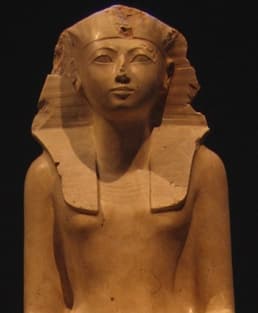
Dawn breaks on the western bank at Thebes. Leaning against the cliff, the three-terraced temple of Deir el-Bahari lights up, and beneath its bright columns awaits she whom the monuments show as a man and whom scribes sometimes call king, sometimes queen. She speaks softly, in a voice that seems to come from the stone itself.
—Do you remember the moment when you ceased to be regent and girded the double crown?
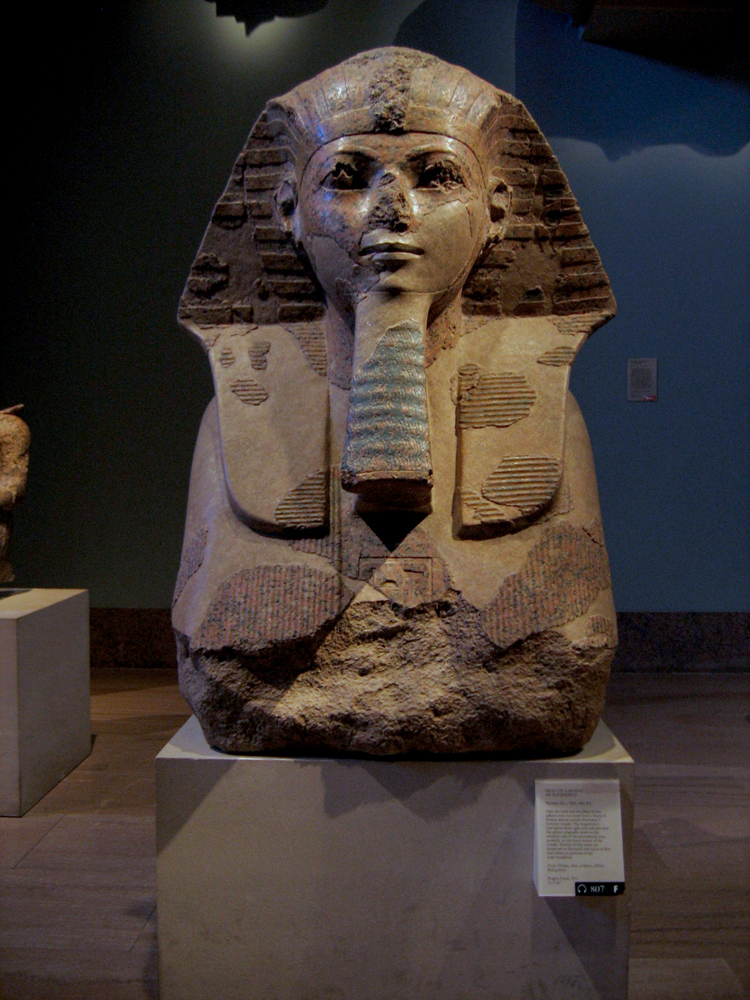
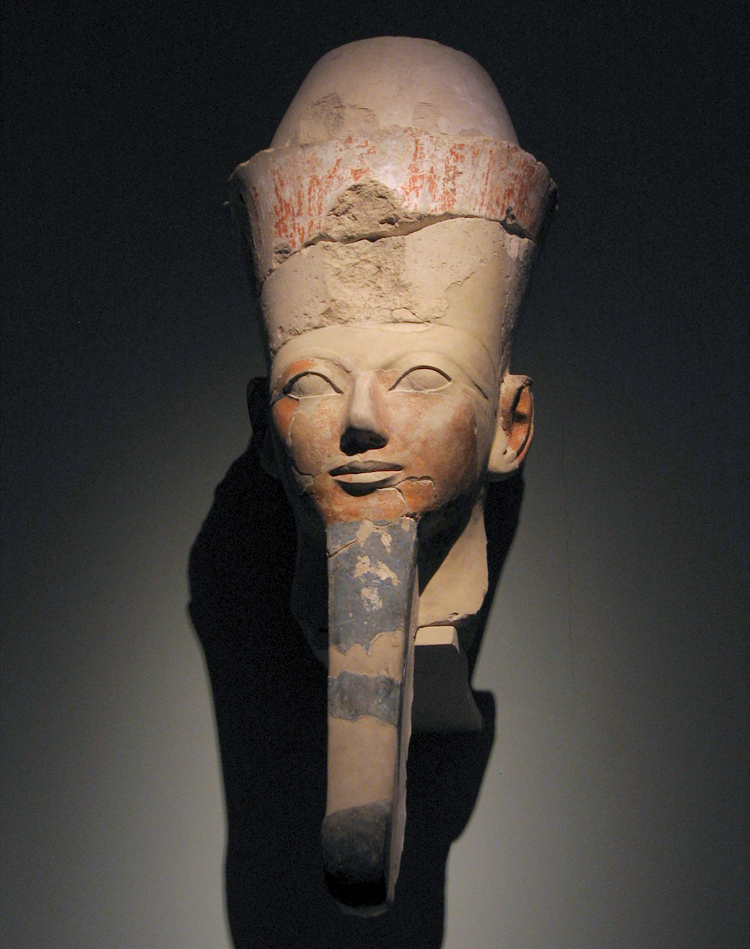
My husband and half-brother Thutmose II departed to the west when his son was still a child at the breast. The regency was entrusted to me, as one entrusts a flock to one who knows how to guard it. A few Nile floods passed, and I understood that governing in another's name is to reign without speaking one's name. So, around the year the child was growing, I girded the double crown. I had the royal false beard attached to my chin, I placed the striped nemes on my brow. My sculptors carved me as a man, for the function of the pharaoh has no sex: it has a duty. The scribes still hesitated, writing me sometimes in the masculine, sometimes in the feminine. No matter the word: I was the living Horus.
Governing in another's name is to reign without speaking one's name.
—Why wear the attributes of men rather than rule openly as a woman?
People think I disguised myself as a man out of pride. They are mistaken. The beard, the loincloth, the uraeus raised on the forehead, are not clothes: they are the signs that the gods gave to the one who holds the world upright. A queen consoles the king; a pharaoh nourishes the temples and repels chaos. To bear this burden, the people had to see on the stone not a daughter of Ahmose, but the eternal form of the sovereign. My coronation name, Ma'atkare, says it all: Ma'at is the ka of Ra. It was as a man of stone that I could embody it, even though my blood was that of a woman. The false beard hid nothing; it revealed my office.
—Tell us about that expedition you launched to the Land of Punt.
I sent my ships where my fathers no longer dared to go, to Punt, at the end of the sea, that fragrant coast that the divine land jealously guards. My reliefs at Deir el-Bahari show everything: 'Loading of the ships, in great quantity, with the marvels of the Land of Punt: all the fragrant woods of the divine land, heaps of myrrh resin, green myrrh trees, ebony and pure ivory.' They brought back gold, incense, panther skins, and above all living myrrh trees, the clump of earth still around the roots. I had them planted before my temple, so that Amun might breathe their perfume until the end of time. A king conquers with the spear; I conquered with the sail and trade.
A king conquers with the spear; I conquered with the sail and trade.
—What justified risking men and ships on such a distant route?
Because the gods hunger for perfume. Without incense and myrrh, the altar of Amun-Ra remains mute; the rising smoke is the voice by which man speaks to heaven. Since the Hyksos had troubled the land, the great southern routes had closed, and Egypt paid dearly for what it could fetch itself. So I armed ships, not for the glory of plunder, but to reopen the path that my ancestors had let silt up. Bringing back the resins of Punt was to nourish the temples and fill the granaries in one gesture. Trade, you see, is another form of piety: what the boat brings from afar, the censer returns to the gods.
—How did you conceive this temple clinging to the cliff, where we stand?
Go to the western bank, where the cliff falls straight as a wall of sky, and see my temple of Deir el-Bahari rising toward it in three terraces. I wanted it thus: not crushed to the ground like a laid stone, but rising step by step, embracing the mountain as if the rock had decided to become a dwelling for Amun. My master builders — I often think of Senemut, who carried my plans — erected these bright columns facing the rising sun. The people will ascend it in procession during the Beautiful Festival of the Valley. I built so that, a thousand floods later, it might be known that here reigned a sovereign who loved the straight line and the light. Stone does not lie; it endures.
I built so that, a thousand floods later, it might be known that here reigned a sovereign who loved the straight line and the light.
—And these obelisks at Karnak, how did you raise them?
The obelisks! Two needles of pink granite, torn in a single block from the quarries of Aswan, brought down the Nile on barges that I thought would bend under the weight. I had them erected in the house of Amun, at Karnak, the tip covered with electrum so that it would catch fire at the first ray. One still stands, taller than six men stacked one upon another. On its face, I had my truth engraved: 'I did this with a loving heart for my father Amun… that he might not say that what I have said is boasting.' For there were already murmurs that I glorified myself. No: I rendered to Ra what is Ra's, and I cried it out in stone so that none might doubt.
—On what basis could a woman claim the throne of Horus?
By the god himself. I had engraved on the walls of Deir el-Bahari the account of my birth: Amun took the form of my father Thutmose I, entered the queen my mother, and declared: 'Hatshepsut shall be the name of my daughter… she shall exercise beneficent kingship in this entire land.' It was not I who chose myself; it was the lord of the gods who designated me before my first breath. That is why no priest could refuse me the crown: to contest my reign was to deny the word of Amun. I did not ascend the throne; I was carried there from heaven.
I did not ascend the throne; I was carried there from heaven.
—What did this duty to restore the temples of the land represent for you?
The first duty of a pharaoh is not to conquer, but to maintain Ma'at — that just order without which the world would fall back into the chaos of the waters. When I received the land, sanctuaries still lay in ruins, wounded from the time when the Hyksos ruled without respect for our gods. I raised what had fallen, rebuilt what was gaping. In the rock of Middle Egypt, at Speos Artemidos, I had a temple carved for the lioness goddess Pakhet, and I had it proclaimed how I had restored what the foreigner had let decay. To give the gods back their house is to give the world back its balance. A sovereign who lets a temple collapse also lets the sky collapse.
—Do you fear that one day your name will be erased from the monuments?
You touch my deepest fear there. In Egypt, a hammered name is a second death — worse than the first, for it closes the door of eternity. I have seen cartouches of ancient kings scraped down to bare stone, and I shuddered. If one day my statues were broken, if my name were replaced by another on my own walls, it would not be me they would kill, but Ma'at itself, for they would lie to history. That is why I multiplied obelisks, temples, inscriptions: the more times my name is engraved, the harder it is to erase everywhere. One can hammer a stone; one cannot hammer the entire cliff. Let whoever comes after me think on that before lifting the chisel.
One can hammer a stone; one cannot hammer the entire cliff.
—How would you describe your bond with Thutmose III, who will reign after you?
They would make Thutmose III and me two enemies fighting over a seat. That is to misunderstand the throne of Egypt. The child I kept grew up at my side; he learns war while I build peace. Our two names appear together on my monuments: we are co-sovereigns, not rivals. One day, when I join the west and my tomb carved in the Valley of the Kings, he will reign alone, and I already sense him impatient to lead the armies of Egypt farther than anyone before him. Let him conquer Asia, so be it — each to his task under the sun. Mine was to open the roads and raise the temples; his will be to bear the spear. One reign does not erase the other: they respond to each other.
Read further
This imaginary interview was generated by artificial intelligence from sources documented in Hatshepsut's profile. It dramatises what the figure might have said based on what we know about them, but does not constitute attested historical testimony. For primary sources and factual documentation, refer to the full profile.